
Lieferung heute & morgen

Qualitätsgarantie

Willkommens-Angebote freischalten: KOSTENLOSE Lieferung | Bis zu 80 % RABATT | Kostenlose 30-Tage-JoyPlus-Testphase
App herunterladen
LocknLock food storage containers are available for the fridge, freezer, microwave, meal prep and transporting food. At first glance, the choice seems straightforward: pick a size, choose a colour, place your order. In practice, however, small differences in closure, material and temperature range often lead to the wrong purchase.
Three typical pitfalls are particularly relevant:
For dry staples such as rice, flour or muesli, a tightly closing lid is often enough. Liquid foods demand more. Look for terms like airtight food storage container, waterproof closure, silicone seal or multi-lock system.
Several LocknLock models feature a four-side closure with a silicone dual-chamber seal. According to the product description, this design is intended to keep liquids inside the container. Before transporting, ensure all closure clips are fully fastened and the seal is correctly seated.
The LocknLock containers featured here are mostly made from polypropylene (PP); the seals are silicone, depending on the model. Several product listings state the containers are BPA-free. This makes them a suitable option for a BPA-free storage box, but does not replace the need to follow the respective instructions for use.
For microwave use, bear in mind:
For freezer use, you should also check the permitted temperature range. Some LocknLock food storage containers are rated for use down to −20 °C. Allow frozen contents to thaw slightly before opening, so that unnecessary pressure is not placed on the closure and seal.
A large volume is not automatically more practical. For single portions, snacks or lunch, sizes between around 700 and 1,100 ml work well. For family leftovers or prepared meals, 1.8 to 2.3 litres is often more suitable. A 3.4-litre container can hold larger quantities, but naturally requires more space.
Check before you buy:
A dishwasher-safe food storage container makes cleaning easier. For several models, placing it on the top rack is recommended. Seals should be cleaned separately and dried thoroughly before the lid is replaced.
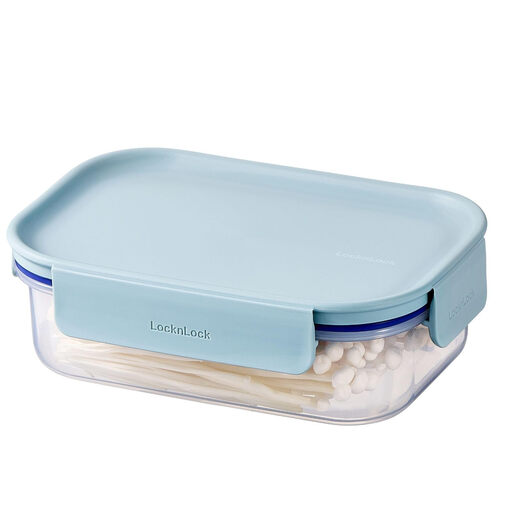
Why this product fits the profile: The compact rectangular shape is ideal for single portions, snacks and simple meal prep. According to the product information, the container is stackable, BPA-free and suitable for the microwave, freezer and dishwasher.
The capacity is clearly stated as 910 ml. This makes it easier to match the size to a portion, rather than buying unnecessarily large containers.
Rectangular shape, flip-top lid, stackable design and stated suitability for microwave, freezer and dishwasher.
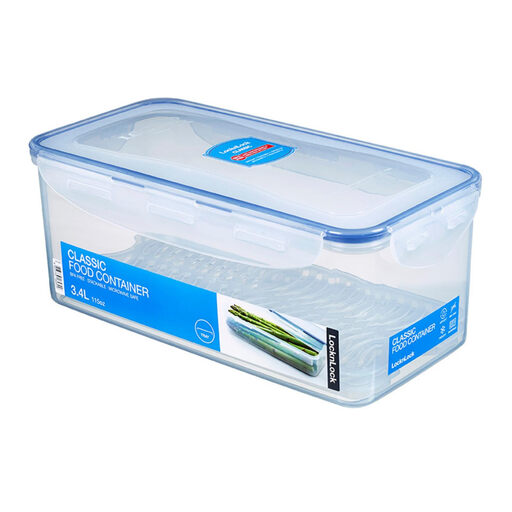
Why this product fits the profile: The large rectangular plastic food container is designed for bigger quantities, family portions and pantry storage. According to the product description, it features a four-side locking system with a silicone dual-chamber seal.
The product information states specific dimensions of 29.7 × 15.2 × 11.8 cm, as well as clear limits for microwave and temperature. This makes it easier to check before buying.
3.4 litre capacity, transparent BPA-free PP container, stackable design and stated suitability for freezer and dishwasher.
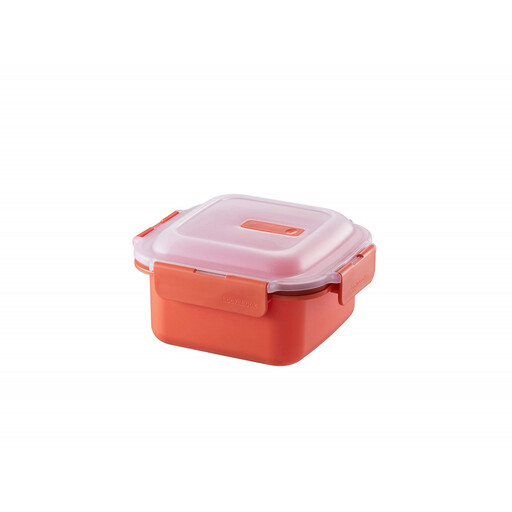
Why this product fits the profile: This model is aimed at professionals, students and meal-prep users who want to store and reheat food in the same container. An integrated steam vent supports controlled use in the microwave.
The microwave function is described with a steam vent and a stated heat resistance of up to 140 °C. However, the container is not intended for oven use.
1,100 ml capacity, square footprint, BPA-free PP and dishwasher-safe design according to the product information.
We have compiled a complete, regularly updated list of products that fully meet these strict selection criteria and the safety regulations in force in the EU.
To keep seals and containers in good working order for as long as possible, you should follow a few simple habits:
Several models are stated as microwave-safe, but usually without the lid or with the steam vent open. The temperature limit varies. The oven, hob and direct heat are not intended for the products mentioned.
For individual meals, models around 870 to 1,100 ml are practical. For larger portions, 1.8 or 2.0 litre containers are suitable. Rectangular and square shapes can often be arranged more space-efficiently in the fridge and bag.
It is not possible to give a general lifespan. It depends on usage, cleaning, temperature changes and the condition of the seal. Check the container regularly and replace it if you notice cracks, significant warping or a closure that is no longer reliable.