
Lieferung heute & morgen

Qualitätsgarantie

Willkommens-Angebote freischalten: KOSTENLOSE Lieferung | Bis zu 80 % RABATT | Kostenlose 30-Tage-JoyPlus-Testphase
App herunterladen
A food storage container set can make cupboards tidier, protect food from moisture and make portioning easier every day. However, sets vary considerably in size, closures, materials and intended uses. A high piece count alone doesn’t tell you whether the containers will suit your household.
Three common buying mistakes can lead to unnecessary spending:
For practical kitchen storage, choose containers that suit the foods you usually keep:
A set with a range of sizes is usually more versatile than one where every container has the same capacity. For narrow shelves, the external dimensions matter more than the capacity in litres.
With airtight food storage containers, check how the lid closes. Four-sided locking mechanisms, screw-top lids and clip systems can each offer different advantages depending on the design. The important thing is that the lid locks fully into place and the seal is fitted correctly.
A clear container makes it easier to check how much is left. Food storage containers with labels also help you tell similar ingredients, such as flour, starch and icing sugar, apart. If a set includes a pen, check whether the labels can be written on again and removed without leaving residue.
For BPA-free storage containers, the product description should confirm the material. Polypropylene, or PP for short, is used in many food containers with lids. However, every product has its own instructions for microwave, freezer and dishwasher use.
Check the following:
Even a product described as leakproof should be closed properly before carrying liquids and checked regularly for cracks or warping.
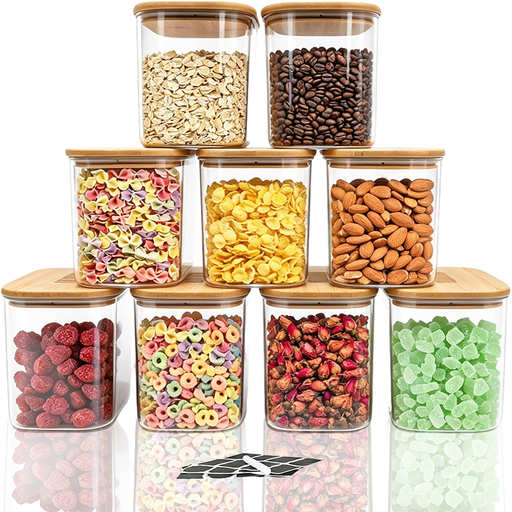
Why this product suits this household: Nine containers of the same size, each with a 1-litre capacity, make it easy to get started with organised food storage. The clear design is intended for nuts, muesli, snacks and dry ingredients.
The uniform size makes the containers easy to stack and avoids ending up with a mismatched collection of different formats. Labels and a pen are included in the set.
9 containers with a total capacity of 9 litres, clear sides and write-on labels.
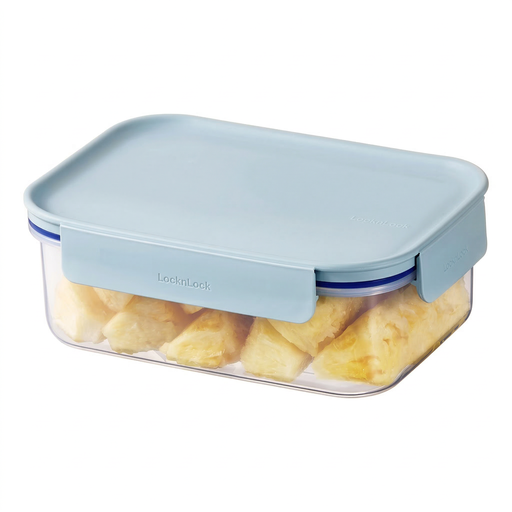
Why this product suits this household: This compact container is designed for small portions, snacks and organising lunchboxes. According to the product description, it has a four-sided locking mechanism and a silicone seal, and is suitable for the freezer, microwave without the lid, and dishwasher.
The locking design is clearly described. The microwave instructions help prevent the lid from being heated by mistake.
420 ml capacity, stackable rectangular shape, BPA-free material and four-sided locking mechanism.
Why this product suits this household: This snack box is designed for school, work, travel and meal prep. Two inserts keep different foods separate, while its slim design, measuring 16.5 × 22.5 × 5.8 cm, is suitable for sandwiches, fruit or snacks.
The two dividers stop wet and dry ingredients from coming into direct contact. The manufacturer describes the design as having minimal gaps, with an airtight and leakproof closure.
1.2-litre capacity, two removable inserts, BPA-free plastic and dishwasher-safe; microwave-safe without the lid.
We’ve put together a complete, regularly updated list of products that meet these strict selection criteria and fully comply with the safety regulations in force in the EU.
Before first use, wash the container, lid, sealing ring and inserts with warm water and mild washing-up liquid. Drying containers thoroughly helps prevent residual moisture from affecting dry food.
For a well-organised pantry, try the following:
For typical breakfast cereals, 1 to 1.5 litres is often a practical size. For larger family packs or if you top up frequently, 1.9 to 2.3 litres may be more suitable. The container’s height and opening width also matter.
It depends on the product. Some containers are microwave-safe, but only without the lid. Check the temperature limits and manufacturer’s instructions before each use. The plastic containers mentioned here are not intended for use in an oven, on a hob or with direct heat.
There’s no set lifespan that applies to every container. It depends on the material, cleaning, exposure to high temperatures and how often it’s used. Replace the container if it develops cracks or warping, the seals become brittle, or the lid no longer closes securely.