If you’re specifically looking for a low-fat cereal bar to take to the Christmas market, start by checking the fat content per 100 g: Germany’s consumer advice centre says that solid foods can contain no more than 3 g of fat per 100 g to be labelled “low fat”. For “reduced fat” claims, also check what the product is being compared with. When choosing a particular variety, consider saturated fat, sugar, energy, serving size and ingredients too.
Which comparison matters to you?
For shoppers with a specific fat limit in mind
If keeping the overall fat content low is your main priority for a snack on the go, compare the figures per 100 g. Germany’s consumer advice centre sets the limit for a “low fat” claim on solid foods at no more than 3 g of fat per 100 g.
For shoppers comparing several nutrients
If you don’t want to choose based on fat content alone, compare saturated fat, sugar and energy per 100 g across similar cereal bars too. A Nutri-Score, where available, can help you compare products within the same category, but it doesn’t replace the nutrition information.
For shoppers with specific ingredient requirements
If certain ingredients or allergens are a deciding factor for you, check the labelling on each individual variety. A low fat content doesn’t tell you whether a bar meets those requirements.
What should you look for when buying?
For a snack at the Christmas market, start by comparing the fat content per 100 g, then check the other nutrition information and the ingredients in the specific variety. The figures per bar can then help you assess the portion you’ve chosen.
| What to check |
What to look for |
Who it matters most to |
| Total fat |
Check the fat content per 100 g. Germany’s consumer advice centre sets the limit for a “low fat” claim on solid foods at no more than 3 g per 100 g. For “reduced fat” claims, check what the product is being compared with too. |
I want to take a bar with a clearly low fat content and not rely solely on a claim on the front of the pack. Around 50% of shoppers put this fat criterion first. |
| Other nutrients |
For similar cereal bars, compare saturated fat, sugar and energy per 100 g, and check the serving size separately. |
Low fat alone isn’t enough to help me choose, as I also want to consider the other nutrients in my snack portion. For around 30% of shoppers, this broader comparison is the priority. |
| Ingredients and allergens |
Read the ingredients list, highlighted allergens and any precautionary allergen statements for the specific variety. |
Before I pack a bar for the market, its recipe needs to meet my requirements for ingredients or allergens. This is the main concern for around 20% of shoppers. |
Common comparison mistakes
-
Assuming “no added sugar” means “low fat”
These claims refer to different things. REWE’s ja! Chocolate Muesli Bar with no added sugar contains 7.6 g of fat per 100 g, which is above the limit Germany’s consumer advice centre gives for a “low fat” claim.
Check the total fat content separately from the sugar claim.
-
Looking only at the front of the pack
Claims about protein, organic ingredients or a particular flavour don’t tell you the fat content. Germany’s consumer advice centre recommends checking the nutrition information, especially when a product makes a nutrition claim.
Compare nutrition information per 100 g for similar bars, and check the ingredients list as well.
-
Comparing bars of different sizes by the piece
You can’t directly compare the figures per bar without taking the weight into account.
Start by comparing the figures per 100 g, then check the weight of each individual serving.
-
Assuming allergen information is the same for every variety
Ingredients and precautionary allergen statements can vary between varieties. For example, Seeberger’s oat bar with dark and milk chocolate carries warnings about possible traces of several allergens.
Check the ingredients and allergen information on the pack of the variety you plan to buy.
Brands and varieties to consider
Corny
REWE stocks Corny cereal bars in several varieties and product ranges, including chocolate, oat and nut options.
- You can compare the varieties by flavour and their individual nutrition information.
- You can’t assume all products in the range have the same fat content; check the nutrition table for the specific variety.
ja! von REWE
REWE provides ingredients and nutrition information for its ja! Chocolate Muesli Bar with no added sugar.
- The figures per 100 g make it easy to compare with other cereal bars.
- REWE lists this variety as containing 7.6 g of fat per 100 g. “No added sugar” is no substitute for checking the fat content.
Seeberger
Seeberger offers oat and nut bars in a range of flavours, with ingredients and nutrition information provided for each product.
- You can check the nutrition and allergen information for the specific variety.
- Seeberger lists its oat bar with dark and milk chocolate as containing 17 g of fat per 100 g, so it isn’t an example of a bar below the low-fat limit mentioned above.
Cereal bars at Joybuy
These cereal bars are worth considering as individually portioned snacks to take with you. If “low fat” is a specific buying requirement, check the fat content of the variety against the 3 g per 100 g limit given by Germany’s consumer advice centre. The product name alone isn’t enough.
 No product image available
Corny Haferkraft Zero Cocoa cereal bars, 4 × 35 g
A handy, individually portioned cereal bar to take with you. Check the fat content per 100 g and the ingredients on the specific pack before choosing based on the name “Zero”.
The listed weight of an individual bar is inconsistent, so check the serving size on the pack before buying. The product description notes that excessive consumption of maltitol may have a laxative effect.
View at Joybuy
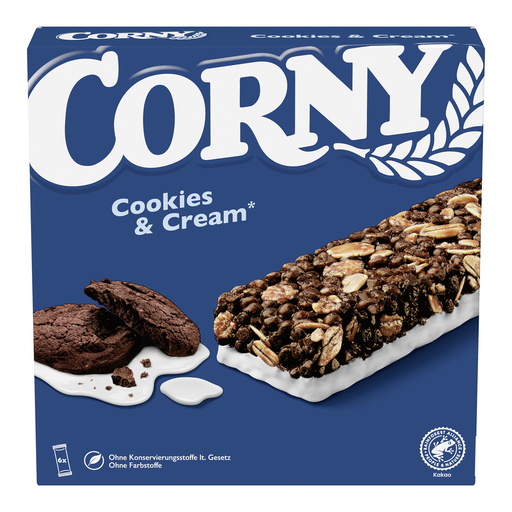 No product image available
Corny Cookies & Cream Cereal Sandwich Bars, 6 × 23 g
A handy, individually portioned snack to take with you. When buying, compare fat, saturated fat and sugar per 100 g rather than assuming a bar’s nutrition information from its size.
If allergens are a concern for you, check this product’s information about gluten and milk, as well as possible traces of nuts, peanuts and eggs.
View at Joybuy
Frequently asked questions
How can I tell if a cereal bar is low in fat?
Check the fat content per 100 g: Germany’s consumer advice centre sets the limit for a “low fat” claim on solid foods at no more than 3 g of fat per 100 g. Check the figures for the specific variety, not just the name of its product range.
Does “reduced fat” mean the same as “low fat”?
No. A reduced-fat claim compares a product with another, while “low fat” refers to a fixed amount per 100 g. If you’re choosing a bar advertised as reduced fat, check both the comparison product and the actual fat content.
Can the Nutri-Score replace the nutrition table?
No, the Nutri-Score doesn’t replace checking individual nutrients and ingredients. Germany’s consumer advice centre says it’s useful for comparing products in the same category or with the same intended use. To check the fat content, also look at the figures per 100 g.
Do I need to check every cereal bar variety for allergens?
Yes. If you need to avoid specific allergens, check the ingredients and allergen information on the specific pack. Germany’s consumer advice centre highlights the importance of this labelling on packaged foods. Information for one variety doesn’t necessarily apply to every bar from the same brand.


