Planners with a specific fat target
If you’re sourcing corn snacks with as little fat as possible for a conference, compare the nutrition information per 100 g rather than relying on claims such as ‘non-fried’ or a product’s light appearance.


If corn snacks are a must for your conference, the stated fat content per 100 g is a more reliable starting point than how they are made: REWE lists 1.2 g of fat per 100 g for its organic corn puffs, while a non-fried corn snack can contain considerably more. Also check the salt, ingredients and allergen warnings, and make sure guests can see this information when the snacks are served. A low fat content alone does not constitute a stated ‘reduced fat’ comparison claim.
If you’re sourcing corn snacks with as little fat as possible for a conference, compare the nutrition information per 100 g rather than relying on claims such as ‘non-fried’ or a product’s light appearance.
When catering for a mixed group, you need to be able to check the ingredients and possible traces for each variety before serving. For example, REWE lists possible traces of gluten, milk, soya and peanuts, among others, for its organic corn puffs.
If you’re serving snacks during a break, plan the pack sizes, separate serving areas and accessible labelling. Salt content and flavouring also matter when putting together a selection of varieties.
First decide whether the snack really needs to be made from corn. Then compare the nutrition information per 100 g, and only after that plan the varieties and how you’ll serve them during the conference break.
| Criterion | What to check when buying | Who it matters most to |
|---|---|---|
| Fat content | Compare fat and energy per 100 g; for ‘reduced fat’ claims, also check the basis for comparison. REWE lists 1.2 g of fat per 100 g for its organic corn puffs. | If corn snacks are going on the buffet, I want a specific fat figure rather than an assumption based on how they’re made. For around 36% of consumers, fat comparison is the main priority. |
| Ingredients and allergens | Check the ingredients and possible traces on the actual pack for each variety, and make the information accessible where the snacks are served. | When guests have different intolerances, I need information that clearly relates to each bowl. Clear allergen and ingredient information is the priority for around 29% of consumers. |
| Serving during the break | Plan pack sizes and serving styles; if you’re offering several varieties, keep the labels with them and organise separate serving areas. | When lots of people are helping themselves in a short time, I want to be able to serve and replenish the varieties without mixing them up. Around 21% of consumers put practical organisation first. |
| Salt and flavouring | Compare salt per 100 g and the flavour; don’t choose a strongly flavoured variety based on its fat content alone. | For a mixed group, I want to know how salty or strongly flavoured the options are. This is the main selection consideration for around 14% of consumers. |
REWE describes Lorenz Chillers Chili Style as a non-fried corn snack, but lists 19 g of fat per 100 g. How a snack is made is no substitute for comparing its nutrition information.
Compare the fat content per 100 g with your buying criteria before choosing a variety for the buffet.
The North Rhine-Westphalia Consumer Advice Centre points out that less fat does not automatically mean a corresponding reduction in calories. Salt and ingredients also remain important when choosing snacks.
Check fat, energy and salt side by side, and see which product group a reduction claim is compared with.
REWE lists several possible allergen traces for its organic corn puffs, and the product page for Lorenz Chillers Chili Style also mentions possible traces. A low fat content doesn’t answer questions about allergens.
Check the pack for each specific variety, make its information accessible, and serve the snacks separately if guests need different options.
In 2023, Lidl reported an ÖKO-TEST verdict for Snack Day Maissnack Bio. This doesn’t tell you whether the product is available today or what’s in a pack currently on sale.
Check the current product labelling and the quantity you need before placing your order.
REWE lists 1.2 g of fat per 100 g for its organic corn puffs and 1 g of fat per 100 g for its organic sea-salt corn cakes. Corn puffs and corn cakes are different types of snack.
Lorenz Chillers Chili Style is a non-fried corn snack. The chickpea crisps also sold by the brand, however, are not corn snacks.
funny-frisch describes its popchips as being popped using heat and pressure rather than fried.
In 2023, Lidl reported an overall ÖKO-TEST verdict for Snack Day Maissnack Bio.
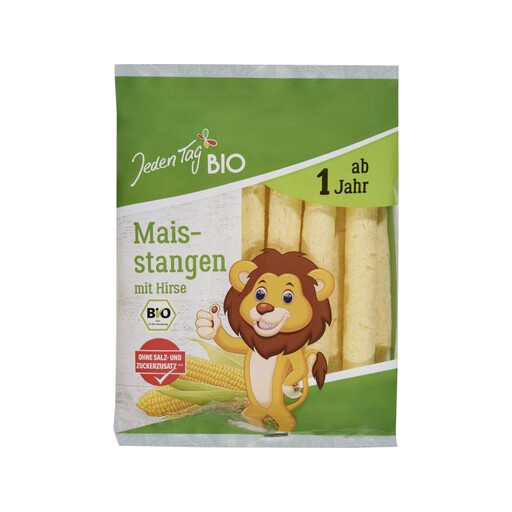
This selection features corn and millet puffs as a snack for the conference break. If low fat content is your main priority, check the figure per 100 g, as well as the ingredients and allergen information on the specific pack.
 No image available
Corn and millet puffs are an option if this is the type of snack you want for the conference break. If you’re choosing based on fat content and allergens, the information on the specific pack is what matters.
Pack size: 50 g.
No. How a snack is made doesn’t tell you that on its own. REWE lists 19 g of fat per 100 g for the non-fried corn snack Lorenz Chillers Chili Style, so compare the nutrition information for the specific varieties.
No. An absolute fat figure doesn’t tell you how it compares with another product. REWE lists 1.2 g of fat per 100 g for its organic corn puffs. If a ‘reduced fat’ claim matters to your choice, check the stated basis for comparison.
The ingredients and allergen information should be clearly linked to each variety on offer. The Federal Ministry of Agriculture, Food and Homeland explains how allergenic ingredients are labelled on food packaging. Keep the original pack for each variety, or its corresponding information, accessible when serving the snacks.
Not necessarily. According to the North Rhine-Westphalia Consumer Advice Centre, a lower fat content doesn’t automatically mean a corresponding reduction in calories. Also compare the energy and salt figures per 100 g, as well as the amount you plan to serve.