People with a strict fat limit
If ‘low-fat’ is a firm requirement for you, the fat content per 100 g matters more than a variety name such as ‘light’.


If you’re specifically looking for a low-fat muesli bar for a break while working from home, check the fat content on the pack: the Verbraucherzentrale says solid foods can contain no more than 3 g of fat per 100 g to be labelled ‘low-fat’. The chocolate muesli bars listed by ALDI SÜD and EDEKA contain 9.1 g, 10 g and 13.9 g of fat per 100 g, so they exceed this limit. If you simply want to compare varieties with different fat contents, consider their sugar, ingredients, allergens and portion size too.
If ‘low-fat’ is a firm requirement for you, the fat content per 100 g matters more than a variety name such as ‘light’.
If you don’t need a variety labelled low-fat, you can compare the fat and sugar content of similar bars, then take the size of each portion into account.
If you need to avoid certain ingredients, check the ingredients list, highlighted allergens and ‘may contain’ information on the specific pack before weighing up the nutritional values.
First decide what matters most in a bar for your work-from-home break. Then compare the nutritional values per 100 g and use the portion information to judge each individual bar.
| Criteria | What to check when buying | Who it matters most to |
|---|---|---|
| Fat content | Check the fat content per 100 g on the pack. For solid foods, the Verbraucherzentrale says products labelled ‘low-fat’ can contain no more than 3 g per 100 g. | If I’m only considering a low-fat bar, a ‘light’ name isn’t enough. This fat limit would be the priority when buying for around 37% of consumers. |
| Sugar and ingredients | Compare ‘of which sugars’ and fat per 100 g; check the ingredients list too if needed. | For my work break, I want to know how the sugar and fat content compare, rather than focus on just one figure. Around 27% of consumers would consider sugar and other ingredients first. |
| Allergens and labelling | Check the ingredients, highlighted allergens and ‘may contain’ information for the specific variety. | If I need to avoid certain ingredients, whether a particular bar is suitable comes before its fat content. Around 18% of consumers would make this check first. |
| Portion size | Compare the pack weight and number of bars with the nutritional information per 100 g and, where given, per portion. | For my break, I want to know how big each bar is and how many portions the pack contains. Around 18% of consumers would prioritise portion size. |
ALDI SÜD lists 10 g of fat per 100 g for GOLDEN BRIDGE Schoko light. That’s more than the 3 g per 100 g that the Verbraucherzentrale gives as the limit for solid foods labelled ‘low-fat’.
If this limit matters to you, check the fat content on the current pack rather than relying on the variety name.
For the GUT&GÜNSTIG Schoko muesli bar with no added sugar, EDEKA lists 2.1 g of sugar and 9.1 g of fat per 100 g. These figures answer different questions.
Compare sugar and fat separately, and check the ingredients list if sugar substitutes are also important to your choice.
The Bio Knusperriegel Nussmix listed by EDEKA is labelled gluten-free and lactose-free, but contains peanuts and almonds. According to EDEKA, it has 33.5 g of fat per 100 g.
Judge this type of bar by its specific nutritional values and ingredients, not just its product category.
Nutritional values and ingredients may differ from those shown in an online product listing, depending on the specific version. ALDI SÜD also notes that GOLDEN BRIDGE products may vary depending on the supplier.
If you have a strict fat limit or an allergy, check the labelling on the bar you’re actually buying.
ALDI SÜD lists several CORNY muesli bars, including Schoko light. This gives you a starting point for comparing specific varieties, rather than a basis for judging the whole brand.
ALDI SÜD stocks different types of bars under the GOLDEN BRIDGE brand. For this comparison, focus on the specific muesli bar rather than treating different types of bar as equivalent alternatives.
EDEKA stocks a classic chocolate muesli bar and a ‘Schoko ohne Zuckerzusatz’ variety. You can compare the fat and sugar content of these two varieties separately.
The EDEKA Bio Knusperriegel Nussmix is a separately labelled nut bar option, not a like-for-like alternative to a chocolate muesli bar.
These two CORNY cereal bars are portioned snack options for a break while working from home. This selection doesn’t mean they’re ‘low-fat’: check the fat content per 100 g on the relevant pack to assess that.
 No image available
An option for your work break if you’re considering the Zero Cocoa variety. The title describes a 4 × 35 g pack; check the actual pack and bar size before buying. To see whether the bar meets your fat requirements, check the fat content per 100 g on the pack rather than relying on the name ‘Zero’.
 No image available
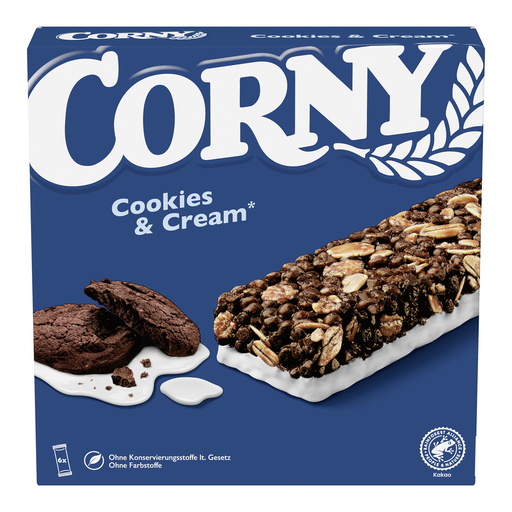
An option if you want to compare individually portioned bars for your work break. The product name specifies six bars weighing 23 g each. Check the nutritional information per 100 g to see whether they meet your fat requirements, and check the allergen information on the specific pack if you need to avoid certain ingredients.
For solid foods, the Verbraucherzentrale says products labelled ‘low-fat’ can contain no more than 3 g of fat per 100 g. So, when comparing muesli bars, check the fat content per 100 g on the current pack.
No. ‘No added sugar’ doesn’t tell you anything about the fat content. EDEKA lists 2.1 g of sugar and 9.1 g of fat per 100 g for its GUT&GÜNSTIG Schoko muesli bar with no added sugar. Compare the two nutritional values separately.
Check the ingredients list, highlighted allergens and ‘may contain’ information on the specific pack. This is particularly important if you need to avoid a certain ingredient; a suitable fat content is no substitute for checking.
Start by comparing muesli bars per 100 g, so you’re comparing different sizes on the same basis. The per-portion information can then help you work out how each individual bar fits into your break.