Families keeping an eye on salt content
You’re planning a straightforward breakfast for school days and want to compare the salt content per 100 g and the ingredients before buying.


When choosing porridge for school days based on its salt content, first compare the figure per 100 g, then check the ingredients and allergen information. Kölln states that its Hafer-Porridge Feine Basis contains 0 g of salt per 100 g; Alnatura gives 0.02 g per 100 g for its extra-fine oat flakes, which let you choose the additional ingredients yourself. A protein blend is a different option: Seitenbacher states that its Raspberry Protein Porridge contains 0.2 g of salt per 100 g and lists milk protein and sea salt among its ingredients.
You’re planning a straightforward breakfast for school days and want to compare the salt content per 100 g and the ingredients before buying.
You want to start with oat flakes and choose the liquid, flavour and sweetness yourself, rather than opting for a flavoured mix.
You’re considering a protein blend for breakfast and want to check its salt content, milk ingredients and other components too.
For school breakfasts, it helps to follow a set order: compare the salt figure per 100 g on porridge and oat flakes first, then choose the preparation method and ingredients to suit your needs.
| Your priority | What to check before buying | Who it matters most to |
|---|---|---|
| Salt content | Compare the salt figure per 100 g; if the product says ‘reduced’, also check which similar product it is being compared with. | When I choose a school breakfast based on salt content, the figure in the nutritional information matters more to me than the flavour. Salt would be the main buying priority for around 50% of consumers. |
| Preparation and ingredients | Read the ingredients list and check whether the recommended preparation uses cold or hot liquid. | On a busy school morning, I want to mix my porridge without any fuss and choose the other ingredients myself. Around 30% of consumers would put this control and flexibility first. |
| Protein blend | Compare the salt and protein figures per 100 g, and read the ingredients and allergen information. | If I’m specifically looking for protein porridge, I want to know what other ingredients come with the recipe. This product profile would be the main consideration for around 20% of consumers. |
These claims don’t mean the same thing: under the EU regulation on nutrition claims, a reduction claim requires a comparison with a similar food. A protein or flavour claim, on its own, also tells you nothing about the amount of salt.
Compare the specific figure per 100 g in the nutritional information. If the pack says ‘reduced salt content’, also check what the comparison is based on.
According to Kölln, its Hafer-Porridge Feine Basis contains spelt and almonds, among other ingredients; Seitenbacher lists milk protein in its Raspberry Protein Porridge. These ingredients may affect your choice, regardless of the salt content.
Check the current ingredients and allergen information for every variety, especially if you’re switching recipes or need to avoid allergens.
The salt figure for the dry product doesn’t automatically reflect the finished meal if you add other ingredients.
So remember to take into account the nutritional information and ingredients for the liquid and any toppings you use.
Kölln Hafer-Porridge Feine Basis may be worth considering if you want to assess a ready-made mix using its stated salt content.
Alnatura extra-fine oat flakes are a base for porridge that lets you choose the additional ingredients yourself.
Seitenbacher Raspberry Protein Porridge is a flavoured protein blend, making it a different choice from plain oat flakes.
These products are oat flakes, or products described as oat flakes, for making your own porridge. If salt content is a key factor in your choice, compare the figure on each pack; for the fourth product, also check its exact product type.
 No image available
For porridge where you choose the liquid and other ingredients yourself. Alnatura lists wholegrain oat flakes as the ingredient in its extra-fine oat flakes and gives a salt content of 0.02 g per 100 g. It also describes preparation with cold liquid. If you have allergies, check the information on the current pack.
 No image available
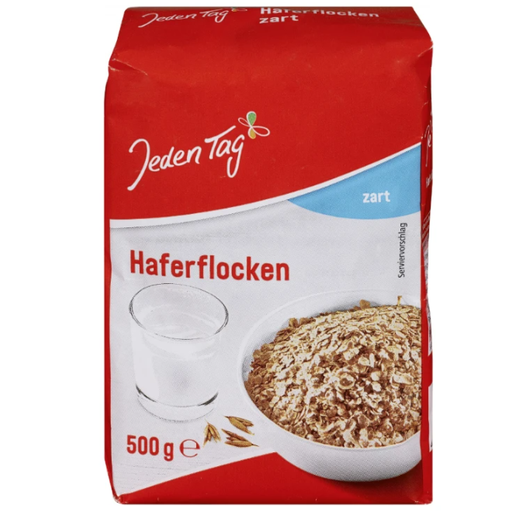
For making your own porridge with fine oat flakes. Before buying, compare the salt figure per 100 g and the allergen information on this pack; information about Kölln Hafer-Porridge Feine Basis doesn’t automatically apply to these flakes.
 No image available
For oat-flake porridge with other ingredients of your choice. If you’re choosing based on salt content, check the figure per 100 g and the allergen information on the specific pack.
 No image available
For a make-your-own oat breakfast, provided the product type suits your chosen preparation method. The description ‘coarse oat flakes’ and the information about the product type aren’t consistent; check the current pack to confirm whether it is flakes, and check the salt content and allergen information there too.
 No image available
For households looking for fine oat flakes in a four-pack to make their own porridge. If a particular salt figure is important to you, check the nutritional information per 100 g on this product; don’t assume that figures for another Kölln variety or pack size apply.
No. ‘Reduced salt content’ is a comparative nutrition claim under EU law; a low figure in the nutritional information alone doesn’t prove that such a comparison has been made. To help you choose, compare the stated salt content per 100 g directly across suitable products.
Yes. Germany’s Federal Ministry of Agriculture, Food and Home Affairs lists oats among the gluten-containing cereals that must be declared. For a specific porridge, also read the pack for information about other ingredients and possible traces.
No. Kölln lists almonds as an ingredient in this variety and also warns that it may contain traces of other nuts, milk and peanuts. If you have allergies, always check the current information on the specific product.
You can make it with cold liquid using Alnatura extra-fine oat flakes: according to Alnatura, the flakes soften when prepared this way. If you mix the porridge the night before, follow the storage instructions for the ingredients you use.