
Lieferung heute & morgen

Qualitätsgarantie

Willkommens-Angebote freischalten: KOSTENLOSE Lieferung | Bis zu 80 % RABATT | Kostenlose 30-Tage-JoyPlus-Testphase
App herunterladen
Finding a chocolate muesli that meets specific dietary needs requires a close look at product labels. Key parameters like sugar, fat, and fibre content are crucial for making an informed choice. This article analyses the criteria for identifying reduced-sugar chocolate muesli and presents a selection of products based on their nutritional information and ingredient lists.
Evaluating a muesli should be based on objective, measurable factors. The following criteria are relevant for a rational purchasing decision:
The terms "reduced sugar" and "no added sugar" are not synonymous.
A low-fat muesli is not necessarily low in calories. The total calorie content (listed in kJ and kcal per 100 g) is composed of carbohydrates, fats, and proteins. Chocolate, nuts, or seeds can increase the fat content and thus the energy density. It is therefore wise to check the saturated fat and total fat content.
A high proportion of whole grain flakes (e.g., oats, wheat, spelt) is an indicator of a high-fibre muesli. Fibre consists of indigestible plant components that can contribute to a feeling of fullness. A whole grain muesli also provides the nutrients of the entire grain kernel. The whole grain percentage is often declared on the packaging and serves as a useful comparison criterion.
The ingredients list provides detailed information about the product's composition. It is arranged in descending order by weight. This is where you can identify hidden sources of sugar (e.g., barley malt extract, caramel sugar syrup). Furthermore, the allergen information is crucial for individuals with intolerances (e.g., to gluten, milk, nuts).
The following selection is based on the manufacturers' declared specifications.
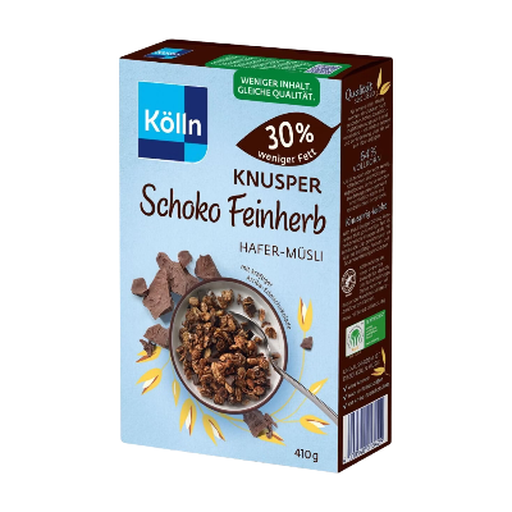
Why we recommend this product: This crunchy chocolate muesli focuses on reducing fat content while maintaining a high proportion of whole grains. It is ideal for consumers who want to manage their dietary fat intake without sacrificing a crunchy chocolate experience.
Pros:
Who it's for: Individuals who prefer a low-fat muesli with a crunchy texture and are comfortable with a moderate sugar content of 20 g per 100 g.

Why we recommend this product: This product directly addresses the demand for sugar reduction. At 13 g of sugar per 100 g, it offers significantly less sweetness than many standard chocolate mueslis without resorting to artificial sweeteners.
Pros:
Who it's for: Consumers who prioritise reducing added sugar and are looking for a classic (non-crunchy) muesli with a high whole grain content.
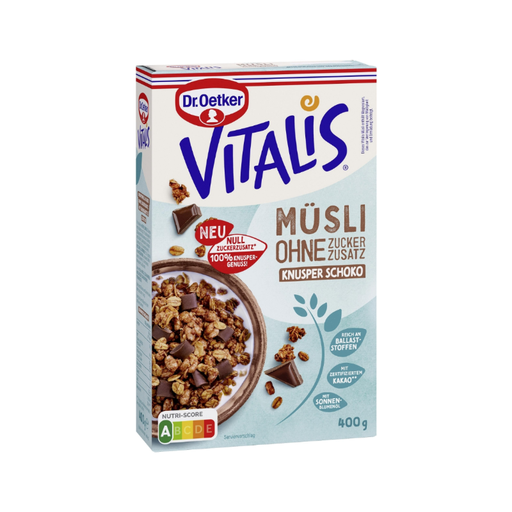
Why we recommend this product: This product is designed for users aiming for maximum sugar avoidance. As a muesli with no added sugar, it has a very low naturally occurring sugar content of just 1.3 g per 100 g.
Pros:
Who it's for: Individuals who want to strictly avoid added sugar, for instance as part of a ketogenic or diabetic-friendly diet, and who accept the use of sugar substitutes like maltitol. At 16 g per 100 g, the fat content is higher than in the other featured products.
The products presented here cover specific requirements for sugar and fat content. If you are looking for other varieties, such as those with a higher fruit or nut content, organic quality, or different types of grains, our Chocolate Granola category offers a wider selection for further analysis.
1. What does "no added sugar" mean in muesli? A muesli with "no added sugar" contains no added table sugar (sucrose), glucose syrup, honey, or other sweetening syrups. However, it may contain sugar that occurs naturally in the ingredients (e.g., from grains, dried fruits, or dairy products). Sugar substitutes (e.g., maltitol, erythritol) or sweeteners (e.g., stevia) are often used to provide sweetness.
2. Is reduced-sugar muesli automatically low-calorie? No. Reducing sugar does not necessarily lead to a reduction in total calories. The sugar content is often compensated for by other ingredients like fats (from nuts, seeds, oil, or chocolate) or more complex carbohydrates. It is therefore essential to check the nutritional table and the energy value per 100 g.
3. What role does fibre play in muesli? Fibre is a plant-based material that the body cannot digest. In muesli, it primarily comes from whole grain cereals. It can increase the volume of food in the stomach, contributing to a longer-lasting feeling of fullness. It is also important for normal digestive function. A high fibre content is therefore a key feature of a nutritionally balanced muesli.