If you’re specifically looking for a cracker with a stated sugar reduction for your morning coffee break, check for the claim “reduced sugar” and see how it compares with a similar product. If you’re mainly concerned with the amount of sugar, compare the “of which sugars” value per 100 g and for the portion you plan to eat. Also check the salt content and ingredients. Lebensmittelklarheit explains that “reduced sugar” means at least 30% less sugar than a comparable food.
Who might be interested in these crackers?
Snackers looking for a lower-sugar coffee break
You’d like something crunchy with your coffee and keep an eye on the stated sugar content. If a specific sugar reduction matters to you, also check what the “reduced sugar” claim is being compared with.
People looking for gluten-free options
You need or prefer gluten-free crackers. When choosing, check that the specific product is labelled gluten-free, as well as reviewing its ingredients and nutritional information.
People keeping an eye on salt
You’re looking for a savoury cracker for your break and don’t want to base your decision on sugar alone. Compare the salt content per 100 g too, and think about your usual portion size.
What should you look for when buying?
When choosing crackers for a lower-sugar coffee break, first consider whether a stated reduction compared with a similar product matters more to you, or whether you’re simply looking for a cracker with a low sugar content. Gluten-free status and salt content may also influence your choice.
| What to consider |
What to check when buying |
Who it matters to |
| Stated sugar reduction |
Does the pack say “reduced sugar”, and which comparable product is used as the basis for the claim? Lebensmittelklarheit says this means at least 30% less sugar. |
If I specifically want less sugar than in a comparable cracker, a low figure for one product on its own isn’t enough. Around 36% of consumers prioritise this comparison. |
| Sugar content of the cracker |
Compare “of which sugars” per 100 g on the same basis, and take your planned portion size into account. |
For my coffee break, it matters how much sugar the cracker itself contains, even if there’s no reduction claim. Around 29% of consumers prioritise this figure. |
| Gluten-free recipe |
Check that the specific product is labelled gluten-free, along with its ingredients, sugar and salt content. |
I need or prefer gluten-free crackers, but don’t want to lose sight of their sugar content. Gluten-free status comes first for around 14% of consumers. |
| Salt and ingredients |
Compare the sugar and salt figures per 100 g, then check the ingredients list. |
I want a savoury cracker that suits my usual portion, without focusing on just one sugar figure. Around 21% of consumers prioritise this balance. |
Common comparison pitfalls
-
Assuming “less sweet” means “reduced sugar”
A description of the taste doesn’t give you a reliable sugar figure. Lebensmittelklarheit explains “reduced sugar” in terms of a comparison with a similar food.
Read the specific claim on the pack, then compare the “of which sugars” value in the nutritional information.
-
Comparing only the sugar content
A low sugar figure on its own tells you nothing about the salt content. Among the products considered here, EDEKA24 and REWE list different sugar and salt figures per 100 g.
Compare both figures on the same basis and think about how much you usually eat.
-
Assuming gluten-free means lower in sugar
A gluten-free label doesn’t tell you anything about the sugar content. The Alnavit Bio Mini Cracker listed by REWE is labelled gluten-free and, according to the available product information, contains rice syrup and 4 g of sugar per 100 g.
Check the gluten-free label, ingredients and nutritional information for the specific cracker you’re considering.
Brands and product ranges to help you choose
The information relates to the specific crackers listed, not to a brand’s entire range.
Alnatura
The Organic Spelt Cracker, plain, is a useful point of comparison if you’re looking for the sugar content per 100 g of a specific product.
- EDEKA24 lists 1.3 g of sugar per 100 g for this cracker.
- EDEKA24 also lists 2 g of salt per 100 g. The sugar figure alone doesn’t prove a reduction compared with another product.
Alnavit
The Bio Mini Cracker is an option for your coffee break that REWE labels gluten-free.
- This product is listed as containing 4 g of sugar per 100 g.
- The recipe contains rice syrup; the gluten-free label doesn’t indicate a sugar reduction.
TUC
TUC Original is a savoury wheat cracker whose nutritional values can be compared with those of other crackers per 100 g.
- EDEKA24 lists 7.1 g of sugar and 1.7 g of salt per 100 g for TUC Original.
- The product information listed doesn’t describe TUC Original as “reduced sugar”.
Wasa
Tasty Snacks Sea Salt is a thin, savoury cracker for anyone who wants to weigh up both flavour and nutritional values.
- REWE lists the sugar and salt content for this product on the same per-100 g basis.
- The figures are 11 g of sugar and 2.38 g of salt per 100 g; they don’t apply to other Wasa products.
Crackers at Joybuy
This product may suit a coffee break if you’d like to check the cracker’s sugar content. You can’t tell whether a “reduced sugar” claim applies just by looking at the absolute sugar figure.
 No image available
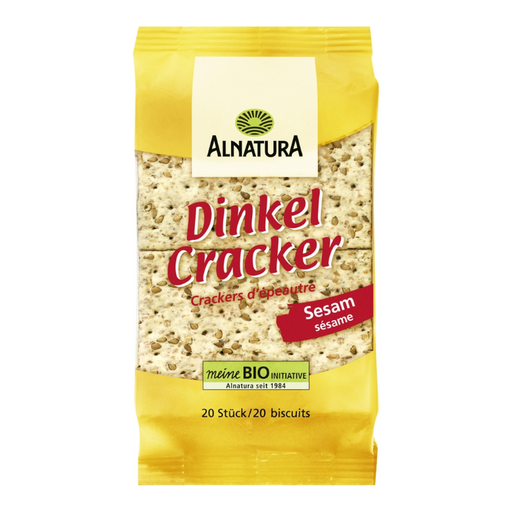
Alnatura Organic Spelt Sesame Crackers 100 g
If you’re keeping an eye on sugar during your coffee break, compare the nutritional information per 100 g and for your portion. The product name refers to spelt, while an accompanying description mentions wholegrain buckwheat. So check the ingredients on the pack before choosing based on the type of grain.
View at Joybuy
Frequently asked questions
What does “reduced sugar” mean for a cracker?
The claim refers to a comparison, not just the sugar content of the cracker itself. Lebensmittelklarheit explains it as at least 30% less sugar than a comparable food. When choosing, you should also check the “of which sugars” value per 100 g.
Is a cracker with 1.3 g of sugar per 100 g automatically “reduced sugar”?
No. That figure alone doesn’t show a reduction compared with another product. EDEKA24 lists 1.3 g of sugar per 100 g for Alnatura Organic Spelt Cracker, plain. Check the specific product claim separately to see whether a cracker is described as “reduced sugar”.


