
Lieferung heute & morgen

Qualitätsgarantie

Willkommens-Angebote freischalten: KOSTENLOSE Lieferung | Bis zu 80 % RABATT | Kostenlose 30-Tage-JoyPlus-Testphase
App herunterladen
For many, a crunchy muesli is the ideal start to the day. However, finding a variety that isn't packed with excessive sugar can be a challenge. Many products on supermarket shelves deliver the desired crunch but come with a high sugar content. This article serves as a guide for anyone looking for a low-sugar crunchy muesli who values clear facts and transparent product information. We'll present a selection of products and offer practical tips for your purchasing decision.
The term "less sweet" is not legally protected and can be interpreted differently from one manufacturer to another. To make an informed choice, the following points are crucial when selecting a low-sugar muesli.
The most reliable indicator is found in the nutritional table on the packaging. Look for the "of which sugars" value per 100 grams. A reduced-sugar muesli often has less than 15 grams of sugar per 100 grams, compared to classic crunchy mueslis. Also, be sure to check the ingredients list. Sugar can be hidden behind terms like glucose syrup, fructose, dextrose, or barley malt extract. The order of the ingredients reveals their proportion in the product.
A healthy crunchy muesli is not just defined by its reduced sugar content, but also by a high proportion of whole grains. Whole-grain oat or wheat flakes are a source of dietary fibre. A high fibre content, often over 10 grams per 100 grams, contributes to a long-lasting feeling of fullness and is a key component of a healthy breakfast.
Crunchy mueslis are available in various pack sizes, from 400 g to 750 g or more. To objectively assess value for money, the base price per kilogram or per 100 grams is crucial. This information is mandatory on supermarket shelves and helps you fairly compare the costs of different products.
Based on the criteria above, we have compiled a selection of products that stand out for their reduced sugar content.
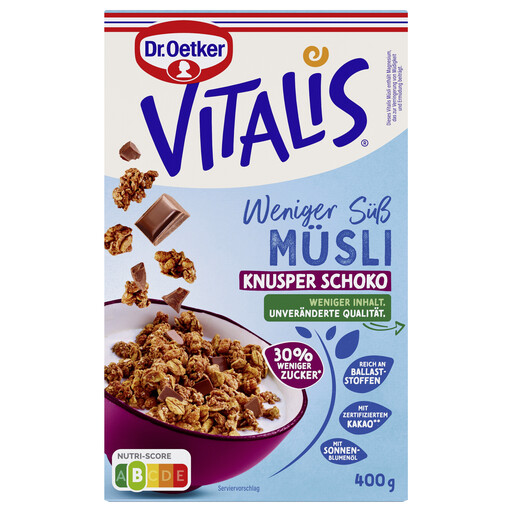
Why It Stands Out: This muesli combines the popular taste of chocolate with a reduced-sugar recipe. It is aimed at connoisseurs who don't want to give up chocolate pieces but still want to keep their sugar intake in check.
Benefits:
Who Is It For? For those who prefer a chocolate muesli for breakfast but are looking for a more conscious alternative to conventional chocolate crunchy mueslis.
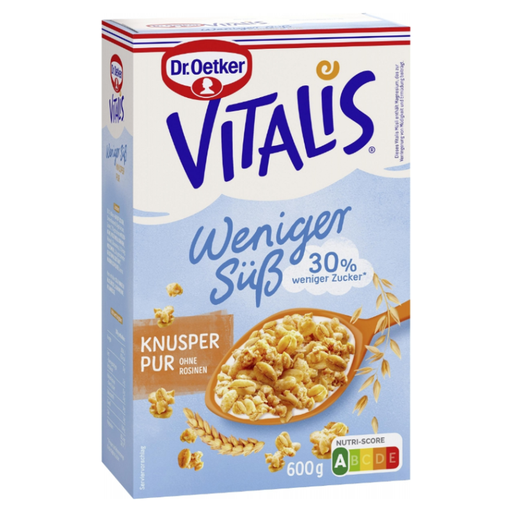
Why It Stands Out: The "Knusper Pur" (Crunchy Pure) version of the Vitalis less sweet range focuses on the essentials: golden-brown roasted whole-grain oat clusters. According to the manufacturer, it contains 30% less sugar than other crunchy mueslis.
Benefits:
Who Is It For? For purists who appreciate a versatile and low-sugar crunchy muesli as a foundation for their customised breakfast.
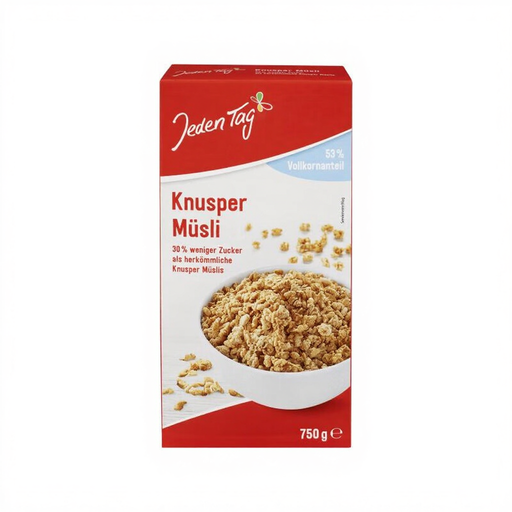
Why It Stands Out: This crunchy muesli offers a large 750 g pack size and a very low sugar content. It is a pragmatic choice for daily use in families or for individuals with high consumption.
Benefits:
Who Is It For? For price-conscious consumers and families looking for a simple, low-sugar, and versatile breakfast option for everyday use.
The products featured here offer a great introduction to the world of reduced-sugar crunchy mueslis. If you prefer other flavours like fruit, nuts, or different types of grains, there are numerous other options to discover.
Browse our entire range of sweet cereals to find the perfect option for you.
The term "less sweet" is not legally defined. It usually means the product has a reduced sugar content compared to the standard version from the same manufacturer or the market average. For an objective assessment, it is always necessary to look at the nutritional table and the "of which sugars" value per 100 g.
A reduced sugar content is an important factor, but not the only one. A healthy crunchy muesli should also have a high content of whole grains and dietary fibre, as well as a moderate fat content. Look for a balanced nutritional profile to choose a product that contributes to a nutritious breakfast.
Sugar goes by many names. On the ingredients list, look for terms ending in "-ose" (e.g., glucose, fructose, sucrose), as well as various types of syrup (glucose syrup, invert sugar syrup), honey, or malt extracts (e.g., barley malt extract). The position on the list is key: the higher up an ingredient is listed, the larger its proportion in the final product.