Parents focused on total sugar
You compare the sugar value per 100 g rather than relying on ‘no added sugar’ alone. A fruit-free variety could suit you if your child likes its taste and texture.


For a toddler’s breakfast with as little total sugar as possible, the words ‘no added sugar’ aren’t enough: also compare the ‘of which sugars’ value per 100 g. Fruit varieties can contain considerably more sugar even without added sugar. Also check that the texture is right for your child, and read the ingredients and allergen information for the specific variety.
You compare the sugar value per 100 g rather than relying on ‘no added sugar’ alone. A fruit-free variety could suit you if your child likes its taste and texture.
You want to avoid added sugar but have fruit in the muesli already. You also bear in mind that dried fruit contributes to the stated total sugar.
You check the specific pack for cereals containing gluten, nuts, milk ingredients and precautionary ‘may contain’ statements. If your child isn’t yet comfortable with a dry mixture, you pay particular attention to the product format and your child’s individual eating skills.
Start by comparing the stated total sugar, then decide which ingredients and texture are right for your child. Dry muesli and a finely textured fruit preparation are two different product formats.
| Criterion | What to check | Who it matters to |
|---|---|---|
| Total sugar | Compare ‘of which sugars’ per 100 g across varieties; don’t assume that ‘no added sugar’ means a low total sugar value. | If keeping sugar as low as possible is my main priority, I want to compare fruit and fruit-free varieties using the same nutritional value. Around 40% of consumers prioritise total sugar. |
| Allergens and eating skills | Check the ingredients and allergen information on the pack, as well as the texture of the product format. | If I need to check for allergens, or my child isn’t yet comfortable with larger pieces, the right ingredients and texture come first. This is the most important selection criterion for around 30% of consumers. |
| Grain base | Look at the first ingredients listed and, where stated, the wholegrain content. | I want to be able to see which flakes make up the mix and what else it contains. A clear grain base is the top priority for around 20% of consumers. |
| Fruit and preparation | Decide whether you want fruit already included or prefer to add it separately to a base; check the product format. | My child is more likely to accept a fruity variety, or I want to put breakfast together myself. Around 10% of consumers value this flexibility most. |
These terms don’t mean the same thing: muesli can contain sugar from its ingredients even when no sugar has been added.
Compare ‘of which sugars’ per 100 g. The Verbraucherzentrale (German consumer advice centre) says that, for solid foods, the claim ‘low sugar’ means no more than 5 g of sugar per 100 g.
In the Kölln Fruit Muesli with No Added Sugar described by REWE, dried fruit and grains contribute to the stated sugar value. A fruity variety isn’t automatically low in sugar.
Check the fruit content and nutritional information together. If you’d rather put breakfast together yourself, you can choose a suitable base and add fruit separately.
Depending on the variety, muesli may contain cereals with gluten, nuts or milk ingredients. A statement about possible traces relates to unintended cross-contamination and is separate from the listed ingredients.
If you have a diagnosed allergy, coeliac disease or a medically prescribed dietary restriction, read the current labelling on every pack. Speak to a healthcare professional if you have any questions about your individual circumstances.
A finely textured fruit preparation differs from dry family muesli in texture, ingredients and storage.
Consider your child’s eating skills and the product format. For a jar, also follow the storage instructions after opening.
It’s the individual variety that matters, not just the brand name. The examples below differ in their sugar claims, fruit content, ingredients and product format.
The dry ‘Low-Sugar Muesli’ is a fruit-free option for comparing total sugar.
The Fruit Muesli with No Added Sugar described by REWE combines a wholegrain oat base with fruit.
The Fruit Muesli described by Selgros is another dry mix containing wholegrain flakes and raisins.
The Bircher muesli in a jar is a finely textured fruit preparation, not a dry muesli mix.
Here you’ll find a crunchy muesli and fine oat flakes as a base for a breakfast you can put together yourself. Oat flakes aren’t a ready-made muesli mix. For both product formats, check that the ingredients and texture are right for your child.
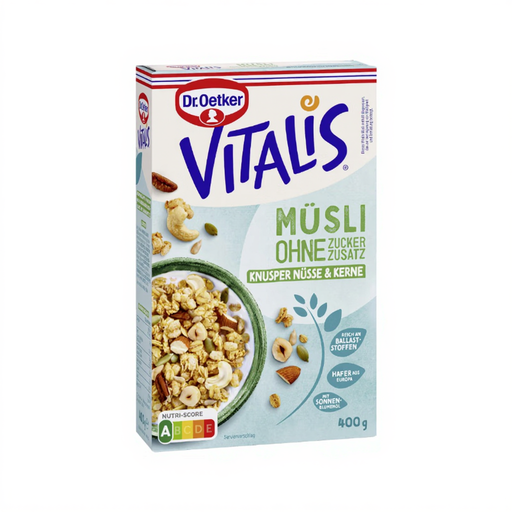 No image available
A crunchy muesli for anyone looking for a ready-made mix rather than individual flakes. Check the current nutritional information, ingredients and possible allergens on the pack. Whether the crunchy texture is right for your child depends on their eating skills.
 No image available
Fine oat flakes are a good base if you’d like to choose the other ingredients for breakfast yourself. They aren’t a ready-made muesli mix, so check the pack labelling before use and choose a preparation that’s right for your child’s eating skills.
No. ‘No added sugar’ means that no sugars, or ingredients added for their sweetening properties, have been added. The total sugar value may still be higher. Check the ‘of which sugars’ value per 100 g in the nutritional information rather than treating the two claims as equivalent.
It depends on the specific mix. For Kölln Fruit Muesli with No Added Sugar, REWE states 22 g of sugar per 100 g and attributes the sugar to dried fruit and grains. For other varieties, check their individual nutritional information.
If you have a relevant allergy, coeliac disease or a medically prescribed dietary restriction, check every specific pack. The ingredients list and allergen information show what it contains; also check any relevant ‘may contain’ statements and speak to a healthcare professional if you have questions about your individual circumstances.
There’s no set age for dry muesli that can take the place of considering your child’s individual eating skills. The Bundesinstitut für Öffentliche Gesundheit (German Federal Institute of Public Health) says that children can start trying many family foods from around one year old; still, check the texture of the specific mix. Alnatura explicitly states that its finely textured Bircher muesli in a jar is suitable from 8 months.