If you’re keeping an eye on sugar
You want to compare the sugar content of different types of porridge. To do so, check the ‘of which sugars’ figure per 100 g and read the ingredients list, rather than relying solely on the ‘no added sugar’ claim.


If you’re serving porridge alongside a potato supper as a less sweet or savoury option, a plain oat base is easier to season to suit than a fruit or chocolate mix. Still, compare the declared sugar content per 100 g and check the ingredients: ‘no added sugar’ does not mean ‘sugar-free’, and a high protein content tells you nothing about the sugar content on its own.
You want to compare the sugar content of different types of porridge. To do so, check the ‘of which sugars’ figure per 100 g and read the ingredients list, rather than relying solely on the ‘no added sugar’ claim.
You’re looking for a plain oat base that you can make with stock, vegetables or other savoury ingredients, rather than a mix that’s already flavoured with fruit or chocolate.
You pay attention to protein content, but also want to know how much sugar a particular variety contains. The two figures need to be compared separately.
First decide whether sugar content, a base suitable for savoury dishes or protein content matters most to you. Then compare the nutritional information on the same basis and check the ingredients and allergens for the specific variety.
| Criterion | What to check | Who it matters most to |
|---|---|---|
| Sugar content | Compare ‘of which sugars’ per 100 g of the uncooked product and read the ingredients list. | If I’m looking for a less sweet mix, I want to know the total declared sugar content, including in products with no added sugar. Around 50% of consumers put this first. |
| Savoury preparation | Look for a simple recipe and check whether it contains dried fruit or sweet flavourings. | For a potato supper, I want to choose the seasoning myself rather than start with a fruit or chocolate flavour. This is a priority for around 30% of consumers. |
| Protein and sugar | Check protein and sugar per 100 g for the same product. | If protein is especially important to me, I still don’t want to overlook a sweet recipe just because of its protein claim. Around 20% of consumers prioritise protein content here. |
According to the labelling guidance explained by the German Food Federation, a product with no added sugar can still contain sugars that occur naturally in its ingredients.
So also check the ‘of which sugars’ figure per 100 g and read the ingredients list.
Seitenbacher lists 30 g of protein and 19 g of sugar per 100 g for its Protein Porridge Chocolate. The protein figure alone therefore doesn’t answer the question of how much sugar it contains.
Compare both figures separately, making sure they’re based on the same nutritional information.
Fruit or chocolate flavours may clash with the savoury dish you have planned.
If you want to season it yourself, check the ingredients of a plain oat base before choosing a flavoured mix.
Sugar information doesn’t tell you whether a product contains cereals, nuts or possible traces of other allergens.
If you have an allergy or coeliac disease, the ingredients and allergen information on the specific pack are essential.
Recipes and nutritional values vary between products from these brands. The examples help you compare specific products; they aren’t a blanket assessment of the brand.
The range includes both plain and flavoured porridge options.
The brand describes both a way to prepare oats with stock and vegetables, and a protein porridge.
Haferhimmel Porridge Beeren is a fruit-flavoured option labelled ‘no added sugar’.
The range includes porridge products from different brands, made to different recipes.
H. & J. Brüggen KG includes porridge in the categories of its export range.
These products are plain oat bases that you can customise: one porridge and two types of oats that you can use to make porridge. To choose a product based on specific sugar or allergen information, check the details on the relevant pack.
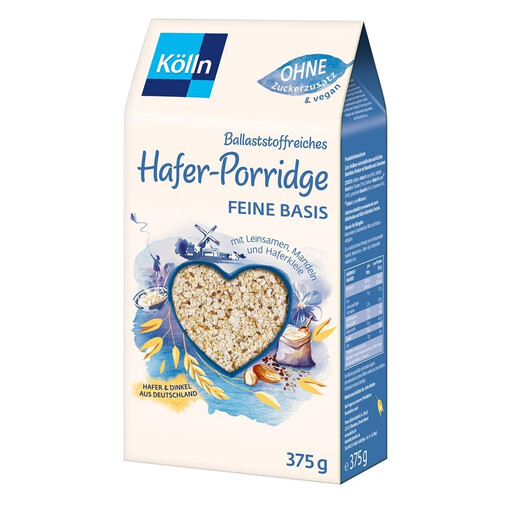 No image available
An oat porridge for you to prepare with your own choice of additional ingredients. Before buying, compare the sugar information and allergen labelling on the specific pack.
 No image available
Fine oats for anyone who wants to put together their own porridge and choose the type of oats carefully. The product description states that the pack contains 500 g; check the ingredients and nutritional information for the way you plan to prepare them.
 No image available
Coarse oats for anyone looking for a plain base to season themselves. Before buying, check the pack size against the information on the pack and, if needed, check the allergen labelling.
No. According to the German Food Federation, ‘no added sugar’ excludes added sugars and other sweetening substances, but not sugars that occur naturally in the ingredients. Check ‘of which sugars’ in the nutritional information for the total amount.
A plain oat base lets you choose how to season it for a savoury dish. Seitenbacher, for example, describes porridge made with stock and vegetables. Before using a ready-made mix, check whether dried fruit, chocolate or other sweet ingredients will work with your meal.
No. Seitenbacher lists 30 g of protein for its Protein Porridge Chocolate, but also 19 g of sugar per 100 g. Compare both figures separately for each variety.
Check the ingredients and allergen information for the specific variety. Kölln Feine Basis contains oats, spelt and almonds; possible traces of peanuts, milk, tree nuts, mustard, sesame and soya, among other allergens, are listed for EDEKA Herzstücke Haferhimmel Porridge Beeren.