Organisers who need a no-added-sugar option
You’re looking for rusks with the relevant claim for your conference, but still want to check the sugar content per 100 g and how many portions you’ll need.


If you specifically need rusks without added sugar for a conference break, look for that claim and check the sugar content per 100 g too. Brandt Original Rusks without added sugar, listed by REWE, contain 4.5 g of sugar per 100 g. If lactose-free is your priority, the lactose-free Brandt variety listed by Combi may be suitable. It is described as containing 30% less sugar than classic Brandt Original Rusks, but has 9.3 g of sugar per 100 g. You’ll also need to take account of the allergens in the variety you actually serve.
You’re looking for rusks with the relevant claim for your conference, but still want to check the sugar content per 100 g and how many portions you’ll need.
You need to distinguish a lactose-free option from one that simply has less sugar, and check for other allergens against your guest list.
If you’re serving rusks at a buffet or as part of a dish, you’ll need to make allergen information for the product actually being served accessible. The Federal Ministry of Agriculture, Food and Home Affairs highlights the need to label the 14 major allergens.
First, establish whether “without added sugar” or lactose-free is a firm requirement. Then compare the nutritional information and plan for allergen queries and portions based on how you’ll serve the rusks.
| Criterion | What to check | Who it matters to |
|---|---|---|
| Sugar content | Check the claim against the “of which sugars” figure per 100 g. “Without added sugar” does not mean “sugar-free”. | If I need to meet a no-added-sugar requirement, a general claim of “less sugar” isn’t enough. Around 33% of consumers prioritise this requirement. |
| Allergens | Check the ingredients and allergen information on the pack you buy, and make it accessible for the way you plan to serve the product. | For an open buffet, I want to be able to answer questions about the allergens in the food; around 27% of consumers put this first. |
| Lactose-free | Check the lactose-free claim on the specific variety and consider any other allergens separately. | If my guest list requires a lactose-free option, rusks with reduced sugar alone aren’t enough. Around 20% of consumers prioritise this requirement. |
| Portioning | Compare the number of slices or portions in the pack with your planned guest numbers and serving arrangements. | If I’m catering for a large number of guests during the break, I need to plan how much to buy and how to serve it efficiently. Around 20% of consumers prioritise this. |
A product with this claim can still contain sugar: REWE lists Brandt Original Rusks without added sugar as containing 4.5 g of sugar per 100 g.
As well as checking the claim, read the “of which sugars” line in the nutritional information.
The lactose-free Brandt variety listed by Combi contains wheat and soya; the lactose-free claim doesn’t tell you whether these ingredients are present.
Check the latest ingredients and allergen information for each variety you plan to serve against your guests’ requirements.
“30% less sugar” compares sugar content; it doesn’t mean the product is sugar-free or that all carbohydrates have been reduced by the same amount. Lebensmittelklarheit explains that the claim is based on a comparison with similar foods.
Also check the sugar content per 100 g for the specific variety you’re buying.
When food is served unpackaged, guests must be able to access information about the relevant allergens. The Federal Ministry of Agriculture, Food and Home Affairs lists the 14 major allergens.
Before serving, record the information from the packs you’re actually using and keep it to hand in case guests have questions.
Two different Brandt varieties are relevant here: Original Rusks without added sugar, and lactose-free Original Rusks with a relative sugar-reduction claim.
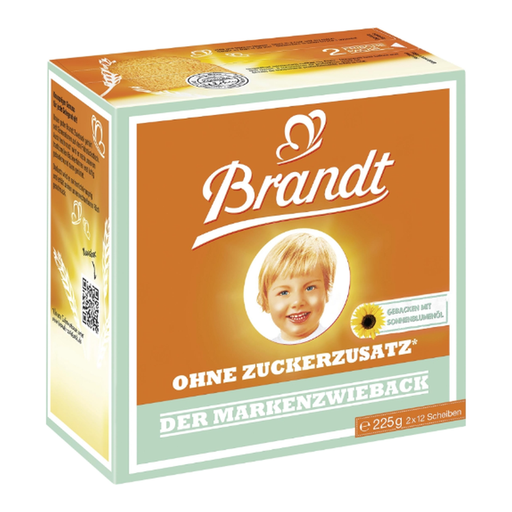
This selection features Brandt Wholegrain Rusks without added sugar for your conference break. They’re not the same as the Brandt Original Rusks mentioned above, so check their own pack for sugar content, portions and allergens.
 No image available
This wheat-based wholegrain variety could be suitable for a conference break where no added sugar is required. For your quantity and allergen planning, check the sugar content per 100 g, the number of slices, and the ingredients and allergen information on the specific pack. Store in a cool, dry place.
No. REWE lists the Brandt Original Rusks without added sugar sold there as containing 4.5 g of sugar per 100 g. Check the “of which sugars” figure on the variety you actually buy.
It means the sugar content is at least 30% lower than that of similar foods; it doesn’t mean the product is sugar-free. Lebensmittelklarheit explains the basis for this comparison. For your choice, the specific sugar content per 100 g still matters.
Not on the basis of the lactose-free claim alone. Wheat and soya are listed for the lactose-free Brandt variety sold by Combi; check the ingredients and allergen information for the product you plan to serve.
When food is served unpackaged, guests must be able to identify the relevant major allergens. The Federal Ministry of Agriculture, Food and Home Affairs lists the 14 major allergens; check the information on the packs you’re using before serving.
Check the best-before date and storage instructions on the packs you’ve bought, and work out how much you need from the stated number of slices or portions. The Brandt varieties described here should be stored in a cool, dry place.