
Lieferung heute & morgen

Qualitätsgarantie

Willkommens-Angebote freischalten: KOSTENLOSE Lieferung | Bis zu 80 % RABATT | Kostenlose 30-Tage-JoyPlus-Testphase
App herunterladen
A TV lowboard is often the visual centerpiece of the living room. It not only supports the television but also significantly defines the style of the space. However, the selection is vast, and not every model that looks good at first glance proves practical in daily use. Before you make a decision, it's helpful to understand the common pitfalls that often only become apparent after the purchase.
As a Joybuy Product Recommendation Officer, I analyse product data to provide you with objective criteria for your selection. This guide focuses on the three most common problems with TV furniture and shows you what to look out for.
To avoid these pitfalls, you should focus on a few core technical specifications. These objective criteria will help you evaluate the durability and functionality of a TV lowboard.
The choice of material is crucial for stability. Common options include:
Pay close attention to the specified maximum static load capacity of the top panel. This should be significantly higher than the weight of your television. For a TV stand for a 65-inch TV, which often weighs between 20 and 30 kg, a load capacity of at least 40-50 kg provides a sensible safety margin, especially if other devices will be placed on the board.
The type of installation affects not only the look but also the requirements of your living space.
Modern features can significantly enhance user convenience.
Based on these objective criteria, we have identified several models that offer a suitable solution for different user profiles and requirements.

Why This Fits Their Persona: Ideal for users who prefer a minimalist and clean aesthetic. The wall-mounted design creates a floating look that makes the room feel larger and more airy.
Stability depends on proper wall installation, thus bypassing the typical weakness of a wobbly freestanding unit. The closed front completely conceals cables and devices.
Maximises free floor space and simplifies cleaning. The UV-coated door surface is durable and easy to maintain.
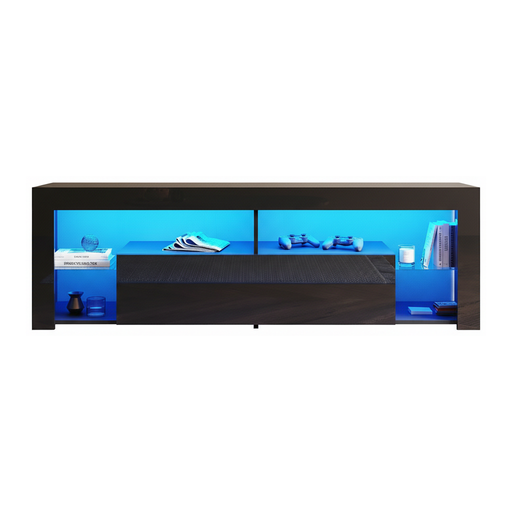
Why This Fits Their Persona: Designed for large screens and extensive media equipment. This black living room cabinet with high-gloss elements and integrated LED lighting creates a modern entertainment hub.
The model is explicitly designed for TVs up to 65 inches and offers reliable stability with its freestanding construction. Open compartments and a drawer allow for organised storage of devices and accessories.
Integrated LED lighting with 16 colour options. A combination of open glass shelves and a closed drawer provides flexible storage.

Why This Fits Their Persona: A versatile solution for those seeking a durable and multi-functional piece of furniture. It can serve as a TV table, a sideboard in the dining room, or a storage cabinet in the office.
The steel construction offers high stability and a maximum static load capacity of 50 kg for the top surface, minimising the risk of sagging. Its simple design is timeless and less susceptible to short-lived trends.
Extremely versatile in its use. The steel construction is moisture-resistant and very easy to clean. An adjustable shelf allows for flexible storage customisation.
We have compiled a complete, up-to-date list of products that fully meet these strict selection criteria and all relevant safety regulations.
The ideal height depends on your seating height and the size of your TV. As a rule of thumb, the centre of the TV screen should be roughly at eye level when you are sitting on the sofa. For most living rooms, this means a total height (lowboard + TV stand base) of about 90 to 120 cm from the floor. A lowboard itself, therefore, typically has a height between 30 and 50 cm.
No. A wall-mounted TV board requires a solid, load-bearing wall made of concrete, solid brick, or sand-lime brick. Special caution is needed with drywall or other partition walls. Here, special hollow-wall anchors must be used, and the total weight (board + TV + contents) must not exceed the wall's load limit. When in doubt, a professional should assess the wall's suitability.
A high-gloss TV cabinet surface requires gentle care to avoid scratches. For cleaning, use a soft, lint-free cloth (e.g., microfibre) lightly dampened with water. Absolutely avoid abrasive cleaners, harsh chemicals, or rough sponges. Dust is best removed with an anti-static duster.