Shoppers with a firm fat limit
You want to add only cereal bars to your weekly shop that stay within a set fat limit per 100 g. The nutrition table is what matters here, not the product name.


When doing your weekly shop, compare the fat content of similar cereal bars per 100 g rather than relying on terms such as “light”. For solid foods to be labelled “low fat”, the Verbraucherzentrale sets a limit of no more than 3 g of fat per 100 g. A bar with less fat than a comparable variety may still exceed this limit. If sugar or allergens matter to your choice, check the relevant information on the specific pack too.
You want to add only cereal bars to your weekly shop that stay within a set fat limit per 100 g. The nutrition table is what matters here, not the product name.
You buy bars to keep in stock and want to find a lower-fat option among similar varieties, even if it does not meet the “low fat” threshold.
You consider sugar, sweeteners or allergens as well as fat. In that case, one nutritional value alone is not enough to make your choice.
First decide whether you need to stay below a set fat limit or simply want to compare similar varieties. Then check any other details that matter for your weekly supplies.
| Criterion | What to check | Who it matters to |
|---|---|---|
| Set fat limit | Check the fat content per 100 g. For solid foods to be labelled “low fat”, the Verbraucherzentrale sets a limit of no more than 3 g per 100 g. | If I’m only considering bars below a set fat limit, I’ll rule out varieties above it. Around 36% of consumers would prioritise this limit. |
| Similar varieties | Compare the fat and saturated fat content per 100 g of similar cereal bars. | I want to find a lower-fat option for my cupboard without automatically classifying it as “low fat”. Around 29% of consumers would put this comparison first. |
| Ingredients and allergens | Check the sugar content per 100 g, ingredients list and allergen labelling for the specific variety. | If sugar or particular ingredients have more influence on my choice, I don’t want to infer them from the fat content. For around 21% of consumers, this information would come first. |
| Pack size | Check the total weight, as well as the number and size of the individual bars. | The pack needs to contain the right number of bars for my weekly supplies. Around 14% of consumers would focus primarily on planning the quantity they need. |
Terms in a product name do not replace the fat information. ALDI SÜD lists 9.4 g of fat per 100 g for CORNY Schoko light, which is above the low-fat limit given by the Verbraucherzentrale.
Check the fat line in the nutrition information per 100 g for each variety.
A sugar-related claim does not answer the question of fat content. EDEKA lists 9.1 g of fat per 100 g for GUT&GÜNSTIG Müsliriegel Schoko ohne Zuckerzusatz.
Compare sugar and fat separately, and check saturated fat too if relevant.
Recipes vary even within the same brand. ALDI SÜD lists 24.7 g of fat per 100 g for a GOLDEN BRIDGE peanut cereal bar. Allergen information also needs to match the specific variety.
When planning your weekly supplies, check the nutrition information and ingredients on the specific pack.
CORNY offers a range of cereal bars, making it easy to compare varieties within the brand.
You can compare the nutrition information for two chocolate cereal bars from this EDEKA own-label range.
This own-label range also includes cereal bars. The fat content of each individual variety is what matters when making your choice.
These CORNY bars are worth considering when comparing varieties and pack sizes for your weekly shop. Don’t assume they are “low fat” based on their names alone; check the nutrition information on each pack.
 No image available
If you choose this variety for your weekly supplies, compare the fat content on the pack with your limit; the stated values are above the “low fat” threshold.
The product title gives the pack size as 4 × 35 g, while another quantity detail differs. Check the pack contents before buying.
 No image available
You can include the individual bars when putting together your weekly supplies. Based on the stated values, this variety is not suitable if you’re sticking to a strict fat limit and looking for a “low fat” option.
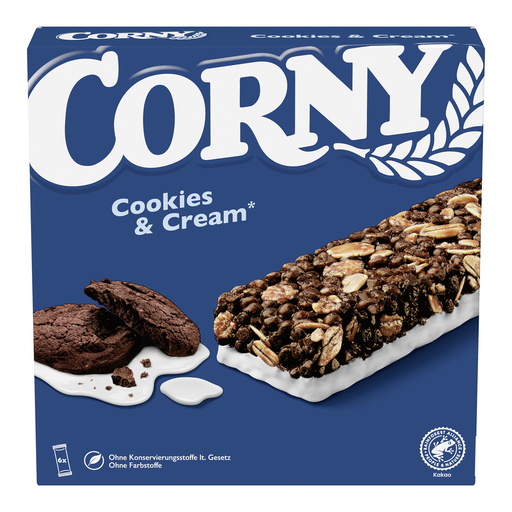
The product title gives the pack size as 6 × 23 g. If allergens matter to your choice, check the labelling on the specific pack.
For solid foods to be labelled “low fat”, the Verbraucherzentrale sets a limit of no more than 3 g of fat per 100 g. Having less fat than another variety is not enough on its own to qualify for this claim.
No. The claim does not tell you about the fat content. EDEKA lists 9.1 g of fat per 100 g for GUT&GÜNSTIG Schoko ohne Zuckerzusatz, so compare fat and sugar separately.
For comparing cereal bars of different sizes, start with the values per 100 g. The Lebensmittelverband Deutschland describes these as a common basis for comparing nutrition values; you can then take the weight of an individual bar into account.
Check the ingredients list and highlighted allergens for the specific variety. The Lebensmittelverband Deutschland distinguishes declared ingredients from voluntary “may contain” warnings: these warnings indicate possible accidental traces, not necessarily an ingredient in the product.