When choosing a cereal bar for a school break, a lower fat content alone isn’t enough to go on. Compare fat, sugar and energy per 100 g, and check the size of the bar in its wrapper. Depending on what you’ve had for breakfast, it may be better viewed as one part of a snack; the ingredients and allergen information must also suit the person eating it.
Who is this comparison for?
Shoppers focusing on fat content
If you’re packing a cereal bar for a school break, the fat content per 100 g can help you compare similar varieties. A word like “light” on the front of the pack is no substitute for checking the nutrition information.
Families planning the whole break
For these families, sugar, ingredients and the size of each bar matter too. The German Nutrition Society considers snacks in the context of breakfast, and also includes fruit or vegetables as part of food brought in for a school break.
Families managing allergies
If you need to avoid cereals containing gluten or other allergens, check the ingredients list and highlighted allergen information on the specific pack. Fat content doesn’t determine whether a bar is suitable for someone with these needs.
What should you look for when buying?
Start by comparing the nutrition information per 100 g for similar cereal bars, then check the individual portion. If allergens are relevant, checking the labelling on the specific pack is a separate and essential step.
| What to check |
What to look for |
Who it matters most to |
| Fat content |
Compare fat and saturated fat per 100 g across similar bars, and check the information on the current pack. |
I mainly want to choose a bar with a lower fat content rather than relying on “light”. For around 45% of shoppers, this comparison of fat content comes first. |
| Sugar, ingredients and portion size |
Check sugar and energy per 100 g alongside the ingredients list and the weight of each bar. |
I want to know what else is going into the school-break bag and how the variety fits with breakfast. Around 36% of shoppers prioritise looking at the overall picture. |
| Gluten and other allergens |
Check the ingredients list and highlighted allergen information on the pack you’re actually buying. |
If an allergen needs to be avoided, the labelling on the specific pack determines whether it’s suitable. For around 19% of shoppers, this check is their top priority. |
Common mistakes when buying cereal bars
-
Assuming “light” tells you everything about the bar
A lower fat content on its own tells you nothing about sugar, energy or ingredients. For the varieties listed by EDEKA24, Corny Schoko contains 17.6 g of fat and 34 g of sugar per 100 g, while Alnatura Ahorn-Dattel contains 9.7 g of fat and 23 g of sugar per 100 g. These figures relate to two specific products; they’re not a verdict on every bar from either brand.
Compare fat, sugar and energy per 100 g. Then check the weight of an individual bar and the ingredients it contains.
-
Confusing “no chocolate” or “organic” with gluten-free
Despite containing no chocolate, the Alnatura Bio Müsli-Riegel Ahorn-Dattel described by EDEKA24 contains oats, barley malt flour and wheat flour. So the wording on the front of the pack doesn’t tell you whether it’s gluten-free.
If you need to avoid gluten, look for suitable gluten-free labelling and check the ingredients and allergen information on the specific pack.
-
Planning for the bar to be the whole snack
The German Nutrition Society considers snacks in relation to breakfast and includes foods such as fruit or vegetables among the options for a school break. A cereal bar on its own won’t necessarily provide all of these.
Plan what to pack based on breakfast, and add something such as fruit and a drink alongside the bar if needed.
-
Assuming online nutrition information applies to every pack
ALDI SÜD notes that different suppliers may provide different nutrition information for its GOLDEN-BRIDGE cereal bar.
Use online product information to narrow down your options, then check the nutrition information and ingredients on the specific pack before buying.
Cereal bar brands to help guide your choice
The information below relates to specific varieties and can help you compare their labelling. It isn’t a general assessment of the brands as a whole.
Corny
The Corny varieties considered here include a classic chocolate cereal bar and a banana and vanilla-flavoured protein bar.
- EDEKA24 lists Corny Schoko as containing 17.6 g of fat and 34 g of sugar per 100 g; Corny Protein Banane-Vanille contains 16.9 g of fat, 1.1 g of sugar and 24.4 g of protein per 100 g.
- Here, the sugar content alone doesn’t indicate a similarly lower fat content. The ingredients listed for both varieties contain cereals with gluten.
GOLDEN BRIDGE
The Schoko light variety sold by ALDI SÜD provides specific pack information for comparing fat content.
- ALDI SÜD lists GOLDEN BRIDGE Schoko light as containing 10 g of fat and less than 1.5 g of sugar per 100 g.
- ALDI SÜD notes that nutrition information may vary between suppliers. The labelling on the pack you buy is the one to rely on.
Alnatura
The Bio Müsli-Riegel Ahorn-Dattel considered here is a variety without chocolate, described by EDEKA24.
- EDEKA24 lists this variety as containing 9.7 g of fat per 100 g, and mentions oats and dates in its description.
- The same bar is listed as containing 23 g of sugar per 100 g. Its ingredients also include cereals containing gluten, so “organic” and “no chocolate” are no substitute for checking the labelling.
Cereal bars to compare by fat content at Joybuy
These Corny bars are worth considering when comparing individually portioned snacks. Check the nutrition information on each pack before deciding: pack size alone won’t tell you the fat content or what makes up the whole school-break snack.
 No image available
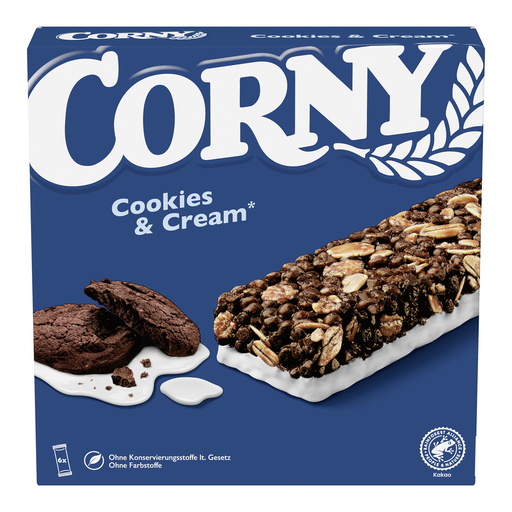
Corny Cookies & Cream Cereal Sandwich Bars, 6 × 23 g
These individually sized bars can be included as part of a school-break snack. The product name specifies six bars weighing 23 g each; check the pack for fat, sugar and energy per 100 g, as well as the ingredients and allergen information.
View at Joybuy
 No image available
Corny Free Chocolate No Added Sugar Cereal Bars, 6 × 20 g
The product name specifies six smaller bars, each weighing 20 g. Don’t judge this variety on “No Added Sugar” alone: check the fat, sugar and energy information, and if needed, look at the ingredients and any sweetener and allergen information on the pack.
View at Joybuy
 No image available
Corny Free White Chocolate No Added Sugar Cereal Bars, 6 × 20 g
This variety is an option if you’re looking for an individual bar for a school break from a pack of six, with each bar weighing 20 g. “No Added Sugar” doesn’t mean sugar-free: check the sugar and fat content per 100 g, and if you need to avoid allergens, check the current ingredients list.
View at Joybuy
 No image available
Corny Haferkraft Zero Cocoa Cereal Bars
This bar can be included when comparing nutrition information per 100 g. Check the specific pack for the number of bars and the weight of each one before planning a portion for a school break. Also check the ingredients, allergens and any sweetener information.
View at Joybuy
Frequently asked questions about school break times
Does “reduced fat” also mean “low fat” or “low calorie”?
No. “Reduced fat” describes a comparison of fat content; it doesn’t automatically mean the product is low in fat or energy overall. So compare the nutrition information per 100 g and bear in mind the size of the bar you’re actually packing.
Is one cereal bar enough for a snack at secondary school?
A cereal bar can be part of a snack, but it doesn’t have to be the whole thing. The German Nutrition Society considers the size of a snack in relation to breakfast and also includes fruit or vegetables; so remember to plan the other parts of the break-time meal too.
How can I tell whether a cereal bar contains cereals with gluten?
Read the ingredients list and the highlighted allergen information on the specific pack. The Federal Ministry of Agriculture, Food and Regional Identity explains that ingredients which can cause allergies or intolerances must be highlighted in the ingredients list on packaged foods. Cereals containing gluten include wheat and barley, for example; if needed, also check whether the product is suitable for a gluten-free diet.
Does the nutrition information for a supermarket own-brand product always stay the same?
Not necessarily: ALDI SÜD notes that different suppliers may provide different nutrition information for the GOLDEN-BRIDGE bar described here. So when you buy it, rely on the labelling on the pack in front of you.


