People comparing sugar levels
You want to know how much sugar a product contains overall. To do this, compare the nutrition information per 100 g and distinguish between ‘no added sugar’ and the actual total sugars figure.


When choosing porridge with sugar and portion size in mind, start with the total sugars per 100 g and the amount you actually prepare – not the words ‘no added sugar’. Plain oats let you choose your own ingredients; with ready-made fruit or protein mixes, you should also compare the ingredients list and the other nutritional values.
You want to know how much sugar a product contains overall. To do this, compare the nutrition information per 100 g and distinguish between ‘no added sugar’ and the actual total sugars figure.
You want to take the dry amount, as well as milk, plant-based drinks and extras, into account when planning your meal. The information on the pack is a starting point for working out how much you actually use.
You might be looking for a ready-made flavour or paying extra attention to the protein content. Either way, sugar, energy and the ingredients in the specific mix are still important points to compare.
First decide whether you want to add your own ingredients to a plain oat base or use a ready-made mix. Then compare the nutrition information on the same basis and plan how much you’ll put in your bowl.
| Criterion | What to check | Who it matters to |
|---|---|---|
| Total sugars | Compare ‘of which sugars’ per 100 g and the ingredients list; don’t assume that ‘no added sugar’ means a low total sugars figure. | If the sugar content matters more to me than flavour or protein, I need a comparable figure on the pack. Total sugars are the top priority for around 33% of consumers. |
| Portion and energy | Use the energy per 100 g to work out the amount for your dry portion, and take the liquid used to prepare it and any extras into account. | For the meal I’m planning, what ends up in the bowl – including milk or toppings – matters. Portion planning is the main concern for around 33% of consumers. |
| Plain oat base | Check the ingredients and stated wholegrain content of the specific variety; add your own extras in the amounts you choose. | I’d rather choose the sweet ingredients myself than use a ready-made fruit mix. That’s why around 20% of consumers prefer to start with a plain base. |
| Flavour or protein | For ready-made mixes, compare sugars, energy and, where relevant, protein per 100 g; check the ingredients and allergens too. | If I need something quick in the morning or want to compare protein content, I shouldn’t overlook the rest of the nutrition table. This is the main priority for around 14% of consumers. |
Ingredients such as dried fruit also contribute to the stated total sugars. Despite being labelled ‘no added sugar’, Seitenbacher Fruit Porridge contains 19 g of sugars per 100 g, according to the manufacturer.
Compare the ‘of which sugars’ figure per 100 g, then check the amount in your portion.
A prominent protein claim doesn’t tell you how much sugar or energy the mix contains. The consumer advice centre recommends checking the nutrition table even when a product makes claims like these.
If extra protein matters to you, compare protein, sugars and energy on the same basis.
Milk, plant-based drinks, syrup, nuts and dried fruit change the nutritional values of your finished bowl. Seitenbacher says that porridge made with water is less creamy and flavourful than porridge made with milk.
Decide on your dry amount, liquid and any extras before you prepare your porridge.
Kölln Oat Porridge with Nuts contains hazelnuts and may contain other tree nuts, milk and peanuts, according to Kölln. This information applies to this variety and not automatically to other Kölln products.
If you have an allergy, check the labelling on the specific pack.
Kölln offers a range of porridge mixes. The ingredients and nutritional values to consider depend on the variety.
Seitenbacher offers a choice of plain oat options and ready-made fruit and protein mixes.
REWE’s range includes own-brand plain and berry porridge, among other options.
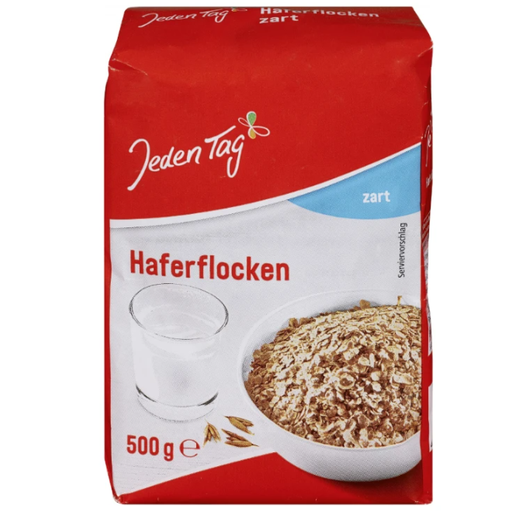
These oats could work well as a base if you want to choose the liquid, portion size and other ingredients yourself. Descriptions such as ‘coarse’, ‘fine’ and ‘finely milled’ help you choose the type of oats you want; to compare nutritional values, check the pack for the specific variety.
 No image available
A coarse oat base for making porridge with your own choice of ingredients. Check the pack details to work out how much to use for your planned portion.
 No image available
A fine oat base for making porridge your way. Compare the nutrition information for these oats and choose a dry amount to suit your meal.
 No image available
Finely milled oats for a base you can customise with your own porridge toppings. The pack contains 400 g; for an individual meal, it’s the amount you use that counts.
 No image available
An oat base for making porridge your way, if you’re looking for fine oats. Before choosing, check the product type on the pack: the details about oats and wholegrain oat flour are unclear.
No. Porridge can contain sugars from its ingredients, such as dried fruit, even if no sugar has been added. So compare ‘of which sugars’ per 100 g rather than assuming the total sugars content from the front-of-pack label.
Start by comparing ‘of which sugars’ per 100 g on the same basis. The ingredients list and the dry portion you plan to use will then help you decide which mix suits the way you prepare your porridge. The consumer advice centre recommends checking prominent nutrition claims against the nutrition table.
No. Wholegrain content is one feature of a particular variety, while the amount you use, the liquid and any extras all affect the finished meal. Compare the sugars and energy in the mix too, and take into account anything you add yourself.
It applies to your overall diet, not to a fixed limit for one bowl of porridge. The German Nutrition Society, together with other professional organisations, gives general advice to get less than 10% of your total energy intake from free sugars. When comparing products, you still need to check the ingredients and nutrition information for the specific mix.