People who check the sugar content
You want to buy rusks for your afternoon coffee without relying solely on the claim “no added sugar”. Compare the “of which sugars” value per 100 g as well.


If you’re looking for rusks with less sugar to enjoy with your afternoon coffee, compare the “of which sugars” value per 100 g and check the ingredients list too. Three variants described by REWE as having no added sugar have declared values ranging from 1.8 g to 4.5 g per 100 g; wholegrain content, salt and allergens are separate factors to consider. If you have a specific dietary requirement or difficulty swallowing, follow the advice of your healthcare professional rather than relying on general product recommendations.
You want to buy rusks for your afternoon coffee without relying solely on the claim “no added sugar”. Compare the “of which sugars” value per 100 g as well.
As well as the sugar content, you take account of the type of grain, fibre, salt and the ingredients list. If you follow a particular diet, check the labelling on the specific pack.
If you’re buying rusks for an older person with allergies, difficulty swallowing or a medically adapted diet, check that they meet the agreed requirements before comparing sugar values.
Start by comparing the declared sugar content per 100 g. Then check the other nutritional information and ingredients, as well as any individual dietary requirements.
| Criterion | What to check when buying | Who it matters most to |
|---|---|---|
| Sugar content | “Of which sugars” per 100 g and the ingredients list; don’t assume “no added sugar” means “sugar-free”. | If I want rusks with less sugar, I need a comparable value rather than just a claim on the pack. Around 50% of consumers prioritise this sugar value when buying. |
| Wholegrain and other nutritional values | Type of grain, fibre and salt per 100 g; check claims for the specific variant only. | I also want the type of grain to suit me with my afternoon coffee, and I don’t want to overlook the other nutritional values. For around 30% of consumers, this ingredients and nutrition profile is the top priority. |
| Suitability and dietary requirements | Allergen labelling on the pack and, where relevant, any individually agreed dietary or food-texture requirements. | If I’m shopping for someone with an allergy or a special diet, the product must meet those requirements first. This suitability is the main criterion for around 20% of consumers. |
Rusks with no added sugar can still contain sugar. REWE lists values of 1.8 g to 4.5 g of sugar per 100 g for three variants labelled accordingly.
Compare the “of which sugars” line in the nutritional information on each pack.
The sugar value alone tells you nothing about the other nutritional values or ingredients. For Sommer Bio Demeter Wholegrain Rusks, REWE lists 1.2 g of salt per 100 g alongside 2.4 g of sugar; the product contains wheat.
Read the full nutritional information and ingredients list before making your choice.
Holle Organic Spelt Baby Rusks are sold as a baby product. That classification and its sugar content don’t tell you whether it’s suitable for an individually adapted diet or for someone with chewing or swallowing difficulties.
If there are specific requirements, follow the agreed dietary guidance and seek professional advice if needed.
The Markenzwieback variant with no added sugar may suit people looking for a classic rusk with this labelling.
Bio Demeter Wholegrain Rusks combine the “no added sugar” claim with wholemeal wheat flour as the main ingredient.
Bio Spelt Baby Rusks are sold as a baby product and have no added sugar; they aren’t specifically marketed as a choice for older people.
This selection features a wholegrain rusk whose product name states “no added sugar” and which, according to its description, is offered as a snack to enjoy with coffee. To compare the actual sugar content, check the nutritional information on the specific pack.
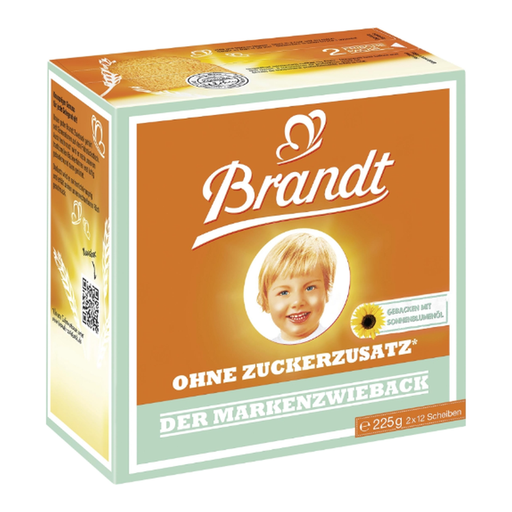 No image available
The product description recommends these rusks as a snack to enjoy with coffee. The name highlights wholegrain and “no added sugar”; check the nutritional information and ingredients on the specific pack to help you decide.
No. “No added sugar” refers to added ingredients, not the total sugar content of the rusks. So check the “of which sugars” value per 100 g in the nutritional information too.
The claim alone doesn’t tell you how many grams of sugar there are per 100 g. When deciding what to buy, compare the nutritional information for the specific products using the same serving basis, and check the ingredients list.
No. The sugar value alone doesn’t answer questions about an individually prescribed diet or the required food texture. If you have specific requirements, follow the advice of your healthcare professional.
Always check the labelling on the pack you buy: REWE lists wheat and soya for Brandt Markenzwieback with no added sugar, wheat for Sommer Bio Demeter Wholegrain Rusks, and a type of wheat for Holle Bio Spelt Baby Rusks. Possible traces also vary by variant.