Guests who want to avoid added sugar
Look for a recipe that is clearly labelled accordingly. Still check the sugar content in the nutritional information: ‘no added sugar’ does not mean that the rusks contain no sugar.


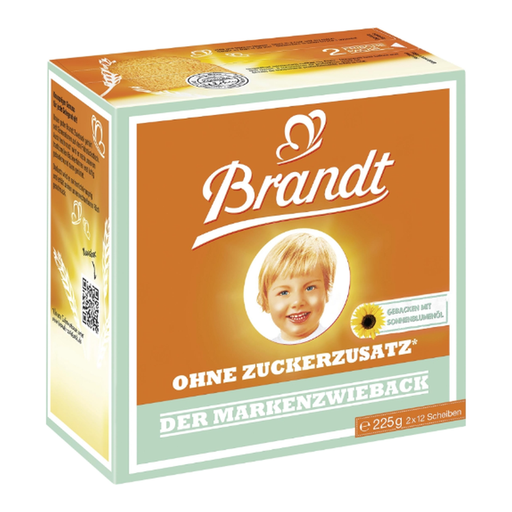
If you’re looking for rusks to enjoy with coffee in your hotel room, with no added sugar and a low declared sugar content as priorities, Brandt Markenzwieback without added sugar is worth considering: REWE lists this variety as containing 4.5 g of sugar per 100 g. If you specifically need lactose-free rusks, you could look at the clearly labelled lactose-free Brandt variety; Müller lists it as containing 9.3 g of sugar per 100 g. Both varieties contain wheat and soya, and ‘no added sugar’ does not mean ‘sugar-free’.
Look for a recipe that is clearly labelled accordingly. Still check the sugar content in the nutritional information: ‘no added sugar’ does not mean that the rusks contain no sugar.
A variety clearly labelled lactose-free is essential to your choice. You’ll need to compare the sugar content separately: Müller lists Brandt Markenzwieback lactose-free as containing 9.3 g of sugar per 100 g.
If guests only need a few slices per hotel room, individually wrapped packs and dry storage are important. The 225 g pack of Brandt Markenzwieback without added sugar listed by REWE is split into two inner packs, each containing twelve slices.
When choosing rusks to serve with coffee, first compare the sugar content per 100 g and the recipe you want. Then consider your guests’ requirements and how you plan to portion them to decide which pack is right for you.
| Criteria | What to check | Who it matters most to |
|---|---|---|
| Sugar and recipe | Check the ‘no added sugar’ claim, ingredients list and ‘of which sugars’ figure per 100 g together. REWE lists Brandt Markenzwieback without added sugar as containing 4.5 g per 100 g. | If I don’t want to offer added sugar with coffee, I still want to be able to check the declared sugar content. Around 50% of consumers would make this a priority when deciding what to buy. |
| Lactose and allergens | Check the specific pack for its lactose-free label, ingredients and allergen information; lactose-free does not mean gluten-free or allergen-free. | For guests with specific dietary requirements, the chosen variety must be labelled accordingly. Around 30% of consumers would prioritise this check. |
| Portioning and storage | Check the inner packs, number of slices and storage instructions against how much will be used per room. REWE lists the 225 g pack without added sugar as containing two inner packs of twelve slices each. | If rusks are only put out occasionally, I don’t want to open a large pack for every serving. Around 20% of consumers would focus mainly on portioning. |
These claims do not mean the same thing. Brandt Markenzwieback without added sugar, as listed by REWE, still contains 4.5 g of sugar per 100 g.
As well as checking the recipe claim, always read the ‘of which sugars’ line in the nutritional information.
The lactose-free Brandt variety described by Müller contains wheat and soya. The variety without added sugar listed by REWE also contains wheat and soya, and may contain traces of other allergens.
Check the ingredients and allergen information on the actual pack you buy for the guests you’re catering for, rather than assuming it will be suitable for everyone.
A larger pack does not tell you how much sugar it contains or whether it can be split into portions for individual rooms. ALDI SÜD lists GOLDÄHREN rusks in a 450 g pack as containing 14 g of sugar per 100 g, and notes that product information may vary by supplier.
Compare the sugar content per 100 g and the inner packs with the amount you expect to need per room.
The Brandt rusk varieties compared here have different features: no added sugar or a clearly labelled lactose-free recipe.
The 450 g pack of rusks listed by ALDI SÜD is included here as a comparison for pack size, not as a lower-sugar option.
A wholemeal rusk labelled ‘no added sugar’ is listed here to serve with coffee in a hotel room. Check its sugar content and inner packaging on the specific pack; the nutritional information for the Brandt Markenzwieback variety mentioned above does not automatically apply to this product.
 No image available
Worth considering as rusks without added sugar to serve with coffee. Before serving, compare the sugar content per 100 g, the inner packaging, and the ingredients and allergen information on the specific pack.
No. ‘No added sugar’ does not mean that the product contains no sugar. REWE lists Brandt Markenzwieback without added sugar as containing 4.5 g of sugar per 100 g; check the figure separately for every other variety.
No, you can’t determine the energy content from the sugar figure alone. Compare the nutritional information per 100 g for the specific products and, if needed, the amount per portion.
A lactose-free label does not cover other dietary requirements. The lactose-free Brandt variety described by Müller contains wheat and soya; use the ingredients and allergen information on the pack you buy to guide your choice.
Follow the storage instructions on the pack and keep the rusks dry. If you only need a few slices per room, separate inner packs can avoid having to open the whole supply every time you serve them.