For hosts who want to control the sweetness
You want to limit the added sugar in the batter and let guests choose their own sweet toppings. For packaged waffles, compare the sugar content per 100 g and check whether fruit or sweeteners are used.


If you want to control the amount of added table sugar in the batter and let guests choose how sweet their toppings are, you can make waffles with apple purée and serve the toppings separately. They will still contain sugars from the fruit ingredients. When choosing packaged waffles, check the sugar content per 100 g, the ingredients list and the allergen information. For low-carb recipes, it’s also worth checking the fat content and which sweeteners are used.
You want to limit the added sugar in the batter and let guests choose their own sweet toppings. For packaged waffles, compare the sugar content per 100 g and check whether fruit or sweeteners are used.
Some guests may only be able to eat certain ingredients. Check the recipe and toppings separately: information about sugar content doesn’t tell you whether something is suitable for vegans, or whether it contains lactose or allergens.
You want to plan the batter, serving and toppings so guests can customise their waffles. For recipes, check the number of portions and preparation time. Serving toppings separately lets everyone choose right up until serving.
Making dessert waffles at home gives you control over the batter and toppings, while packaged waffles can be compared by their ingredients and nutritional information. A reduced-carb recipe, however, doesn’t automatically tell you about its fat content or allergens.
A good choice if: You want to control the added table sugar in the batter and choose the toppings yourself.
Keep in mind: Apple purée still contains sugar; other ingredients will depend on the recipe.
A good choice if: You want to bring waffles along and compare nutritional information and ingredients before buying.
Keep in mind: Claims on the front of the pack are no substitute for checking the sugar content per 100 g and looking for allergens.
A good choice if: The carbohydrate content of a particular recipe is your main concern.
Keep in mind: EDEKA’s low-carb recipe contains nuts, dairy products and eggs. EDEKA states that it has 75 g of fat per portion.
| What matters | What to check when buying | Who it matters to |
|---|---|---|
| Sugar and sweetening | For packaged waffles, compare sugar per 100 g; check the ingredients and which sweeteners are used. | I want to assess how sweet the waffles are without assuming that fruit ingredients or sugar substitutes mean they’re “sugar-free”. For around 50% of consumers, the type of sweetener is a priority. |
| Ingredients for guests | Check the ingredients and allergen information for the waffles and toppings separately. For homemade options, also consider how they’re prepared. | If guests need to avoid certain ingredients, I need to choose waffles and toppings that are suitable for them. Around 30% of consumers prioritise this suitability for their guests. |
| Serving and toppings | For recipes, check the number of portions and preparation time; plan the toppings separately. | For my garden party, I want to serve several portions without deciding how sweet everyone’s waffles should be. Serving plans are the main concern for around 20% of consumers. |
Waffles with no added sugar may still contain sugar from ingredients such as fruit purée. The two claims don’t mean the same thing.
For packaged waffles, compare the sugar content per 100 g and read the ingredients list.
According to the recipe, EDEKA’s low-carb waffle recipe contains 75 g of fat per portion, as well as ingredients including peanut butter, hazelnuts, quark and eggs.
Check the carbohydrate content, fat and ingredients for each specific recipe. If guests have relevant allergies, plan a suitable alternative and serve it separately.
The sweetness of the finished waffle also depends on what guests put on it. A less-sweet base doesn’t dictate which toppings they can choose.
Serve fruit and other toppings separately, and label the ingredients used in any homemade options.
Verbraucherzentrale notes that consuming large amounts of sugar substitutes can have a laxative effect.
For packaged products, check the ingredients list for sweeteners such as erythritol or xylitol. If you bake with them, have a waffle option without these ingredients available too.
REWE publishes waffle recipes, including spelt waffles made with apple purée and oat drink.
EDEKA offers recipes for quark waffles with no added sugar and for low-carb waffles.
ALDI SÜD publishes baking tips on replacing sugar.
Dr. Oetker publishes a waffle recipe that uses apple purée instead of added table sugar.
These packaged spelt waffles could work as a plain base, with toppings served separately. They’re different from freshly made, sweet dessert waffles.
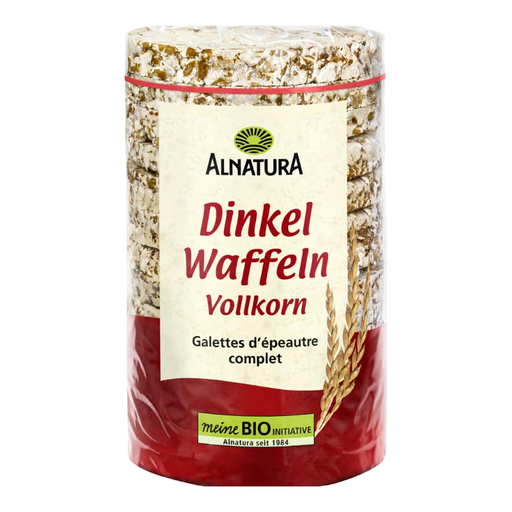 Image unavailable
If you’re looking for a plain base for separate toppings instead of freshly made dessert waffles, these spelt waffles could be a good option.
The nutritional information lists 0,8 g of sugar per 100 g. Spelt contains gluten, so check for another option if any of your guests need to avoid gluten.
No. Ingredients such as fruit purée can contain naturally occurring sugars, even if no sugar has been added for its sweetening effect. For packaged waffles, the nutritional information per 100 g shows how much sugar the product contains.
Compare the sugar content using the same measure, ideally per 100 g. Under the labelling rules set out by the European Union, sugar must be included in the nutrition declaration for pre-packed foods.
Yes. The sugar content doesn’t tell you whether a product contains allergens. If relevant to your guests, check the information for waffles, baking ingredients and toppings, particularly for cereals containing gluten, eggs, milk, peanuts and tree nuts.
Not necessarily. Verbraucherzentrale notes that consuming large amounts of sugar substitutes can have a laxative effect. Check the ingredients and offer another waffle option for guests who prefer to avoid these sweeteners.