Who should compare these products?

TV snackers keeping an eye on fat and energy

You want to choose nuts to enjoy while watching TV and compare them with your usual snack. To do this, you’ll need the fat and energy figures per 100 g for both packs; a lower figure per portion alone doesn’t make the products comparable.

Fans of roasted flavours who are watching their salt intake

You enjoy roasted nuts but want to know whether salt or oil has been added. The ingredients list and salt figure tell you more than the word ‘roasted’ on the front of the pack.

Households with questions about allergens and storage

Before buying, you check the allergen and may-contain information on the specific pack, and want to store any opened nuts in a way that keeps them in good condition.

What should you look for when buying?

First, compare the fat and energy per 100 g with your usual TV snack. Then use the ingredients, salt information and labelling on the pack to decide which option best suits your other needs.

Criteria What to check Who it matters most to
Fat and energy Compare the fat in g and energy in kcal per 100 g with your usual snack. If I want a lower-fat snack while watching TV, I need to compare it directly with my usual pack. Around 42% of consumers would make this nutritional comparison their main priority.
Salt and ingredients Check the salt per 100 g and see whether oil or salt appears in the ingredients list. I don’t want to automatically choose a salted option just for the roasted flavour. For around 33% of consumers, checking salt and other ingredients would be the main priority.
Portion size, freshness and allergens Check the pack size and allergen and may-contain information; follow the storage instructions after opening. If I want the pack to last for several evenings in front of the TV, or allergens are a concern, I need clear instructions for handling it at home. Around 25% of consumers would consider this their main priority.

Common buying misconceptions

  • Assuming ‘roasted’ means ‘lower in fat’

    Roasting describes how the nuts are processed, not their fat content. EDEKA lists plain cashews with 47.1 g of fat per 100 g; REWE lists roasted, unsalted ja! cashews with 48.2 g per 100 g.

    Compare the nutrition information per 100 g with your usual snack before deciding that one variety is lower in fat.

  • Overlooking the ingredients list

    Roasted and salted cashews may contain oil and salt as well as nuts. The examples listed by EDEKA and REWE that contain these ingredients have 1 g and 0.92 g of salt per 100 g respectively.

    If you want to limit salt or added oil, check the ingredients list and salt figure for each variety individually.

  • Leaving an opened pack lying around

    If you’re thinking of buying a larger pack, consider how you’ll store what’s left. The Verbraucherzentrale advises against eating nuts that smell musty or rancid, or taste bitter.

    Set aside your TV snack portion in advance and follow the pack’s storage instructions for the rest.

    If the remaining nuts turn rancid, you’ll have to throw them away.

  • Guessing allergen information from the type of nut

    The name of a nut mix doesn’t tell you everything about the allergens and possible traces listed on its pack.

    If allergens are a concern for you, check the ingredients and may-contain information on each specific product every time.

Brands to help guide your choice

EDEKA GUT&GÜNSTIG

The example listed by EDEKA is plain cashew nuts in a resealable 200-g bag.

  • EDEKA lists cashews as the only ingredient, with 47.1 g of fat, 603 kcal and 0 g of salt per 100 g.
  • EDEKA notes that pack information may vary and availability may differ between stores. So check the pack you’re actually buying.

ja! (REWE)

REWE lists roasted, unsalted ja! cashews in a 200-g pack.

  • The listed ingredients include only roasted cashews; REWE gives the salt content as 0.04 g per 100 g.
  • At 48.2 g of fat and 606 kcal per 100 g, this particular variety isn’t lower in fat than the plain cashew example just because it’s roasted.

Alesto (Lidl)

Lidl sells both plain nuts and seasoned snacks under its Alesto brand.

  • The different varieties give you a reason to compare ingredients lists carefully for added ingredients.
  • The brand description is no substitute for checking the fat, energy or salt figures on an individual pack.

FARMER NATURALS (ALDI SÜD)

ALDI SÜD lists roasted cashews in a 200-g pack.

  • For the listed product, ALDI SÜD gives 48 g of fat, 606 kcal and 0.04 g of salt per 100 g.
  • ALDI SÜD notes that products and nutritional information may vary between suppliers; when buying, check the labelling on the specific pack.

Seeberger

REWE lists Seeberger cashews in a number of varieties, including a roasted and salted option.

  • The listed ingredients include cashews, salt and rapeseed oil, so you can check exactly what’s in the recipe.
  • For this variety, REWE gives 50 g of fat, 626 kcal and 0.92 g of salt per 100 g. These figures don’t apply to all Seeberger products.

Nut mixes on Joybuy

These two 150-g mixes are worth considering if you’re thinking of having trail mix or a nut and fruit mix instead of plain nuts while watching TV. Compare the figures per 100 g on the relevant pack with your usual snack; the figures for plain cashews don’t apply to a mix.
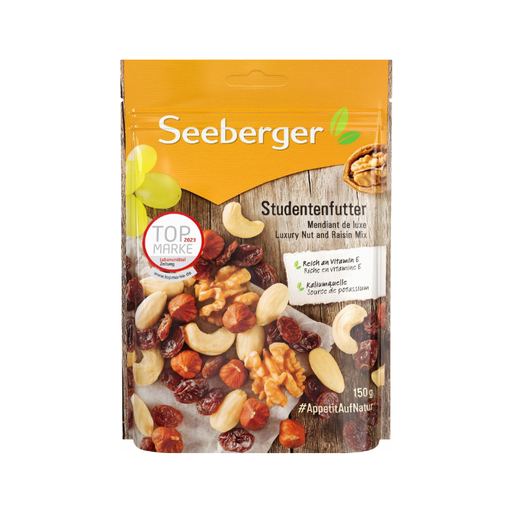
Seeberger Trail Mix, 150 g

Seeberger Trail Mix, 150 g

A 150-g pack for an evening in front of the TV if you fancy trail mix rather than plain nuts. Compare the fat and energy per 100 g with your usual snack, and check the ingredients and allergen information on the pack.

View on Joybuy
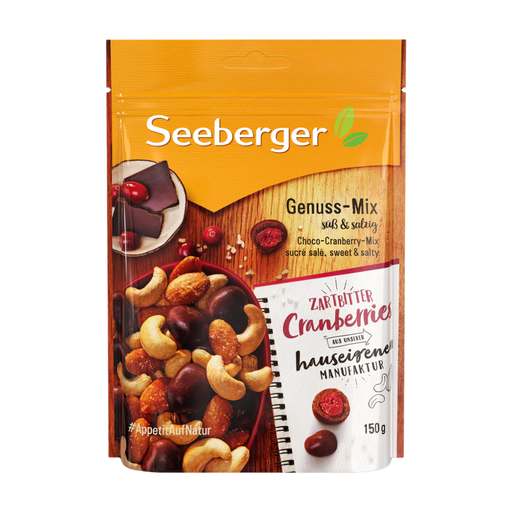
Seeberger Pleasure Nut & Fruit Mix, 150 g

Seeberger Pleasure Nut & Fruit Mix, 150 g

A 150-g nut and fruit mix for anyone looking for something other than plain nuts to enjoy while watching TV. As well as the fat and energy per 100 g, check the ingredients and the allergen and storage information on the specific pack.

View on Joybuy

Frequently asked questions

Are roasted nuts automatically lower in fat than plain nuts?

No. The roasted, unsalted ja! cashews listed by REWE contain 48.2 g of fat per 100 g, while the plain cashews listed by EDEKA contain 47.1 g. For your evening in front of the TV, what matters is comparing the specific pack with your usual snack.

Does ‘no added salt’ also mean less fat?

No. Information about added salt doesn’t tell you how much fat a product contains. REWE gives 48.2 g of fat per 100 g for its roasted, unsalted ja! cashews, so check the fat, energy and salt figures separately.

How can I tell whether nut products contain oil and salt?

First read the ingredients list, then check the salt per 100 g. The ingredients list for the plain cashew product listed by EDEKA contains only cashews; the roasted, salted Seeberger cashews listed by REWE also contain salt and rapeseed oil.

What should I do with an opened pack of nuts?

Follow the storage instructions on the specific pack and seal the rest after setting aside your portion. The Verbraucherzentrale advises you not to eat nuts that smell musty or rancid, or taste bitter.

Is the product name enough to check if I have a nut allergy?

No. Check the ingredients and the allergen and may-contain information on every specific pack. You can’t work out whether a product is suitable for you from the words ‘nuts’ or ‘nut and fruit mix’ alone.