Shoppers comparing sugar levels
You want to eat less sugar with your tea, so you compare the ‘of which sugars’ figure per 100 g across similar types of biscuit. The portion you’d normally eat is part of your decision too.


Choose biscuits to enjoy with tea by checking the sugar per 100 g and comparing similar types, rather than relying on claims such as ‘less sweet’. If you want to avoid sweeteners or polyols, check the ingredients list too: ‘sugar-free’ and ‘no added sugar’ don’t answer that question.
You want to eat less sugar with your tea, so you compare the ‘of which sugars’ figure per 100 g across similar types of biscuit. The portion you’d normally eat is part of your decision too.
You’re looking for a type of biscuit with a lower stated sugar level, but want to avoid certain sweeteners or polyols. That’s why you check the ingredients list as well as the nutrition information.
You also choose based on type and texture. A digestive biscuit and a chocolate cookie can differ in their ingredients, nutritional values and sweeteners.
First decide whether the stated sugar level or avoiding sweeteners matters more to you. Then compare similar types of baked goods and factor in the portion you plan to have with your tea.
| What to check | What to look for when buying | Who it matters to |
|---|---|---|
| Sugar level | Compare ‘of which sugars’ per 100 g across similar biscuits. If a product claims a reduction, check what it is being compared with. | I want to make a conscious choice to eat less sugar with my tea, so I need a comparable figure rather than a slogan on the packaging. This sugar figure is the main consideration for around 42% of shoppers. |
| Sweeteners | Check the ingredients list for sweeteners and polyols such as maltitol or isomalt; take note of any advice about excessive consumption. | A low sugar level isn’t much use for my choice if the recipe contains sweeteners I want to avoid. Around 33% of shoppers prioritise checking these ingredients. |
| Type of biscuit and portion | Compare the type of baked good, ingredients, and sugar, energy and fat per 100 g; factor in the portion you usually eat. | I want to choose a type of baked good I enjoy with my tea, without assuming the sugar figure tells me everything about its nutritional values. This is the main consideration for around 25% of shoppers. |
Lebensmittelklarheit describes ‘reduced sugar’ as a comparison with a similar food of the same type, with at least 30% less sugar. On its own, this doesn’t tell you how much sugar the biscuit contains per 100 g.
Use the claim as a starting point, then compare ‘of which sugars’ per 100 g across similar biscuits.
A biscuit with no added sugar may contain sweeteners or polyols. Verbraucherzentrale notes that polyols can have a laxative effect when consumed in large quantities.
Check the specific ingredients listed and follow the advice on the relevant pack.
Retailer La Casa de las Golosinas lists Gullón Chip Choco Zero as containing less than 0.5 g of sugar, but also 458 kcal and 24 g of fat per 100 g. These figures apply to this variety, not to every biscuit from the brand.
Check sugar, energy and fat together, and factor in the portion you plan to have with your tea.
A claim about sugar doesn’t replace checking the ingredients. Different biscuit and wafer recipes may also contain different allergens that you need to look out for.
Check the current allergen information and any ‘may contain’ warnings on the pack for each variety.
Gullón Zero includes different types of biscuit, including chocolate cookies and digestive biscuits. Check the information for each recipe separately.
REWE stocks various types of Bahlsen biscuits, including classic biscuits, wafers and chocolate biscuits. If you’re choosing a lower-sugar option, the specific variety matters.
Here you’ll find a range of baked goods for teatime: biscuits described as sugar-free, butter biscuits labelled as having 30% less sugar, and hazelnut wafers labelled ‘no added sugar’. Compare their information with similar types of baked goods; wafers aren’t biscuits.
 No image available
If you fancy a shortbread-style biscuit with your tea, this variety could be an option if you’re happy to consume polyols. Check the ingredients list for maltitol, erythritol and isomalt, as well as the pack’s advice about excessive consumption.
 No image available
If you prefer filled sandwich biscuits to butter biscuits with your tea, this offers a different type of biscuit to consider. According to the product information, it contains maltitol; don’t judge the nutritional information on sugar alone.
 No image available
If you enjoy a classic butter biscuit with your tea, you can consider this variety based on its claim of 30% less sugar. Also compare ‘of which sugars’ per 100 g and check what the comparison on the pack is based on; the percentage alone doesn’t tell you whether the absolute sugar level is low.
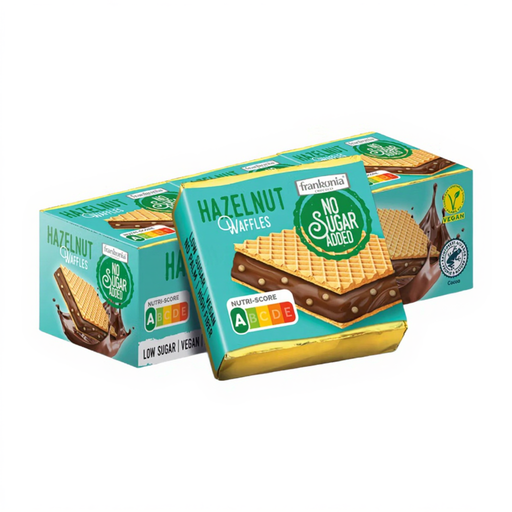 No image available
If you’d prefer hazelnut wafers to biscuits with your tea, the ‘no added sugar’ claim is a starting point for comparison. Before choosing, check the sugar per 100 g and the full ingredients list; the claim alone doesn’t mean ‘sugar-free’ or ‘no sweeteners’.
The claim describes a comparison; it doesn’t automatically mean the sugar level is low. Lebensmittelklarheit explains that it means at least 30% less sugar than a comparable food of the same type. For your choice, the ‘of which sugars’ figure per 100 g is still key.
No. ‘No added sugar’ doesn’t rule out sweeteners or polyols, and it doesn’t necessarily mean ‘sugar-free’ either. Check the ingredients list and the sugar information in the nutrition declaration for the specific biscuit.
Maltitol and isomalt are polyols, which you can check for in the ingredients list when choosing a product. Verbraucherzentrale notes that polyols can have a laxative effect when consumed in large quantities, so be sure to read the advice on the relevant pack too.
Follow the storage instructions on the specific pack. World of Sweets advises storing Gullón Zero Digestive in a ‘cool, dry place’; for other varieties, follow the instructions on their own packaging.