
Lieferung heute & morgen

Qualitätsgarantie

Willkommens-Angebote freischalten: KOSTENLOSE Lieferung | Bis zu 80 % RABATT | Kostenlose 30-Tage-JoyPlus-Testphase
App herunterladen
The LR44 button cell is a standardised, widely used power source for a variety of small electronic devices. Thanks to its compact dimensions of 11.6 mm x 5.4 mm and a nominal voltage of 1.5V, it is used in many everyday products. One challenge for consumers is the multitude of names for the same battery type. The LR44 is identical in construction and interchangeable with models sold under the designations AG13, V13GA, A76, or 357.
This article serves as a technical guide to help you understand how they work, the differences between available chemistries, and how to select the right product for your specific use case.
Your choice of battery should be based on key technical parameters. The two primary technologies for this battery type are alkaline and silver-oxide. This choice directly impacts the performance and lifespan of the powered device.
Although the LR44 (alkaline) and SR44 (silver-oxide) button cells are mechanically identical in size, they differ fundamentally in their electrochemical composition and discharge characteristics.
Alkaline Battery (LR44): The "L" in the designation stands for alkaline chemistry. These batteries offer a nominal voltage of 1.5V. A characteristic of an alkaline battery is a continuously declining voltage curve during discharge. This means the voltage drops as the battery is used. For devices with low power requirements or those insensitive to voltage fluctuations (e.g., simple toys, LED torches, or some calculator batteries), this is a cost-effective solution.
Silver-Oxide Battery (SR44): The "S" indicates silver-oxide technology. These batteries have a slightly higher and, most importantly, a very stable nominal voltage of 1.55V. Their voltage curve remains constant for almost the entire lifespan, dropping off rapidly only just before being fully depleted. This characteristic is essential for precision electronic devices like a watch battery or medical instruments, as a fluctuating voltage could impair their function or measurement accuracy. Furthermore, silver-oxide batteries typically offer higher energy density and lower self-discharge, making them ideal for long-term, reliable power.
While they are physically compatible, functional suitability depends on the end device. A device designed for the stable voltage of an SR44 may operate unreliably or inaccurately with an LR44.
The following product selection is based on an analysis of technical specifications and intended use cases.
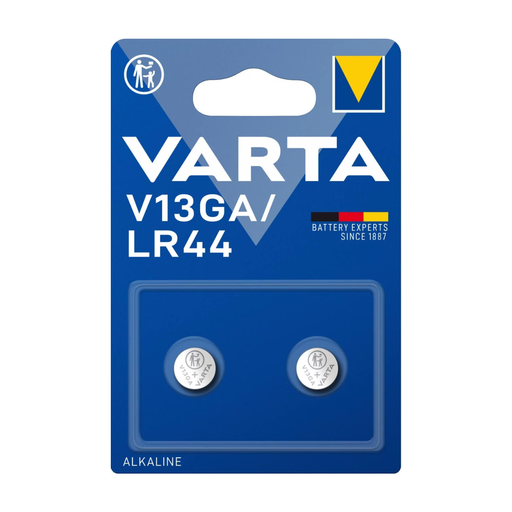
Why We Recommend This Product The VARTA Battery V13GA/LR44 is a dependable alkaline button cell for a wide range of standard applications. Its specifications show a nominal voltage of 1.5V and a capacity of 125 mAh. A key feature is its child-safe blister pack, which meets household safety requirements. As a product from an established German manufacturer, it delivers the consistent power output expected for everyday devices.
Pros
Who It's For Users who need a reliable battery for everyday devices like remote controls, calculators, or toys, and who value a brand guarantee and certified packaging safety.
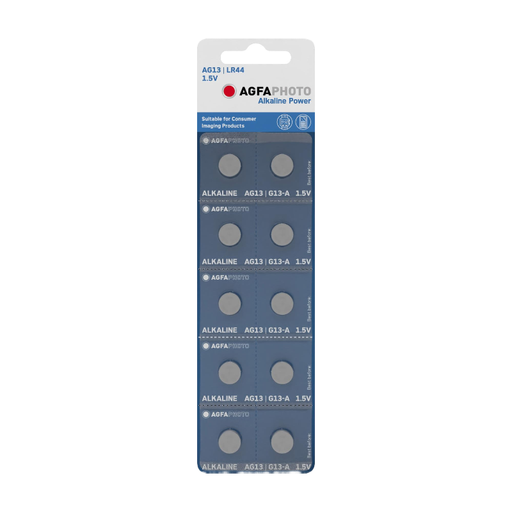
Why We Recommend This Product This product from AgfaPhoto offers a set of ten LR44 button cells. According to the manufacturer, each cell has a capacity of 850 mAh, making it attractive for applications with higher energy demands. The bulk pack is an economical solution for users who regularly buy button cells or want to stock up. The 1.5V alkaline chemistry is suitable for a wide variety of devices.
Pros
Who It's For Users with a high consumption of LR44 batteries, such as households with many electronic toys, as well as small business owners who have a regular need for standard applications.
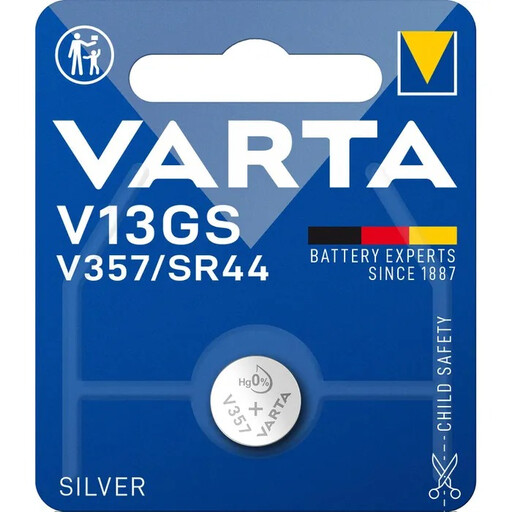
Why We Recommend This Product The VARTA V13GS/SR44 is a silver-oxide battery specifically designed for demanding applications. Its most important feature is the stable output voltage of 1.55V, which remains nearly constant throughout its entire service life. With a capacity of 180 mAh and low self-discharge, it is optimised for long-term use in precision devices. Its mercury-free composition also complies with modern environmental and safety standards.
Pros
Who It's For Owners of high-quality wristwatches, digital calipers, medical devices (e.g., blood glucose meters), or other precision instruments where a constant and reliable power supply is essential for correct operation.
The LR44 button cell is just one of many available sizes and types. If you need a different battery for your device, you can find a wide selection of other Button Cells in our main category. There, you can search specifically for the correct designation or the required dimensions for your device.
1. What is the difference between LR44 and SR44? The main difference is the cell chemistry. LR44 is an alkaline battery with 1.5V, and its voltage gradually drops during use. SR44 is a silver-oxide battery with 1.55V that delivers a very stable voltage until the end of its life. Therefore, SR44 is preferable for precision devices like watches, while LR44 is a cost-effective alternative for less demanding devices like toys or torches.
2. Can I use an LR44 battery in a watch? Technically, it is possible, as the dimensions are identical. However, it is not recommended. Watches are calibrated for the stable voltage of a silver-oxide battery (SR44). The declining voltage of an LR44 can cause the watch to run inaccurately or stop prematurely. For reliable performance, you should always use the battery type recommended by the watch manufacturer (usually SR44).
3. How long is an LR44 button cell's shelf life? The shelf life of an unused LR44 button cell depends on its quality and storage conditions. Alkaline cells typically have a shelf life of about 3 to 5 years when stored in a cool, dry place. Silver-oxide cells (SR44) often have a longer shelf life of 5 to 10 years due to their lower self-discharge rate. The exact details can be found on the manufacturer's packaging.