
Lieferung heute & morgen

Qualitätsgarantie

Willkommens-Angebote freischalten: KOSTENLOSE Lieferung | Bis zu 80 % RABATT | Kostenlose 30-Tage-JoyPlus-Testphase
App herunterladen
A lunch box with compartments should keep different foods separate, remain leakproof in your rucksack and be easy to clean. For professionals, schoolchildren, students and families, this may sound straightforward. In practice, however, unclear product details, unsuitable closures or misjudged dimensions can quickly lead to disappointing purchases.
An airtight lunch box can keep food fresh, but that does not automatically mean it is suitable for liquids. What matters is a continuous seal, a secure closure and specific information from the manufacturer about leak resistance. Even a lunch box with removable inserts can allow liquid to pass through at the joins if the compartments are not sealed individually.
For soups, dressings or yoghurt, you should therefore check whether the container is explicitly described as a leakproof lunch box or as waterproof. With salad boxes, a separate sauce container is often more practical than one large compartment for all the ingredients.
A bento box with five small compartments may seem versatile, but it could offer less room for a complete lunch than a box with one large main compartment and an insert. So do not just check the stated capacity in litres; consider the shape and internal layout too.
Around 800 to 1,000 ml is often enough for a sandwich, fruit and snacks. If you want to carry a larger meal or meal prep for a working day, 1.4 to 2.3 litres may be more suitable. The external dimensions must still fit in your rucksack, bag or fridge.
With a microwave-safe lunch box, the information often means that the container may be heated without its lid or with the steam vent open. Lids with tightly closed clips can become misshapen or come loose because of the pressure generated. Dishwasher suitability may also be limited to the top rack.
For this reason, read the usage instructions before buying. Details such as maximum power, heating time, freezing temperature and position in the dishwasher are more relevant to everyday use than general marketing claims.
Choose the size based on your usual portions:
Check whether the dividers are permanently integrated or removable. Removable inserts make cleaning easier and allow more flexible use. Permanently integrated dividers, on the other hand, stop the layout from shifting while you are on the move.
Polypropylene, or PP for short, is used in many plastic boxes. According to the product information, the materials used in the models listed here are described as BPA-free. A BPA-free lunch box should also be suitable for the intended food contact. Silicone seals can improve the effectiveness of the closure, but they should be checked regularly for cracks, deformation and residue.
Stainless steel is an alternative to plastic. A lunch box made from 304 stainless steel is robust and suitable for storage, but it is not automatically microwave-safe. For reheating, plastic models with clear manufacturer instructions are generally more straightforward.
Check the following before buying:
A dishwasher-safe lunch box saves time in everyday life. Nevertheless, seals and lids should be allowed to dry completely after cleaning before the box is stored closed.
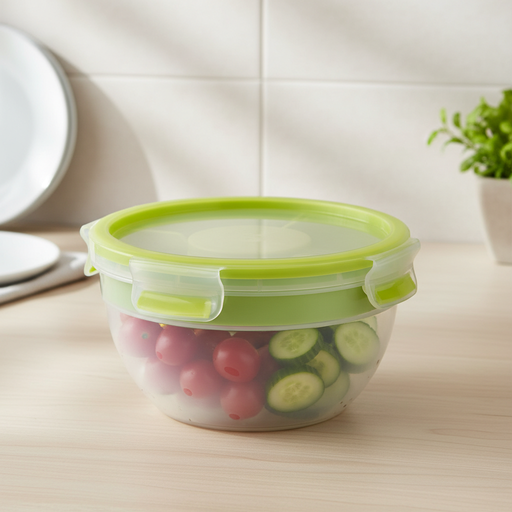
Why this product suits this profile: With a capacity of 1 litre and two practical inserts, this box is suitable for smaller meals and snacks, as well as use at school, university or in the office.
The inserts keep different foods separate, helping you transport soft and crunchy ingredients individually. There are specific restrictions for microwave use: a maximum of 600 watts for 1.5 minutes, and the lid must not be tightly closed.
1 litre capacity, two inserts, and freezer and dishwasher suitability according to the product information.
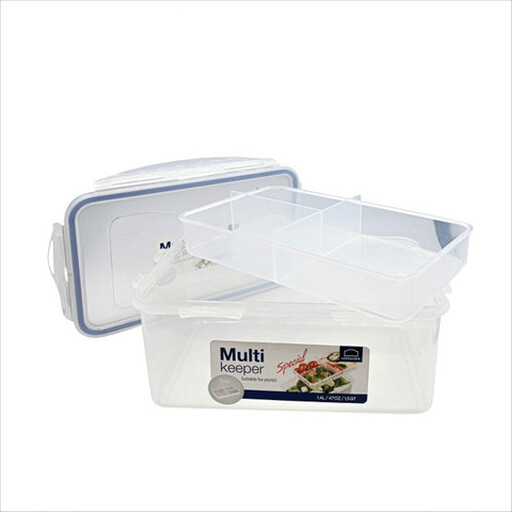
Why this product suits this profile: With its rectangular 1.4-litre format and integrated divider, this container is designed for larger lunch portions, leftovers and meal prep for work or school.
The product information states that it has an airtight and watertight closure. This makes it suitable for transporting meals with separate components. The lid must be removed when heating; the container is not suitable for use in an oven or on a hob.
1.4-litre capacity, integrated divider, and suitability for the microwave without the lid, freezer and dishwasher according to the product information.

Why this product suits this profile: The 3-in-1 layout is designed for salads, toppings and dressings. According to the product description, cutlery and a sauce container are already included.
Dressings are transported separately, keeping salad ingredients apart until you are ready to eat. For microwave use, the lid must be removed completely; the container is not intended for use on a hob, in an oven or over direct heat.
950 ml capacity, removable insert with three sections, separate sauce container and included cutlery according to the product information.
We have put together a complete, regularly updated list of products that fully meet these strict selection criteria and the safety regulations applicable in the EU.
Even a carefully chosen lunch box for work and school will only remain functional if it is used correctly:
For snacks and smaller meals, 800 to 1,000 ml is often sufficient. For a complete lunch with side dishes, around 1.3 to 1.5 litres is usually more suitable. Large meal-prep portions or substantial salads may require more than 2 litres. The key factors are your portion size and the space available in your bag and fridge.
No. Compartments alone do not prevent liquids from escaping. Check whether the product description mentions a seal and an airtight or watertight closure. For salad, yoghurt or dressing, a separate container with a secure seal is another practical solution.
Its lifespan depends on the material, closure, cleaning and how it is used. Frequent contact with high temperatures, harsh cleaning products or drops can put stress on plastic and seals. Check the box regularly and replace it if cracks, significant deformation or a permanently weakened seal develop.