
Lieferung heute & morgen

Qualitätsgarantie

Willkommens-Angebote freischalten: KOSTENLOSE Lieferung | Bis zu 80 % RABATT | Kostenlose 30-Tage-JoyPlus-Testphase
App herunterladen
A lunchbox should reliably carry meals to school, the office or on a day out. In practice, however, weaknesses often only become apparent after a few weeks: the lid does not seal properly, sauce leaks into your bag or cleaning the many individual parts becomes unnecessarily time-consuming. So when choosing a bento lunchbox or sandwich box, you should consider more than just the colour and capacity.
The term leak-proof lunchbox is only really meaningful when the seal, fasteners and dividers work well together. A loosely fitted compartment does not automatically prevent liquid from reaching neighbouring sections. For soups, dressings or yoghurt, a continuous silicone seal and a secure closure are important.
Even if a box is described as leak-proof, it should be carried upright in your bag. Seals can lose their effectiveness through dirt, deformation or wear.
A lunchbox with compartments looks tidy, but fixed dividers reduce the available space. This can be useful for sandwiches and fruit. For large portions, pasta salad or meal prep, removable dividers are often more flexible.
Pay attention to the total capacity in millilitres or litres, rather than just the number of compartments. 900 ml to 1 litre is often suitable for a single meal. 1.4 to 1.5 litres gives you more room, but is heavier and takes up more space in your bag.
A box with a specified temperature range is not automatically suitable for every type of heating. With plastic containers, the lid and inserts often need to be removed before heating. A thermal food container, on the other hand, works through vacuum insulation and generally must not be placed in the microwave.
The specific manufacturer’s instructions for microwave use, freezer compatibility, dishwasher cleaning and direct heat are what matter. A lunchbox should not be placed on a hob or in the oven unless this is expressly permitted.
Polypropylene, or PP for short, is commonly used for many sandwich boxes and bento boxes. It is lightweight and, depending on the product, may be suitable for use in the microwave, freezer or dishwasher. Check whether the manufacturer states that the product is BPA-free and made from materials suitable for contact with food.
A stainless steel lunchbox is generally robust and less likely to absorb odours. However, uninsulated stainless steel boxes do not automatically keep food warm. A vacuum-insulated container, such as one made from 304 or 316 stainless steel, also includes an insulating layer. Looking after the seal and lid is particularly important.
One or more clips, a continuous seal and precisely fitting inserts are important design features. Multiple fasteners distribute the closing pressure, but can increase the cleaning effort. Check the following before buying:
The mechanism should be easy for children to understand. Older boxes or those with visible cracks should no longer be used.
A dishwasher-safe lunchbox saves time, although restrictions such as cleaning in the top rack often apply. Silicone seals should be removed regularly and dried thoroughly. This helps prevent residue and odours.
A lunchbox supplied with cutlery is also practical for the office. A lunchbox with cutlery can eliminate the need to carry a separate knife, fork or spoon. For hot food, a wide opening is useful, as it makes filling, eating and cleaning easier.
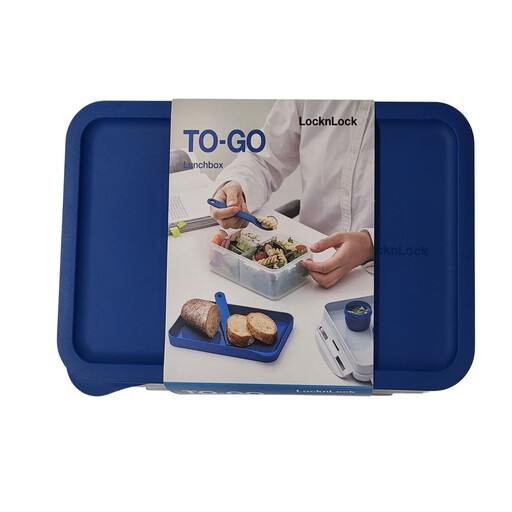
Why this product suits this profile: The 1-litre box combines three removable compartments with a cutlery set and a sauce container. This makes it suitable for school, work and prepared meals.
The removable compartments are more flexible than fixed dividers. According to the product details, the box has a four-sided closure and an airtight, watertight design.
1,000 ml capacity, three inserts, cutlery and sauce container; according to the supplier, suitable for the dishwasher, freezer and microwave without the lid.
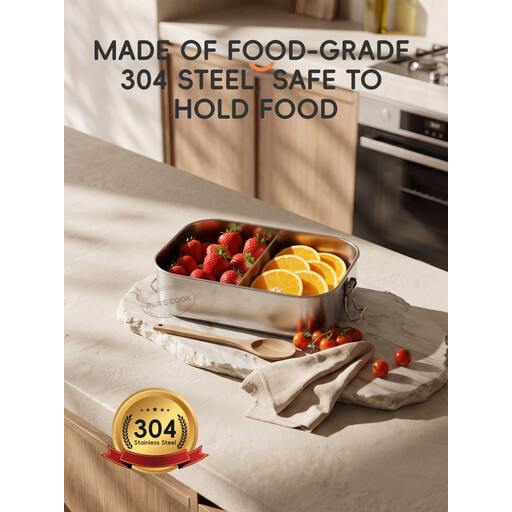
Why this product suits this profile: The two-part design made from 304 stainless steel is aimed at users who value a durable material and separated foods.
The design uses clips and a removable silicone seal. Before carrying it, make sure the seal is fitted correctly and do not overfill the box.
304 stainless steel, two separate sections and, according to the product description, a dishwasher-safe design.
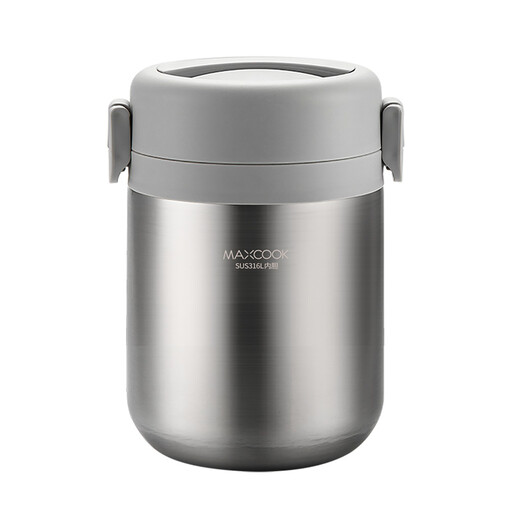
Why this product suits this profile: The wide neck makes it easier to fill and eat soups, stews or pasta. The format is suitable for large portions and hot meals eaten on the go.
The vacuum insulation is designed for hot or cold food. The container must not be placed in the microwave and should be washed by hand, according to the product details.
1.5-litre capacity, 316 stainless steel, wide opening and, according to the product details, a thermal holding time of around 4 to 6 hours.
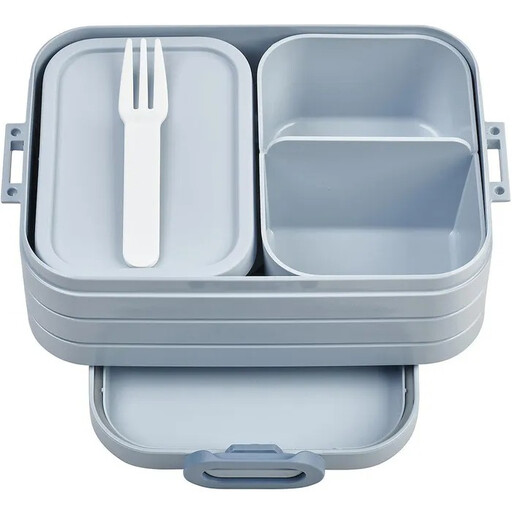
Why this product suits this profile: Two separate compartments and an additional box with a fork keep the main meal, side dishes and snacks organised. At 900 ml, the format remains relatively compact.
The inserts can be removed and cleaned separately. According to the product details, the box is not suitable for the freezer; this helps prevent incorrect use.
900 ml capacity, removable bento boxes, supplied fork and dishwasher suitability according to the product description.
We have put together a complete, regularly updated list of products that fully meet these strict selection criteria and the safety regulations applicable in the EU.
Wash a new lunchbox with warm water and mild washing-up liquid before using it for the first time. Remove the seals regularly, clean the contact surfaces and allow all parts to dry completely. With thermal containers, do not leave the lid soaking for long periods with liquid around the sealing area.
Avoid overfilling and check the box, clips and seal for cracks or deformation. When using a microwave, remove the lid completely unless the manufacturer states otherwise. Hot food can cause burns, so allow the contents to cool sufficiently before eating directly.
For a single meal, 700 to 1,000 ml is often enough. If you take larger portions, fruit or several side dishes with you, you can choose a model with a capacity of 1.4 to 1.5 litres. The external dimensions and weight are also important, particularly when carrying it in a rucksack.
No. Compartments alone do not prevent leaks. Look for a continuous seal, well-fitting inserts and information from the manufacturer about liquid-tightness. Even so, liquid foods should preferably be carried upright.
Remove all inserts and seals, rinse off any residue promptly and dry the individual parts thoroughly. With a dishwasher-safe lunchbox, follow the instructions regarding the top rack and individual components. Thermal containers are often cleaned by hand.