
Lieferung heute & morgen

Qualitätsgarantie

Willkommens-Angebote freischalten: KOSTENLOSE Lieferung | Bis zu 80 % RABATT | Kostenlose 30-Tage-JoyPlus-Testphase
App herunterladen
A cluttered entryway with shoes blocking the path is a common nuisance. The right shoe cabinet not only creates order but can also enhance the look of your hallway. The selection is vast, ranging from slim tilt-out cabinets to spacious shoe chests, with a solution for every need.
This article serves as a practical guide. We'll introduce different types of shoe storage, provide specific tips for making your choice, and present a selection of models that meet various requirements for space, capacity, and design.
Before making a decision, the following three points will help you define your needs and find the perfect piece of furniture for your home.
The type of cabinet is a key factor in how well it will fit into your space.
A realistic assessment of your storage needs is crucial. Count your current pairs of shoes and plan for a buffer for future purchases. Precisely measure the available space in your hallway, bedroom, or dressing room—height, width, and especially depth are critical. For collectors or families, there are special high-capacity models available.
The material affects not only the look but also the durability and maintenance.
Here, we present three different models, each suited to various living situations due to their specific features.
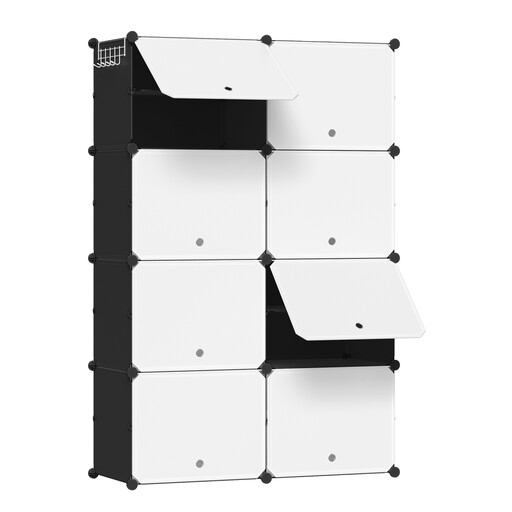
Why it stands out: This model is distinguished by its exceptional flexibility. The modular interlocking system of PP panels allows you to adapt the cabinet to your specific space and needs—whether as a tall rack, a wide sideboard, or several smaller boxes.
Pros:
Who is it for? Ideal for families, shared apartments, or shoe collectors who need flexible and expandable shoe storage in the hallway with maximum capacity.

Why it stands out: This shoe chest combines an attractive barn door style design with practical functionality. Its light green finish and clean lines make it a piece of furniture that not only organizes but also serves as a visual highlight.
Pros:
Who is it for? Perfect for those looking for a functional shoe cabinet with doors that blends harmoniously into modern or farmhouse-inspired decor while also serving as a storage surface.
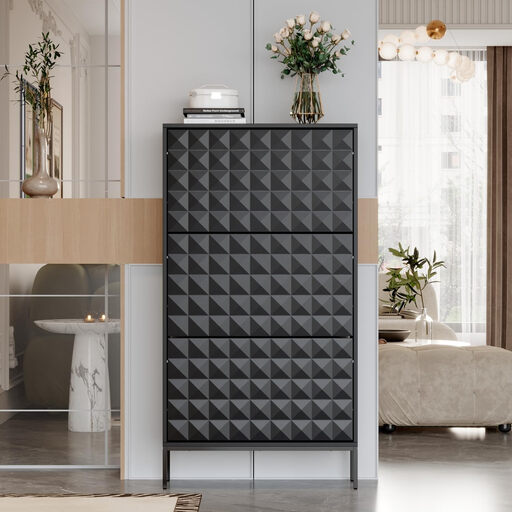
Why it stands out: As a classic tilt-out cabinet, this model is the ultimate solution for tight spaces. With a depth of only 24 cm, it is an extremely narrow shoe rack that fits even behind doors or in very tight entryways.
Pros:
Who is it for? For those living in apartments with limited space who need an efficient and discreet shoe storage solution for a narrow hallway.
If our recommendations don't include the perfect model for you, you can find a wider selection in our category. Discover more shoe racks with doors to find the ideal solution for your home.
The depth of a shoe cabinet depends on its type. Standard shoe cabinets and chests are typically 30 to 40 cm deep to accommodate shoes lying flat or standing up. Tilt-out cabinets are significantly slimmer, with depths of just 17 to 25 cm, as the shoes are stored at an angle.
A shoe rack is an open shelving system where shoes are visible and directly accessible. A tilt-out cabinet is a closed unit with special tilting drawers. It is much slimmer than a rack, making it particularly well-suited for tight spaces.
Capacity varies greatly depending on the size and design. Small models often hold only 6 to 12 pairs of shoes. Larger shoe chests or modular systems can easily accommodate 24, 32, or more pairs. It's advisable to check the product description carefully, as the stated capacity is often based on a standard shoe size.