Hosts with a small holiday-cottage kitchen
If you’re equipping a kitchen for a succession of guests, the oven you choose should suit the size of dish you’ll use, have a safe place to stand and be straightforward to operate.


For a macaroni cheese bake in a single dish, a freestanding mini oven is usually the obvious choice, provided the dish fits and the oven can be positioned safely according to its instructions. For smaller portions, an air fryer may be an option if you have a baking dish explicitly approved for it. A built-in oven makes most sense if there’s already a suitable space for one. The actual measurements of your dish and the space available matter more than the stated capacity in litres.
If you’re equipping a kitchen for a succession of guests, the oven you choose should suit the size of dish you’ll use, have a safe place to stand and be straightforward to operate.
If you’re making a bake in one shared dish, check its external dimensions, including the handles and height – not just the oven’s capacity.
If you’re only cooking a small portion, you could consider a compact oven or an air fryer with a dish confirmed as suitable for it.
A freestanding oven is usually a good choice for a bake in one dish, as long as both the dish and the space required for the oven suit the model. An air fryer and a built-in oven are alternatives for different space and portion requirements.
Suitable if: you want to bake in one dish and the dish, power connection and available space all suit the exact model.
Trade-off: More usable oven space may accommodate larger dishes, but it takes up more room.
Suitable if: you’re making smaller portions and can find a dish explicitly approved for your exact air fryer model.
Trade-off: The basket and compatible accessories limit the usable dish size; a dish you already own won’t necessarily be suitable.
Suitable if: there’s already a suitable space for a built-in oven in the holiday cottage, or you’re equipping a kitchen designed for one.
Trade-off: Appliance dimensions and kitchen planning differ from those of a freestanding worktop oven.
| Buying priority | What should you check? | Who is this important for? |
|---|---|---|
| Will the oven dish fit? | Compare its external dimensions, including handles and height, with the oven’s internal dimensions, shelf positions and the specifications for the exact model. | If I want to serve the bake in one shared dish, I don’t want to discover it won’t fit when it’s time to cook. Around 36% of consumers put a good fit first. |
| Can the oven be positioned safely? | Check the worktop, socket and clearances specified in the instructions; don’t put a worktop oven in an alcove as if it were a built-in appliance. | When space is tight, I need somewhere to use the appliance in line with its instructions. Around 29% of consumers prioritise where the oven can be placed. |
| Which heating settings do I need? | Check the exact model for top and bottom heat, optional fan-assisted cooking, usable shelf positions and a timer. | If I want to cook the bake using my preferred heating setting, the functions I can actually select are what matter. Around 21% of consumers prioritise baking functions. |
| How easy is it to clean and use? | Check for a removable crumb tray and read the cleaning instructions; don’t compare wattage figures as a measure of energy used to cook a bake. | After making a cheesy bake, I want accessories that are easy to clean and a realistic idea of how much energy it uses. Around 14% of consumers prioritise cleaning and use. |
You should also check the conformity information for the specific electrical appliance being offered. A model name or test result alone doesn’t prove that the appliance being sold meets the applicable EU requirements.
Handles and the height of the dish can stop it fitting, even when the oven’s capacity seems sufficient.
Measure the outside of the dish and compare its dimensions with the internal measurements, shelf positions and specifications for the exact model.
Depending on the dish, you may also need to buy a suitable accessory.
The instructions for the Steba KB M19 explicitly state that it must not be used as a built-in oven, and include requirements for its power connection and positioning.
Check the instructions for the exact model and make sure the holiday cottage meets its positioning and connection requirements.
Philips lists the HD9945/01 baking dish for certain air fryer model ranges, not every appliance.
Before buying, compare the air fryer’s full model number with the accessories listed as compatible.
You may need an accessory specifically approved for a different model.
An appliance’s rated power in watts doesn’t tell you directly how many kilowatt-hours it will use to cook the same bake.
If energy use is important, only compare figures based on the same test and unit.
The BGE 1580/E is a freestanding worktop oven with a 30 l capacity.
The KB M19 is a more compact worktop oven, with a 19 l capacity.
The TO 2058 is a freestanding oven that Severin also lists for casseroles and bakes.
The TO 26 SilverStyle is a freestanding 26-l oven.
Philips lists the HD9945/01 baking dish as an accessory for certain air fryer models.
The HBA571BB4 is an example of a built-in oven for a suitably planned kitchen.
Here you’ll find freestanding mini and combination ovens, as well as an air fryer oven. Before buying, check the dimensions of your dish and the available space, along with the conformity information for the specific appliance being offered.
 No image available
Could be an option for cooking a bake in a holiday cottage, provided the dish fits and there’s enough space for the oven.
32 l, 1.600 W, timer, crumb tray and a temperature range of 100–250 °C are listed in the product name.
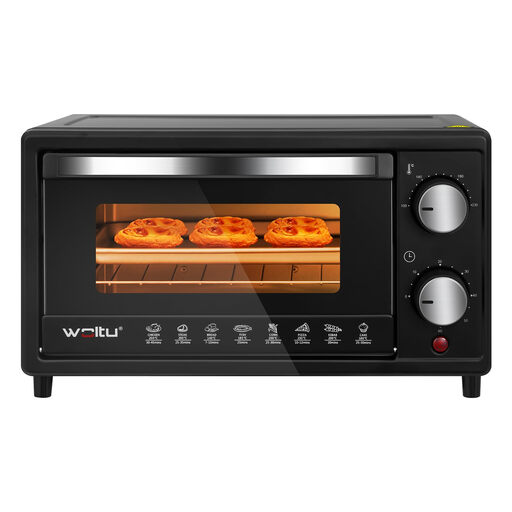 No image available
Its compact size may appeal if you’re cooking smaller portions; still, check your dish’s dimensions against the exact appliance.
10 l, pizza function and a temperature range of 100–230 °C are listed in the product name.
 No image available
Worth considering as a freestanding oven for a bake, as long as your dish, the available space and the requirements for the exact model are all compatible.
28 l, temperature control and a timer are listed in the product name.
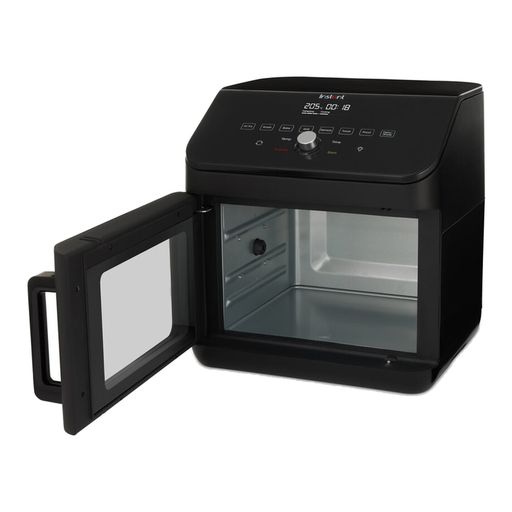 No image available
A compact alternative for smaller portions; only use an oven dish if it’s suitable for this exact model.
13 l is listed in the product name. Check in advance which dish will fit and whether it’s approved for the appliance.
 No image available
Could be an option for cooking for several guests, provided there’s enough space and the oven dish fits.
30 l, 21 programmes, rotisserie and dehydrator, suitable for a 13-inch pizza, and 1.800 W are listed in the product name. The product information says to keep the appliance away from flammable materials such as curtains or wooden tables.
No. Measure the outside of the dish, including its handles and height, and compare it with the oven’s internal dimensions, shelf positions and specifications for the exact model. Depending on the model, manufacturers may list internal dimensions or the maximum size of a round baking tin. The latter doesn’t confirm that any rectangular dish will fit.
Not just because it fits inside. The instructions for the Steba KB M19 explicitly state that this model isn’t a built-in oven, and include requirements for its power connection and positioning. Follow the instructions for any other model you’re considering.
The German Federal Institute for Risk Assessment recommends keeping food at a temperature of at least 60 °C throughout when holding it hot, and heating it to 70 °C throughout for at least two minutes. This is food hygiene advice, not a guarantee that a keep-warm function will reach those temperatures.
For a newly purchased item, you can generally claim your statutory rights against the seller for defects within two years of the item being handed over or received. The consumer advice centre distinguishes these rights from a voluntary manufacturer’s guarantee; you may also have a right to cancel in certain circumstances.
No. For electrical appliances where EU product law requires CE marking, the manufacturer uses it to declare that the appliance meets the applicable requirements. According to information from the European Union, no central EU body issues a general CE certificate for this purpose; check the information for the specific appliance being offered.