
Lieferung heute & morgen

Qualitätsgarantie

Willkommens-Angebote freischalten: KOSTENLOSE Lieferung | Bis zu 80 % RABATT | Kostenlose 30-Tage-JoyPlus-Testphase
App herunterladen
The arrival of a new Apple Silicon chip is a significant indicator of shifts in portable computing performance. With the introduction of the Apple M5 chip in the 2026 MacBook Air, the 13-inch model repositions itself. It targets a demographic that requires a blend of high-performance computing for AI applications, extended battery life, and ultimate portability. For those considering purchasing an Apple MacBook Air M5, this is a technical analysis of the 16GB RAM and 512GB SSD configuration.
The decision to invest in a notebook of this calibre should be based on a rational assessment of its technical parameters. The following aspects are crucial for professionals, creatives, and students.
The Apple M5 chip is the centrepiece of this update. Its architecture combines performance cores for demanding tasks with efficiency cores for everyday processes. This enables optimised power management and contributes to its extended battery life.
A key feature is the enhanced Neural Engine. This component is responsible for accelerating machine learning and AI tasks. For users, this translates to higher-performance execution of features within macOS and applications that leverage "Apple Intelligence"—such as text generation, image analysis, or code completion. The hardware-accelerated Neural Accelerators and the GPU's ray tracing are particularly relevant for creatives working in 3D rendering or video editing.
Opting for 16GB of unified memory is a future-proof decision. This capacity allows for fluid multitasking across several demanding applications, as is common in a professional workflow. In conjunction with the M5 chip's high memory bandwidth (153 GB/s, according to Apple), data processing bottlenecks between the CPU, GPU, and Neural Engine are minimised.
A 512GB SSD provides a solid foundation for the operating system, essential applications, and current projects. The high read and write speeds of solid-state drives significantly contribute to system responsiveness, from fast boot-ups to the rapid loading of large files.
The 13.6-inch Liquid Retina display, with a native resolution of 2560 by 1664 pixels, offers a high pixel density (224 ppi), resulting in sharp text and image rendering. Support for one billion colours is advantageous for colour-critical work in photography and design.
Weighing just 1.23 kg and with a height of 1.13 cm, the MacBook Air remains an extremely lightweight notebook for creatives and mobile professionals. Connectivity has been updated to the latest standards with the Apple N1 chip, enabling Wi-Fi 7 and Bluetooth 6. The two Thunderbolt 4 ports allow for the connection of up to two external displays, as well as high-speed data transfer and charging.
Based on the requirements for a modern, AI-capable, and portable workstation, we present two models that cater to different user profiles.
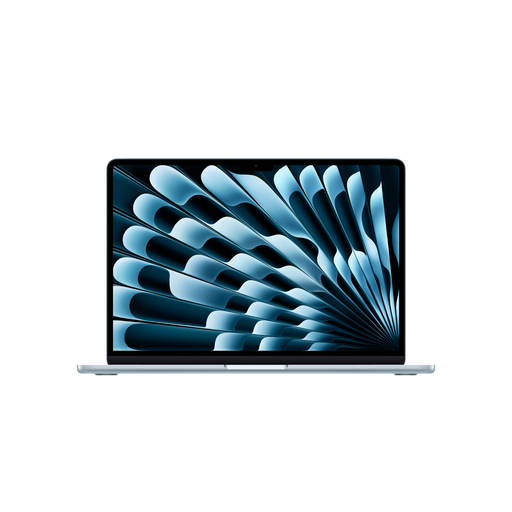
Why we're featuring this product: This model represents the pinnacle of the Air series for 2026. The combination of the M5 chip, 16GB of memory, and 512GB of SSD storage is precisely tailored to the needs of power users who refuse to compromise on mobile performance. The Sky Blue MacBook Air is also a stylish option for users who value design.
Advantages:
Who It's For: This 13-inch laptop with AI is ideal for software developers, content creators, data analysts, and professionals who are frequently on the go and require maximum computing power in an ultra-portable form factor.

Why we're featuring this product: The MacBook Neo, with its A18 Pro chip, is positioned as a sensible alternative for users whose daily tasks require solid performance but not the peak power of the M5 chip. It offers many core features of the Apple ecosystem in an equally lightweight chassis.
Advantages:
Who It's For: Students, educators, and office professionals looking for a reliable, secure, and portable notebook for word processing, presentations, web research, and media consumption.
The models featured cover specific user profiles. Should your needs require a different configuration regarding memory, processor, or screen size, we recommend exploring the broader product range. You can find a comprehensive overview of available models in our Laptop with Keyboard category.
1. What are the key advantages of the Apple M5 chip in the 2026 MacBook Air? The Apple M5 chip offers higher CPU and GPU performance compared to previous generations. Its main advantage lies in the vastly improved Neural Engine with dedicated accelerators, which significantly speeds up AI-powered tasks like real-time text analysis, image editing, and "Apple Intelligence" system functions. Furthermore, its efficient architecture enables long battery life even under high performance.
2. Is 16GB of memory sufficient for the MacBook Air M5? For its target audience of professionals and creatives, 16GB of unified memory is an excellent choice. This amount allows for smooth operation when running multiple memory-intensive programs simultaneously (e.g., code editors, design software, virtual machines) and ensures the device is well-equipped for future software demands.
3. What is the real-world battery life of the MacBook Air M5? Apple states a battery life of up to 18 hours for video playback and up to 15 hours for wireless web browsing. These figures are determined under laboratory conditions. In practice, the actual battery life depends heavily on usage intensity, screen brightness, and the applications being run. For a mixed workday of word processing, web browsing, and video conferencing, all-day use without recharging is a realistic scenario.