
Lieferung heute & morgen

Qualitätsgarantie

Willkommens-Angebote freischalten: KOSTENLOSE Lieferung | Bis zu 80 % RABATT | Kostenlose 30-Tage-JoyPlus-Testphase
App herunterladen
If you’re looking to buy a magnesium supplement, you’ll quickly come across products offering 400, 500 or even 600 mg of magnesium per daily dose. Then there are terms like depot, direct granules, citrate, bisglycinate and B vitamins. With so much choice, comparing products isn’t always straightforward. What really matters is finding the right dosage, magnesium compound and format to suit your lifestyle.
Claims like Magnesium 400 mg, Magnesium 500 mg or Magnesium 600 mg usually refer to the amount of elemental magnesium per daily serving. A higher dose isn’t necessary for everyone. For sensitive individuals, product warnings note that magnesium supplements above an additional 250 mg per day may have a laxative effect.
That’s why you should cross-check your daily dose with your diet and any other supplements you’re taking. If you already use a multivitamin or an electrolyte product, remember to add up the magnesium content.
A magnesium depot is designed for time‑released delivery. This can be useful if you prefer to take it just once a day. However, it doesn’t automatically mean the product is better suited for every situation.
Claims about particularly fast absorption shouldn’t be taken in isolation either. What’s more important is the specific magnesium form, the amount of elemental magnesium, and the manufacturer’s instructions.
Direct granules, effervescent tablets and sticks may contain sweeteners, flavourings or acidity regulators. For example, the product information for Doppelherz Active Magnesium 500 + B12 + D3 Depot DIRECT mentions aspartame, and therefore a source of phenylalanine.
If you follow a specific diet, check the full ingredients list. Terms like vegan magnesium, gluten‑free magnesium or lactose‑free magnesium are only reliable when clearly stated on the product page or packaging.
For many adults, products with 300 to 400 mg per daily serving are a good starting point. Variants with Magnesium 500 mg or Magnesium 600 mg are, according to product information, intended for adults and should not be combined with other magnesium products unless the manufacturer advises otherwise.
Look out for these points:
Common forms include magnesium citrate, magnesium oxide and magnesium bisglycinate. Products may also combine several compounds. The chemical form affects the composition and can be relevant for individual tolerance.
For instance, tetesept Magnesium 600 Triple Action combines magnesium oxide, magnesium citrate and magnesium bisglycinate, according to the product information. WeightWorld Magnesium Complex brings together citrate, bisglycinate, malate and oxide. Such blends make comparison more challenging: always check how much elemental magnesium is actually present per daily dose.
Added vitamins can also play a role. Magnesium with vitamin B12 or magnesium with B vitamins appeals to those who want to combine several nutrients in one serving. That said, it doesn’t replace a balanced diet.
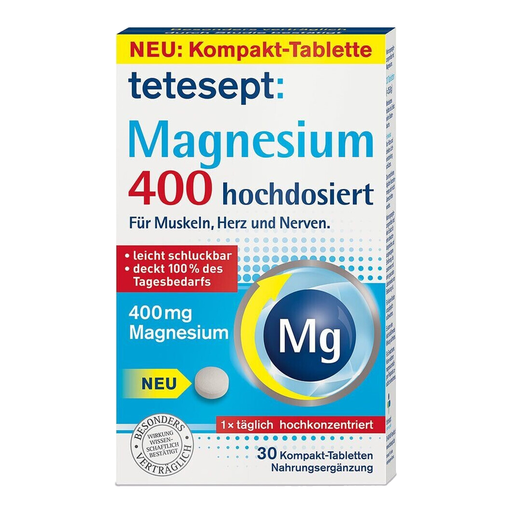
Why this product fits the profile: One tablet a day offers a straightforward routine for adults who prefer a classic format.
The product information clearly states the 400 mg per tablet. There are no unnecessary additions of vitamins or plant extracts.
400 mg magnesium per daily dose; according to the product information, gluten‑free and lactose‑free.

Why this product fits the profile: The combination of three magnesium compounds appeals to buyers who focus on the formulation rather than just the pack size.
The product information explicitly lists magnesium oxide, magnesium citrate and magnesium bisglycinate. The 600 mg dosage should not be combined with other magnesium supplements.
600 mg per tablet; according to the product information, vegan, gluten‑free and lactose‑free.

Why this product fits the profile: Sticks are ideal for commuters, travellers and active adults who don’t want to swallow tablets or carry water.
Each serving is individually packed and, according to the product information, can be taken without water. The B vitamins and other nutrients are clearly listed in the ingredients.
400 mg magnesium per stick; according to the product information, free from declarable allergens.
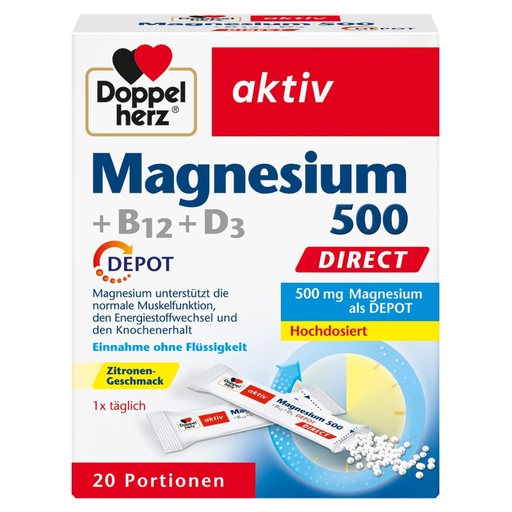
Why this product fits the profile: Direct granules and a depot format combine water‑free intake with time‑released delivery, according to the product information.
The pack contains 20 individually portioned sachets. Before buying, check the ingredients list for aspartame and the source of phenylalanine.
500 mg magnesium per sachet, plus vitamin B12 and D3; according to the product information, gluten‑free and lactose‑free.
We’ve put together a full, regularly updated list of products that meet these strict selection criteria and comply with EU safety regulations.
Food supplements are not a substitute for a varied diet or a healthy lifestyle. Always stick to the recommended daily dose and do not combine several high‑dose magnesium products without checking first.
If you have impaired kidney function, are pregnant, breastfeeding, take regular medication or are undergoing medical treatment, consult a doctor before use. Particularly with higher dosages, also be aware of the possible laxative effect.
It depends on your daily routine. Tablets are good for a fixed schedule at home. Magnesium sticks and magnesium direct granules are designed for on the go and, according to the respective product information, sometimes don’t need water. If you have a sensitive palate or intolerances, check for sweeteners and flavourings.
This depends on the pack size and the daily serving. 30 tablets taken as one tablet a day will last roughly 30 days. With 20 sachets, that’s 20 daily servings. Always follow the dosage recommendation on the label.
A blanket answer isn’t appropriate. Magnesium citrate, magnesium oxide and magnesium bisglycinate differ in their chemical compound and are formulated differently. So compare the amount of elemental magnesium, the ingredients list, the recommended daily dose and your personal tolerance.