
Lieferung heute & morgen

Qualitätsgarantie

Willkommens-Angebote freischalten: KOSTENLOSE Lieferung | Bis zu 80 % RABATT | Kostenlose 30-Tage-JoyPlus-Testphase
App herunterladen
Magnetic building blocks for children combine open-ended construction with shapes, colours and spatial structures. However, choosing the right set is not always easy for parents, grandparents and gift buyers: many sets look similar in product images, but differ considerably in piece size, magnet construction, storage and the range of play options.
100 pieces may initially sound more substantial than 32 or 56 pieces. However, what really matters is which shapes and functional parts are included. A set with lots of similar tiles may be suitable for simple flat designs, while additional geometric pieces, wheels, roofs or ball-run modules allow for more building variations.
Before buying, check:
A high magnetic attraction force can make structures more stable. At the same time, the magnets must be securely enclosed in the plastic. Product specifications may refer, for example, to ultrasonic welding or fully sealed magnetic elements. This is a useful technical indication, but it is no reason to neglect everyday safety checks.
Magnetic building blocks with damaged casings, cracks or a loose magnet should be removed from use immediately. Swallowed magnets can cause serious injuries. If there is any suspicion that a magnet has been swallowed, seek medical assistance without delay.
Many magnetic building blocks for ages 3 and up contain small parts. The age recommendation is therefore not only a guide to the level of difficulty, but is also linked to the risk of swallowing parts. Children under three should not use these sets. Even with older children, age-appropriate supervision is advisable, particularly with complex 3D construction sets or ball runs.
Smaller building blocks with an edge length of around 2.5 cm are suitable for detailed pixel models. Larger magnetic tiles measuring 3.75 cm, 5.5 cm or 7.5 cm are often easier for small hands to grip and allow larger base areas to be created. The dimensions should suit the child’s age, fine motor skills and available play space.
A 32-piece starter set may be enough for creating initial shapes. For larger buildings or shared play, sets with 56 to 100 pieces are a good choice. Extensive 3D construction sets with 126 pieces require more space and should be fully checked and put away after play.
The products featured predominantly specify ABS plastic. Look for smooth, rounded edges without any sharp moulding flash. Descriptions such as “odourless” or “non-toxic” come from the respective product descriptions and should not be regarded as a substitute for the safety information on the packaging and in the instructions.
For children aged three and over, magnetic tiles, creative building blocks and magnetic construction toys can provide a versatile activity. Terms such as STEM learning toys, Montessori toys or educational construction toys describe the intended play concept. They do not automatically guarantee the development of particular skills. The actual benefit depends on the child’s age, interests and the support they receive.
A box, bag or metal tin makes sorting easier and helps reduce lost pieces. When cleaning, follow the manufacturer’s instructions: a dry or slightly damp cloth is often recommended, while immersion in water and harsh cleaning products should be avoided.
Compatibility can only be relied upon when the shape, size and magnet arrangement match. The sets described here include systems measuring 2.5 cm or 7.5 cm in some cases. Different sizes are not automatically compatible with one another.

Why this product suits this profile: This compact set of 32 square tiles, each measuring 3.75 cm, is designed for first building experiments and travel. The metal tin also provides convenient storage.
The manageable number of pieces means beginners do not pay for unnecessary specialist parts. The product specifications also mention smooth edges and ABS plastic.
32 pieces, no batteries required, a portable metal tin, and the option to build in 2D and 3D.
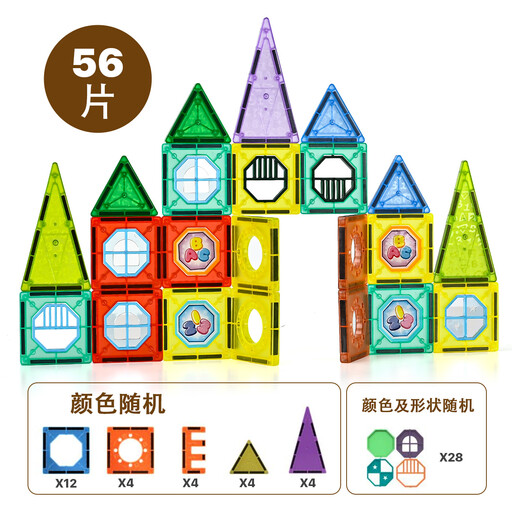
Why this product suits this profile: This 56-piece magnetic tile set specifies securely enclosed magnets, rounded edges and compatibility with other standard magnetic tiles.
The product description clearly explains how the magnets are encapsulated and identifies the material as ABS, rather than simply making a general claim about magnet strength.
Translucent pieces, 56 elements, 3D building options and stated compatibility with standard sets.

Why this product suits this profile: This set is designed for children who want to build ball runs, paths and mazes as well as buildings. It contains 126 pieces and requires three AA batteries for the lighting function; these are not included.
The additional running costs are clearly stated: batteries must be purchased separately and fitted by adults. The warning about small parts and strong magnets is also provided.
126 pieces, transparent 3D elements, ball-run components and a lighting function.
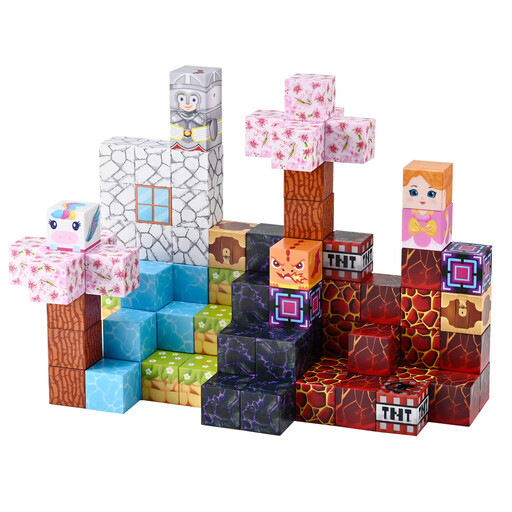
Why this product suits this profile: The 2.5 cm pixel blocks and themed elements are suitable for creating characters, buildings, landscapes and adventure scenes.
Rather than listing only the number of pieces, the set specifies particular texture and functional elements. The box provides storage, although damaged pieces must still be removed from use.
100 pieces, pixel design, ABS plastic, colour box and a focus on detailed 3D scenes.
We have put together a complete, regularly updated list of products that fully meet these strict selection criteria and the safety regulations applicable in the EU.
According to the product specifications, many of the sets featured are intended for children aged three and over. However, they contain small parts and strong magnets. They are not suitable for children under three. Adult supervision is particularly advisable for younger children and when using complex construction sets.
32 pieces are often enough for creating initial shapes. Sets with 48 to 76 pieces offer more possibilities for buildings and 3D models. With around 100 pieces, children can create more extensive scenes; these require more storage space and consistent sorting.
Their lifespan depends on the material, construction quality and how they are used. Securely enclosed magnets, rounded edges and regular checks can help maintain their practical usability. If there are cracks, loose magnets or damaged pieces, the magnetic construction set should no longer be used.