
Lieferung heute & morgen

Qualitätsgarantie

Willkommens-Angebote freischalten: KOSTENLOSE Lieferung | Bis zu 80 % RABATT | Kostenlose 30-Tage-JoyPlus-Testphase
App herunterladen
Magnetic building blocks combine open-ended building with geometric thinking. Depending on the set, children can create flat patterns, houses, vehicles or complex 3D structures. But choosing the right set isn’t always easy for parents, grandparents and educational settings. Product images often show impressive creations, while important details about the magnets, piece sizes and replacement options can be less obvious.
A magnetic building block set with 100 or more pieces may look more comprehensive at first glance than one with 32 or 50. But what matters is the mix of pieces. Lots of identical basic shapes may be enough for simple flat patterns, while triangles, squares, windows, wheels and specialist connectors offer more variety for building.
So don’t just check the total number of pieces. Look at:
A strong magnetic hold can help children build sturdy structures. But for pre-schoolers, it’s just as important that the magnets are safely enclosed within each piece. Damaged edges, cracks or magnets coming loose are clear reasons to stop using the toy.
So, consider claims such as ‘reinforced magnets’ or ‘ultrasonic welding’ alongside the safety warnings. A marketing claim alone isn’t enough to determine whether a toy is safe.
Alphabet, pixel, vehicle and marble run sets appeal to particular interests. But they may be less versatile if a child later wants to build freely. Conversely, a neutral magnetic tiles set may be more practical for groups in nurseries, as several children can develop their own models at the same time.
According to their respective product descriptions, the products featured here are intended for children aged 3 and over. This doesn’t mean younger children should play with them. Small pieces can be swallowed, and swallowing strong magnets can cause serious injuries. Always check the warnings on the packaging and product page before buying and during use.
For magnetic building blocks for children aged 3 and over, you should also:
The sets mentioned here are mostly listed as being made from ABS plastic. Look for rounded edges without burrs, a low-odour material description and magnets that are securely encased. Don’t take references to standards such as CPC, ASTM or EN71 at face value: check whether they apply to the specific product model and can be verified in the documentation.
Many sets can be cleaned with a dry or slightly damp cloth. Immersing them in water or using harsh cleaning products or abrasives may damage the plastic surfaces or magnetic components.
The sets vary considerably in size. For example, some XINQIYUAN sets use 7.5 cm pieces, while Tokky pixel blocks are listed as measuring 2.5 cm. Smaller pieces allow for more detailed scenes, but also mean there are more individual pieces to keep track of.
Other practical considerations include:

Why it suits this profile: This compact 32-piece set comes with a metal storage box, making it a good choice for first building attempts, shorter play sessions and trips.
The stated piece count and included basic shapes are clearly set out. This makes it easier to judge whether it’s a good starting point than with sets whose accessories are unclear.
32 magnetic pieces, ABS plastic and a portable metal box; listed as suitable for children aged 3 and over.
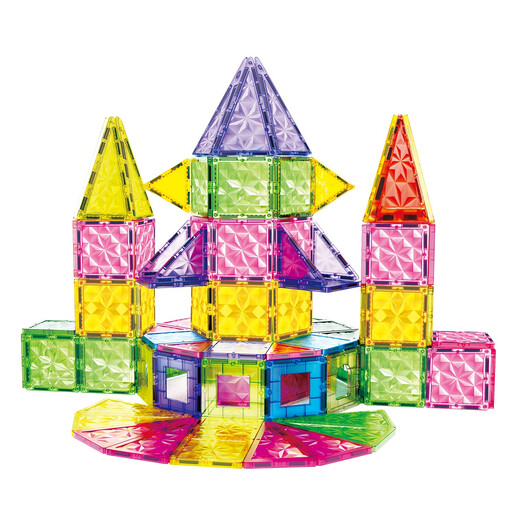
Why it suits this profile: With more pieces and the stated 7.5 cm size, this set gives you more to work with when building taller or larger 3D magnetic structures.
The product details list the piece count, material, example dimensions and warnings. This makes it easier to check whether the set suits your available space and the child’s age.
117 pieces, ABS plastic, a variety of shapes and stated compatibility with common 7.5 cm systems.

Why it suits this profile: Transparent pieces, track elements and lights make this a good choice for children who want to combine moving parts with 3D builds.
The product description clearly states the battery requirement: the lights need 3 AA batteries, which are not included.
126 pieces, track elements, transparent panels and a stated package size of 29,5 × 39 × 7 cm.
A magnetic building block set will last longer if you avoid throwing the pieces, pressing them too hard or washing them with water. Give them a quick visual check after each play session. In settings with several groups, sort the sets by shape and size. This makes it easier to keep track of all the pieces and helps children build more independently.
If you’re choosing a creative building toy as a gift, a clear theme can be helpful. According to the product description, a 48-piece alphabet set such as the Tokky set combines building with letter recognition. A set with wheels may be better for making vehicles. A marble run adds movement to play, but needs more space and closer adult supervision.
We’ve put together a complete, regularly updated list of products that fully meet these strict selection criteria and the safety regulations in force in the EU.
According to the product details for each set, the featured products are intended for children aged 3 and over. The age guidance should be followed carefully because the sets contain small pieces and magnets. Adult supervision is particularly advisable the first time a child uses them and for younger children.
Their lifespan depends on the quality of construction, how they’re used and how they’re cared for. Check the edges, casings and magnet enclosures regularly. Don’t continue using pieces with cracks, loose magnets or damaged surfaces.
They can introduce children to the basics of shapes, colours, stability and spatial awareness through play. The learning benefits depend on the child’s age, interests and the support they receive. Open-ended activities, where children can come up with their own solutions, work well for Montessori-style construction play and STEM-focused activities.