
Lieferung heute & morgen

Qualitätsgarantie

Willkommens-Angebote freischalten: KOSTENLOSE Lieferung | Bis zu 80 % RABATT | Kostenlose 30-Tage-JoyPlus-Testphase
App herunterladen
Magnetic building blocks for children combine open-ended construction with shapes, colours and spatial thinking. However, not every set is suitable for every age or play environment. A high piece count alone says little about how practical a set is for everyday use. Key factors include the magnetic connection, the size of the pieces, the material information and practical storage.
A set with 100 pieces sounds extensive. However, if it contains mainly identical squares, more complex models are only possible to a limited extent. To build houses, vehicles or three-dimensional figures, a magnetic building set for children needs a variety of basic shapes, such as squares, triangles and pieces for roofs or wheels.
The intended age group also matters: 32-piece magnetic building blocks are better suited to beginners or use on the go. A set with 50, 81 or 100 pieces offers more possibilities for larger construction projects. The number of pieces should therefore always be considered alongside the range of shapes included.
The claim “strong magnets” does not automatically mean that a product is safely designed. Check whether the magnets are securely enclosed in the plastic and whether the manufacturer states that they are sealed or welded into a casing. Magnets can come loose if pieces are damaged. This is particularly serious because swallowed magnets can cause severe injuries.
For children aged 3 and over, magnetic tiles and magnetic building blocks should only be used in accordance with the warnings and, for younger children, under supervision. Damaged pieces should be removed from play immediately.
Loose magnetic building blocks are easily lost. A bag, box or metal tin is therefore far more than an optional extra. It makes sorting easier and means the set can be used for holidays, visits or nursery. When buying a gift for a child, it should also be clear whether the packaging is suitable for storage or is merely intended as retail packaging.
Many of the sets considered here are made from ABS plastic. Look for smooth, burr-free edges and sturdy construction. Claims such as “non-toxic” should ideally be supported by specific compliance or testing information. Depending on the model, product descriptions may include references to CPC, ASTM, REACH or EN71. This information comes from the respective product details and does not replace checking the labelling on the packaging.
Cleaning is also important: depending on the model, only wiping with a soft cloth may be recommended. Many magnetic tiles should not be submerged in water, as moisture can affect the internal components.
Dimensions vary considerably. Tokky uses square pieces measuring 3.75 cm in several sets. Other XINQIYUAN sets use tiles measuring 5.5 cm or 7.5 cm. Larger elements are often easier for small hands to grip, while smaller pieces allow more detailed patterns. At the same time, supervision becomes even more important with smaller pieces.
If you already own a construction system, compare the piece size and magnet arrangement. A set may be described as compatible with other systems of the same size, but this does not mean that it is universally compatible with every manufacturer.
Magnetic construction toys can encourage children to combine shapes, experiment with balance and develop their own solutions. Through play, they practise hand-eye coordination, spatial awareness and problem-solving skills. This makes magnetic building blocks a potential addition to STEM toys and educational construction toys.
However, the benefits depend on the child’s age, interests and the support they receive. An idea guide or themed building pieces can make it easier to get started, while open-ended sets leave more room for children to create their own constructions.

Why this product suits this profile: This 32-piece set is aimed at families looking for a manageable educational toy for children aged 3 and over, whether for first construction attempts or trips away. The metal tin doubles as storage.
The piece count remains manageable, while the basic square shapes provide an easy introduction. The tin helps reduce the risk of pieces being lost while travelling.
32 ABS pieces, 3.75 cm individual piece size, strong magnetic connection and portable metal tin.
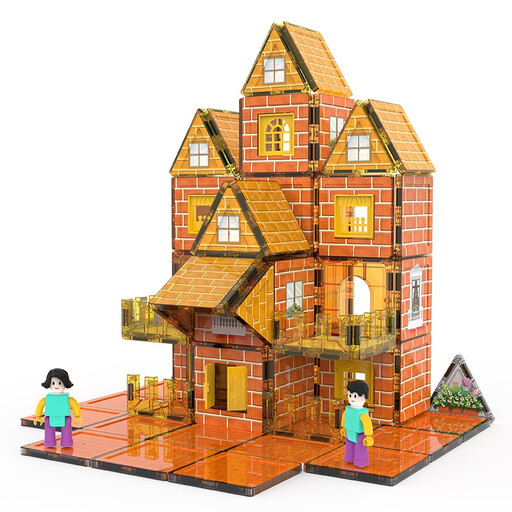
Why this product suits this profile: This set combines 7.5 cm tiles with a villa theme and is aimed at children who want to build more detailed buildings and scenes.
The product description states that the magnets are fully enclosed and that the set has rounded ABS edges and a storage bag. This makes checking and storing the pieces easier.
81 pieces, 7.5 cm format, villa building pieces, reinforced magnetic connections and storage bag.
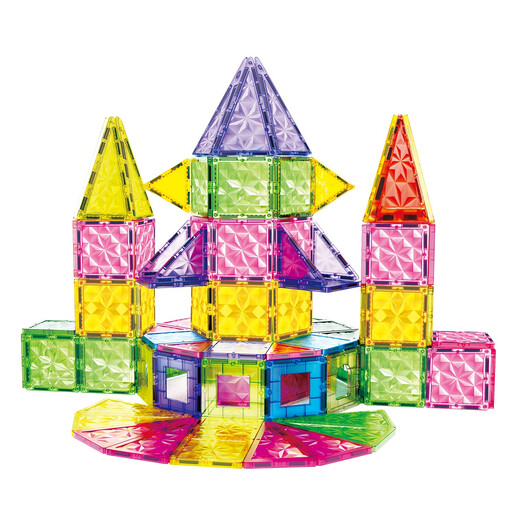
Why this product suits this profile: The wider range of shapes and 117 pieces are ideal for families, groups or settings where larger 3D constructions are built regularly.
The variety of pieces goes beyond a basic set of standard shapes. The description mentions an idea guide, a storage solution and securely enclosed magnets.
117 pieces, 7.5 cm format, diamond surface, various shapes and ABS plastic with smooth edges.
We have put together a complete, regularly updated list of products that fully meet these strict selection criteria and the safety regulations applicable in the EU.
According to their product descriptions, many of the products mentioned are intended for children aged 3 and over. However, they contain small parts and strong magnets. Adults should follow the instructions, supervise children initially and regularly check the pieces for cracks or loose magnets.
Their lifespan depends on the materials, workmanship and how they are used. Do not throw them, bend them excessively or submerge them in water if this is not permitted according to the care instructions. Storing them in a dry place and regularly checking the magnet casings can help you remove damaged pieces at an early stage.
For first experiences, 28 to 50 pieces are often enough. A 32-piece set is easy to manage on the go. For several children or large constructions, 81, 100 or 117 pieces are more suitable. The shapes included, piece size and available storage space remain the key considerations.