
Lieferung heute & morgen

Qualitätsgarantie

Willkommens-Angebote freischalten: KOSTENLOSE Lieferung | Bis zu 80 % RABATT | Kostenlose 30-Tage-JoyPlus-Testphase
App herunterladen
Magnetic building blocks for children combine open-ended building with shapes, colours and simple construction principles. However, choosing the right set is not always easy for parents, grandparents and educational settings. Product images often show large constructions, even though the set contains only a few basic shapes. Claims such as “strong magnets” or “STEM toy” also reveal little on their own about actual suitability.
Before buying, you should therefore check three common pitfalls:
Many magnetic building blocks for ages 3+ contain small parts. The “3+” recommendation refers to the intended age group, not to unsupervised play. Children should not be able to put the building blocks in their mouths. Individual magnetic balls are particularly hazardous: if several magnets are swallowed, they can attract one another inside the body and cause serious injury. If you suspect that magnets have been swallowed, seek medical help immediately.
Look out for:
For younger children, playing together is recommended. After play, all pieces should be counted and stored in a box or bag.
The size of the pieces affects both how easy they are to handle and the types of construction they can create. Small 2.5-cm or 3.75-cm elements are practical for travel and detailed patterns. Larger magnetic tiles measuring 5.5 cm or 7.5 cm are often easier to grip and are suitable for larger surfaces and simple 3D constructions.
The number of pieces should not be considered in isolation. A 28-piece set may be enough for first vehicles or patterns, while larger constructions usually require a range of shapes and more pieces. Check whether the set contains rectangles, windows, wheels, balls or specialist parts in addition to squares and triangles.
Product details often mention ABS plastic, rounded edges and welded magnet chambers. For some sets, suppliers also refer to CPC, ASTM, EN71 or REACH information. These details should always be linked to the specific product and are not a blanket indication of quality for all magnetic toys.
Important points for everyday use:
Storage is another practical consideration. A supplied bag or storage box helps prevent individual pieces from being lost and makes the set easier to use in nurseries, schools, children’s bedrooms or while travelling.
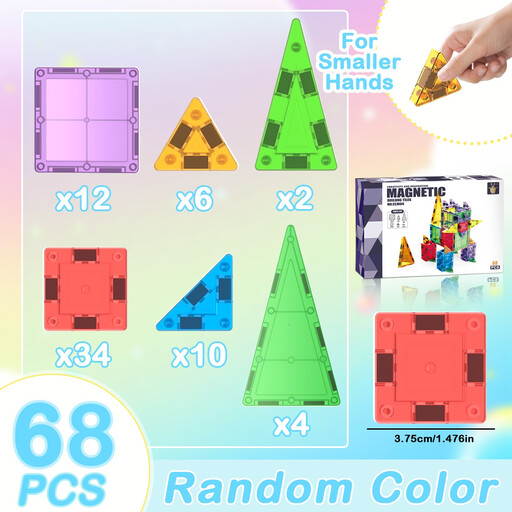
Why this product suits this profile: This set is described as a compact starter solution with 3.75-cm tiles, a storage box and 68 pieces. It is suitable for creating first patterns and manageable 3D models.
The stated individual piece size and number of pieces make it easier to assess what you can actually build than an vague promise of “endless” constructions.
3.75-cm tiles, storage box and, according to the product details, permanently enclosed magnets.
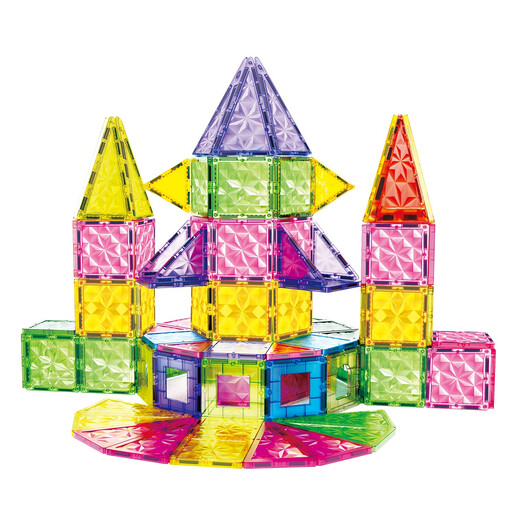
Why this product suits this profile: The larger piece size and selection of different shapes are designed for more ambitious building projects. The set is described as including a storage solution and instructions.
The specific details of 117 pieces and 7.5 cm make it easier to assess a supposedly large set by more than just its packaging.
117 pieces, 7.5-cm format and, according to the product description, welded magnet chambers.
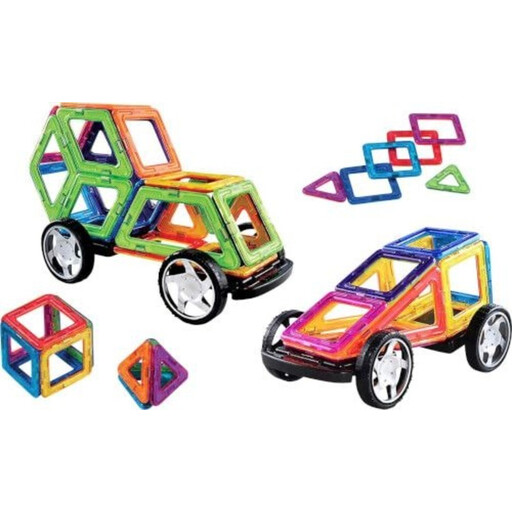
Why this product suits this profile: The included wheels expand classic building into vehicles such as cars and lorries. This makes the set appealing to children who prefer moving models to large surfaces.
The intended use is clear: 32 pieces including wheels and connectors. This helps avoid accidentally buying a tile set for a child who mainly wants to build vehicles.
Wheels and connectors; manual operation without batteries.
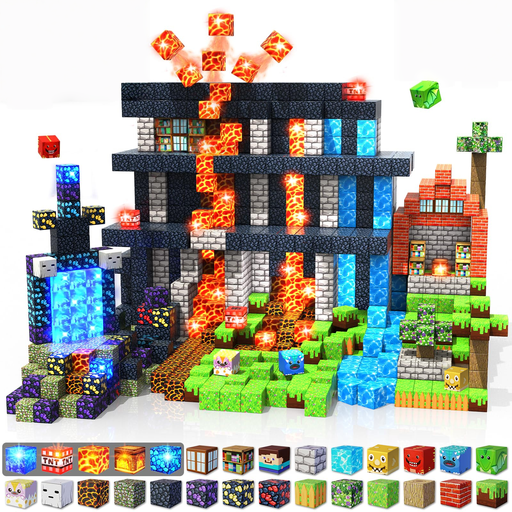
Why this product suits this profile: With 150 magnetic cubes, two themed worlds, six figures, two stories and 24 light blocks, this set offers plenty of components for building and storytelling together.
The product description lists the components individually. This makes it easier to check whether the cubes, figures and light elements really suit the planned family play.
150 magnetic cubes and 24 light blocks; includes an ideas booklet and themed design elements.
We have put together a complete, regularly updated list of products that fully meet these strict selection criteria and the safety regulations applicable in the EU.
To get started, children can begin by laying out flat patterns. They can then move on to simple houses, towers or vehicles. Adults can explain terms such as triangle, square, connection or balance without directing the play completely. This leaves room for children to create their own constructions.
Particular care is required with sets containing magnetic building blocks with balls. Balls should only be used under direct supervision and collected completely after play. Magnetic toys for children should also be kept away from sensitive electronic devices, magnetic cards and medical devices.
The 3+ age recommendation is a guide provided by the manufacturer. The child’s maturity, how they handle small parts and whether supervision is available are also important factors. Magnetic sets with small parts should not be used by children who still frequently put objects in their mouths.
Their lifespan depends on the materials, workmanship and how they are used. Check the pieces regularly for cracks, deformation and exposed magnets. Damaged building blocks should be removed immediately. Dry storage, careful cleaning and avoiding drops can help extend their useful life.
Most classic sets work without electricity. Versions with light blocks may require batteries depending on the design, so you should check the relevant product description before buying. Sets with wheels or balls generally work mechanically and do not require batteries.