
Lieferung heute & morgen

Qualitätsgarantie

Willkommens-Angebote freischalten: KOSTENLOSE Lieferung | Bis zu 80 % RABATT | Kostenlose 30-Tage-JoyPlus-Testphase
App herunterladen
Magnetic building blocks for children combine open-ended construction with geometric shapes, colours and spatial awareness. For parents, grandparents and educational settings, however, choosing the right set is not always straightforward: product pages promote “strong magnets”, STEM learning content or Montessori concepts, while important details such as piece size, storage and safety can easily be overlooked.
A magnetic building block set with 100 pieces may sound substantial at first. What really matters is the shapes included. A set containing mostly small squares allows for different constructions than one with triangles, windows, roofs, balls or connector pieces.
For a first building experience, 32 to 56 pieces may be enough. If several children will be building together or you are planning larger 3D structures, it is better to look for 76, 100 or more pieces. The packaging should clearly state the actual number of pieces and the types of shapes included.
High magnetic strength can be helpful during construction, but it is not the only indication of quality. More important is that the magnets are fully enclosed within the plastic casing and that the casings are robustly made. Details such as ultrasonic welding or a permanently sealed magnet chamber provide specific indications of this.
Magnets must not be accessible or loose. If there are cracks, opened edges or a detached magnet, the toy must be taken out of use immediately. Swallowed magnets can cause serious injuries. Magnetic building blocks should therefore not be given to children under three and should be used under adult supervision.
Many Magnetic Tiles are described as STEM learning toys, Montessori construction toys or aids for developing spatial thinking. These terms primarily describe the play concept and do not automatically demonstrate proven learning outcomes. A good set offers a variety of shapes and sufficient stability so that children can try out their own solutions.
For children aged three and over, smooth, burr-free edges, easy-to-grip pieces and clear warnings are particularly important. Small additional pieces, balls or specialist elements expand the ways to play, but they also require more consistent supervision.
Many of the sets featured here are made from ABS plastic. Look for smooth, rounded edges, low-odour materials and an enclosed construction. The packaging should also include manufacturer details, an EU-based responsible person, the recommended age and safety warnings. The CE marking on toys is an important indication of the manufacturer’s declared conformity with applicable EU requirements; however, it does not replace your own check for damage.
Magnetic tiles for children vary considerably in size. Sets with 2.5 cm pixel or magnetic pieces are suitable for detailed scenes, while formats measuring 3.75 cm, 5.5 cm or 7.5 cm are generally easier to hold. If you want to expand an existing collection, compare the formats first. Magnetic building blocks from different systems are not automatically compatible, even if the product images look similar.
A bag, box or metal tin helps prevent pieces from going missing and makes the set easier to use in nursery, school or while travelling. For regular play, sets with organised storage are more practical than products that offer no suitable storage solution once opened. The pieces should generally be cleaned according to the manufacturer’s instructions, usually with a dry or slightly damp cloth. Magnetic products should not be fully immersed in water.

Why this product suits the profile: With 32 pieces and a metal tin, this compact set is ideal for beginners, shorter play sessions and taking on the go.
The number of pieces, individual piece size of 3.75 cm and storage tin are all clearly stated. This makes it easier to assess the set before buying.
32 pieces, ABS plastic, rounded edges and a portable metal tin.

Why this product suits the profile: The 76 transparent pieces, each measuring 3.75 cm, offer more creative possibilities for families who want to build 2D and 3D structures regularly.
The product description specifies the number of pieces, size, material and safely enclosed magnets rather than relying solely on general marketing claims.
76 pieces, transparent design, ABS plastic and, according to the product details, compatibility with popular magnetic tile sets.

Why this product suits the profile: This extensive set is aimed at frequent users and settings that want to enjoy not only building but also a marble run with a light-up function.
The product details specify 126 pieces, the three AA batteries required and direct adult supervision. This makes ongoing battery costs clear.
126 pieces, transparent 3D elements, marble-run components and a battery-powered light-up function.
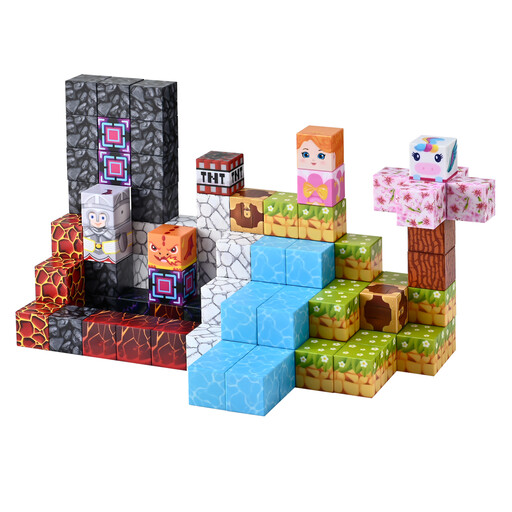
Why this product suits the profile: Pixel elements and themed building pieces appeal to children who want to combine characters, landscapes and stories in their own construction concepts.
The product page specifies 100 pieces, an individual piece size of 2.5 cm, ABS material and rounded edges. This makes it easier to assess the detailed format in advance.
100 pixel building blocks, themed textures, colourful gift packaging and, according to the product details, magnetic connections for multi-layered constructions.
We have put together a complete, regularly updated list of products that fully meet these strict selection criteria and the safety regulations applicable in the EU.
Many of the products mentioned are intended for children aged three and over, according to the product details. Nevertheless, they contain small pieces and strong magnets. Adults should regularly check the pieces for cracks, loose magnets or damaged casings, and supervise younger children while they play.
Their lifespan depends on the materials, workmanship and how they are used. Do not throw them, stand on them or treat them with water or harsh cleaning products. After playing, all pieces should be stored somewhere dry and protected. If there is visible damage, the set should no longer be used.
For first constructions, 32 to 56 pieces are often enough. For houses, vehicles and larger 3D structures, 76 to 126 pieces offer greater flexibility. For groups in schools or nurseries, several compatible sets may be more useful than a single set containing lots of specialist pieces.