
Lieferung heute & morgen

Qualitätsgarantie

Willkommens-Angebote freischalten: KOSTENLOSE Lieferung | Bis zu 80 % RABATT | Kostenlose 30-Tage-JoyPlus-Testphase
App herunterladen
Magnetic building blocks for children combine open-ended construction with geometric shapes, colours and simple building principles. However, not every set suits every child or family routine. Large quantities, “strong magnets” and STEM labels may sound convincing at first, but on their own they say little about how suitable a product is in practice.
Three typical buying patterns often lead to poor decisions:
For the magnetic building blocks considered here, the recommended age is generally 3 years and over. This is not simply a guide to the level of difficulty; it also relates to small parts and enclosed magnets.
When buying, parents should look for the following information:
The CPC and ASTM markings shown for some products refer to US certifications or testing standards. They do not automatically replace checking the conformity information relevant to sales in Germany or the European market. CE marking and the associated product information should also be checked before purchase.
Important: If magnets are swallowed, they can cause serious injuries. If this is suspected, seek medical help immediately. Magnetic building blocks should also be kept away from magnet-sensitive devices, credit cards and medical equipment.
The size of the individual pieces has a significant effect on the play experience. A set with 5.5 cm diamonds is handled differently from a compact starter set with 3.75 cm squares. Larger magnetic tiles are often easier to manage for first constructions, while smaller pieces allow more detailed patterns.
The number of pieces should also suit how the set will be used:
Also check compatibility. Some sets can only be meaningfully expanded with building blocks of the same size. The XINQIYUAN set with 5.5 cm components is stated to be compatible with other magnetic construction sets in this format. Different formats, on the other hand, cannot always be connected securely.
A magnetic construction set with lots of pieces is only practical in the long term if it can be stored neatly. A storage bag or metal tin can help prevent components from disappearing among other toys. Compact packaging is particularly useful for travelling.
Manufacturers’ care instructions vary. Some products should be cleaned with a dry, soft cloth, while others can be wiped with a slightly damp cloth. Soaking in water and harsh cleaning products should be avoided, as they may damage plastic surfaces and the seals around the magnetic elements. A quick visual check after each use is recommended.

Why this product suits this profile: The compact 32-piece set with a metal tin is suitable for first building attempts, shorter play sessions and taking on trips.
The manageable number of pieces helps avoid unnecessary spending, while the metal tin provides a practical solution for preventing components from getting lost.
32 square magnetic tiles, 3.75 cm per piece, ABS plastic and packaging that doubles as a storage container.
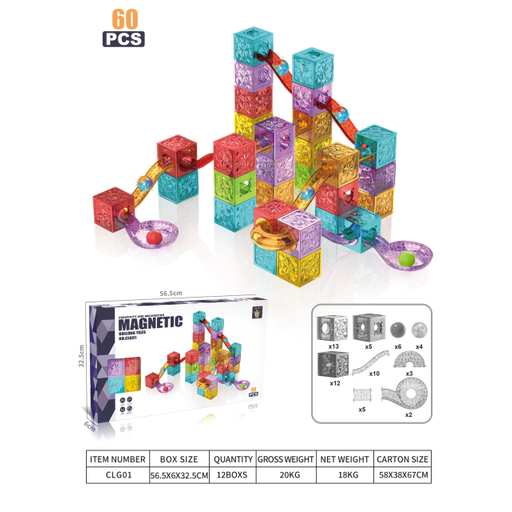
Why this product suits this profile: The 5.5 cm diamonds and 60 pieces provide a clearly defined building format for 2D patterns and larger 3D constructions.
The product information states that the magnets are enclosed and that the pieces have rounded edges, as well as listing CPC and ASTM certifications. These details should nevertheless be checked against the product labelling.
60 pieces, 5.5 cm format, storage bag and, according to the product description, compatibility with additional sets in the same format.

Why this product suits this profile: This 126-piece set is designed for families who want to enjoy transparent tracks and rolling balls alongside construction play.
The additional features are clearly specified: transparent components, track elements and a battery-powered light function. Three AA batteries are not included.
126 pieces, transparent 3D elements, marble-run components and gift box; suitable from 3 years of age under supervision.
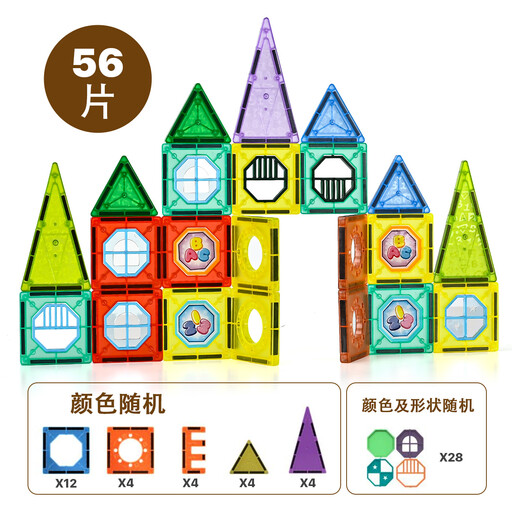
Why this product suits this profile: The 56 transparent magnetic tiles combine a medium-sized set with colourful components and a gift box.
The product description specifies the material, number of pieces, enclosed magnets and rounded edges, rather than justifying suitability with broad educational claims.
56 pieces, transparent ABS components, compatible with other standard sets according to the description, with no batteries required.
Magnetic construction toys can encourage children to combine shapes, distinguish between surfaces and volume, and observe cause and effect. A marble run made with magnetic building blocks also introduces movement, gradients and simple problem-solving.
That does not automatically make a product a complete STEM toy. The educational value mainly comes from how it is used:
For families with children under 3, these sets are generally unsuitable because of the small parts and magnets, provided that the product information expressly rules out use by this age group.
We have put together a complete, regularly updated list of products that fully meet these strict selection criteria and the safety regulations applicable in the EU.
Many sets are approved for children aged 3 years and over. The information on the packaging and in the product description is the key reference. Because of the small parts and strong magnets, children should be supervised when playing with them for the first time. Damaged components must be removed immediately.
Their lifespan depends on the material, how well the magnets are sealed and how the pieces are handled. Avoiding throwing or standing on the pieces, and storing them in a dry place, helps reduce wear and tear. Regularly checking for cracks, loose magnets and sharp edges is more important than giving a blanket number of years.
Classic magnetic tiles and magnetic building blocks normally work without batteries. Special features may be different: the TOKKY set with illuminated tracks, for example, requires three AA batteries, which the product information states are not included.