
Lieferung heute & morgen

Qualitätsgarantie

Willkommens-Angebote freischalten: KOSTENLOSE Lieferung | Bis zu 80 % RABATT | Kostenlose 30-Tage-JoyPlus-Testphase
App herunterladen
Magnetic building blocks for children combine open-ended building with geometric shapes, colours and simple construction principles. But choosing the right set isn’t always easy for parents, grandparents, nurseries and educational settings. Product images often show impressive structures, while the set itself may contain only a few basic shapes. Claims such as ‘strong magnets’ or ‘STEM toy’ don’t, on their own, tell you whether a magnetic building set is right for your child’s age, how it will be used or the toys you already have.
A high piece count sounds appealing, but what matters is how many different shapes are included. A set with lots of identical squares offers different possibilities from one with triangles, windows, doors, roofs or specialist pieces. For 3D building sets for children, the mix of shapes, their dimensions and compatibility are more important than the total number of pieces.
Magnetic strength affects how easily pieces connect and how stable a structure is. For children aged 3 and over, however, it’s particularly important to look for securely enclosed magnets, rounded edges and regular checks. If magnets come loose or the plastic cracks, stop using the toy. Swallowed magnets can cause serious injuries; seek medical help immediately if you suspect a child has swallowed one.
Magnetic tiles for children often contain small parts. Even if a product is recommended for ages 3 and over, an adult should supervise the first use and check the pieces regularly. Magnetic building blocks aren’t suitable for younger siblings if small parts are within reach. A safe storage bag can also help you put every piece away after play.
For children aged 3 and over, choose sets with easy-to-grip pieces and a clear age recommendation. Don’t choose educational toys for children aged 3 and over based on colour alone. Check:
For children under 3, larger, non-magnetic building blocks, such as soft EPE foam modules or large interlocking pieces, may be more suitable. Always follow the age recommendation for the specific product.
Many magnetic building blocks are made from ABS plastic. It’s not just claims such as ‘non-toxic’ that matter, but also clear information about how the product is made and used. Some sets on offer state that the magnets are sealed using ultrasonic welding. Other product information refers to CPC/ASTM, or, for the 116-piece villa set, the EU toy safety standard EN71. Check these details directly on the product page. They don’t replace a visual check before play.
Sets with damaged panels, loose magnets, sharp edges or deformations should be discarded. Clean magnetic building blocks according to the manufacturer’s instructions, usually with a soft, slightly damp cloth. Many sets aren’t designed to be fully immersed in water.
The XINQIYUAN sets selected here mostly have an edge length of 7.5 cm. According to the product information, sets of the same size can be combined. Even so, before adding to a collection you already own, compare the shapes, connection points and manufacturer’s guidance.
A storage bag is handy for families and childcare settings. It helps prevent pieces from going missing and makes it easier to check that everything has been put away after play. Nurseries should also use a labelled box and carry out a quick visual check before each use.

Why this product suits this profile: With 58 pieces, this set offers a manageable introduction to magnetic building and, according to the product information, comes with a storage bag. The 7.5 cm pieces are suitable for making first 2D patterns and simple 3D models.
The piece count and tile size are clearly stated. The product description also flags small parts and magnets, and explains that supervision is required.
58 pieces, 7.5 cm format, storage bag and, according to the product information, compatibility with other 7.5 cm systems.
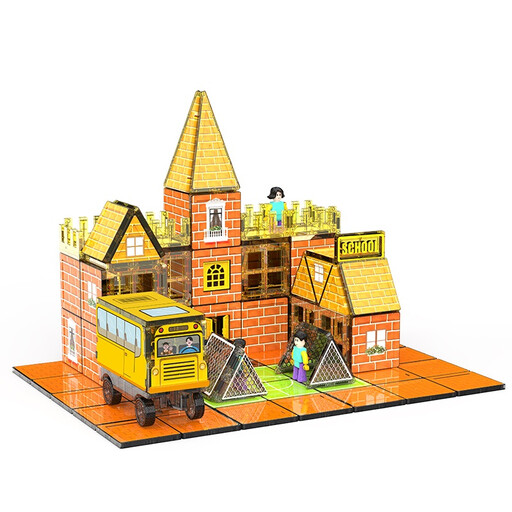
Why this product suits this profile: This set is aimed at children who are ready to build larger houses and other structures. According to the product information, it includes architectural features such as windows, doors and roof pieces.
The product information mentions sealed magnets, rounded edges and a recommended age of 3 and over. Check these details on the product listing before buying.
116 pieces, 7.5 cm format, stated double-layer magnet design and specialist pieces for detailed buildings.
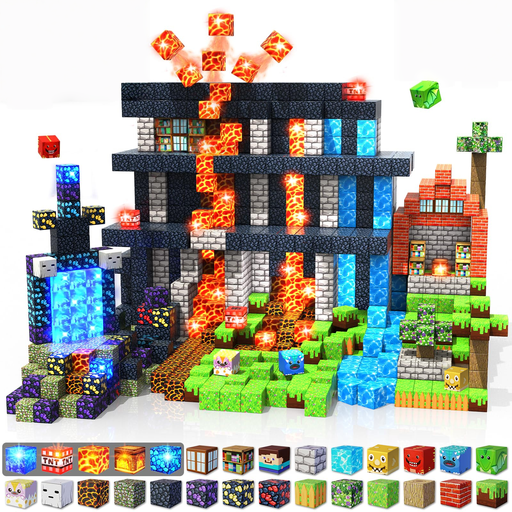
Why this product suits this profile: With 150 magnetic cubes, 24 light-up pieces and themed design templates, this set is well suited to longer play sessions at home or building together with several children.
The product description states the piece count, recommends the set for ages 3 and over, and warns that it contains small parts. Supervision and regular checks of the pieces are still essential.
150 cubes, 24 light-up pieces, two themed worlds and an idea booklet, according to the product description.
We’ve put together a complete, regularly updated list of products that meet these strict selection criteria and fully comply with the safety regulations in force in the EU.
Many sets are intended for children aged 3 and over, according to the product information. However, they contain small parts and magnets. Adults should supervise play, particularly with younger children, and keep siblings under 3 away from the play area.
How long they last depends on the materials, construction, how often they’re played with and how they’re stored. Securely enclosed magnets, smooth edges and careful handling can help them stand up to everyday use. Regular checks are more important than a general claim about how long they’ll last.
Around 50 to 60 pieces are often enough to get started. If you want to build larger houses, vehicles or complex 3D models, a set of around 80 to 120 pieces—or an expansion with compatible shapes—may be a better fit. What matters most is whether the pieces included are right for the kind of play you have in mind.