
Lieferung heute & morgen

Qualitätsgarantie

Willkommens-Angebote freischalten: KOSTENLOSE Lieferung | Bis zu 80 % RABATT | Kostenlose 30-Tage-JoyPlus-Testphase
App herunterladen
Magnetic building blocks for children combine free building with shapes, colours and simple principles of physics. To parents, grandparents and other family members, many sets look similar at first glance. But there are differences in age recommendations, magnetic connections, piece size, storage and play options.
If you focus only on the number of pieces or how strong the magnets are, you could easily buy a set that doesn’t suit your child’s fine motor skills or the way you plan to use it. This buying guide explains which features really matter when choosing magnetic building blocks.
A set with 117 or 150 pieces sounds impressive. But what matters is how many different shapes it includes and whether they can be used to build stable two- and three-dimensional structures. Lots of similar basic shapes may offer fewer possibilities than a smaller set with triangles, squares, connectors or specialist pieces.
Strong holding power can be useful when building larger models. But for children aged 3 and over, it’s just as important that the magnets are securely enclosed in the plastic. Damaged edges, cracks or loose magnet components are deal-breakers. If magnets are swallowed, they can attract one another inside the body and cause serious injuries.
Magnetic building block sets for children aged 3 and over often contain small individual pieces. The age guidance is therefore not just a recommendation for play value; it’s also an important safety factor. Children should not put the pieces in their mouths. Younger children need to be supervised closely by an adult.
Look for product details such as welded, sealed or fully enclosed magnets. References to ultrasonic sealing may indicate how the product is made, but they don’t replace regular checks during everyday use. Before each use, check:
If you spot any damage, stop using the set.
Many magnetic tiles and magnetic building blocks are made from ABS plastic. Look for smooth, burr-free edges and sturdy construction. ‘Non-toxic’ or ‘BPA-free’ shouldn’t be your only reason for buying; also check that the manufacturer and responsible party are clearly identified.
A soft cloth is usually all you need for cleaning. Depending on the product, it can be dry or slightly damp. Fully submerging the pieces in water may affect the magnetic components or connections, so check the product description for care instructions.
Large magnetic tiles with edges around 7.5 cm are often easier for little hands to grip. Smaller formats, on the other hand, can allow for more detailed constructions. Compare:
A 28-piece set may be enough to get started, while regular users may benefit from 76, 117 or more pieces. Compatibility details should be treated as information from the manufacturer, not as a guarantee that the pieces will fit every third-party product.
The selection below matches specific sets to different needs. The details are based on the relevant product descriptions.
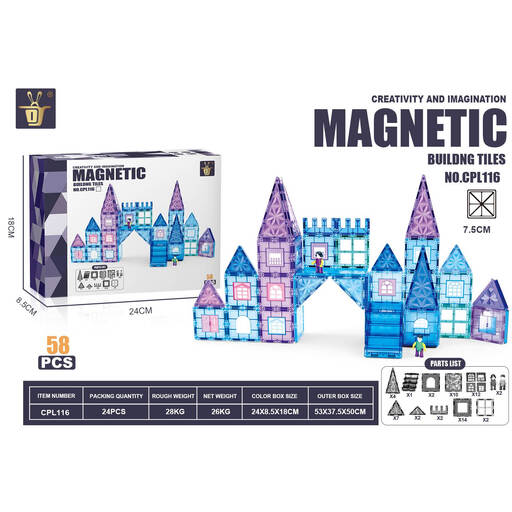
Why this product suits this need: This 58-piece set offers a manageable introduction to magnetic construction toys. The stated 7.5 cm size of each piece and the storage bag make it practical for first building attempts and taking along on the go.
The number of pieces is manageable, so you don’t have to pay for a very large set unnecessarily. According to the product details, the magnets are enclosed in the ABS casing; you should still check the pieces regularly for damage.
58 pieces, 7.5 cm format, storage bag and no batteries required.
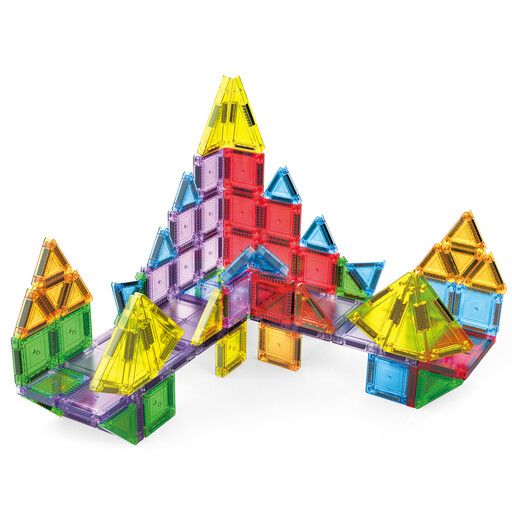
Why this product suits this need: This transparent set contains 76 pieces with a stated edge length of 3.75 cm. It’s a good choice for families looking for a variety of shapes, visible connections and a compact format.
The product description specifies enclosed magnets, smooth edges and ABS plastic. This gives you clear details about key aspects of the construction, though you’ll still need to check the pieces visually.
76 transparent pieces, 3.75 cm format, geometric shapes and suitability for 2D and 3D constructions.
Why this product suits this need: This 126-piece set is designed for children who want to build as well as create marble runs and use light-up features. It offers families several ways to play in one set.
The number of pieces and the included marble-run components are clearly specified. The light feature’s battery requirements are also stated: it needs 3 AA batteries, which are not included.
126 pieces, transparent 3D building elements, marble-run components and a light feature.
Collect all the magnetic building blocks after play and store them somewhere dry. A bag or box helps prevent small pieces from going missing. Keep sets away from electronic devices, magnetic cards and medical devices if the manufacturer advises you to do so.
If you think a child has swallowed one or more magnets, seek medical help immediately. Do not induce vomiting. The sets listed are not suitable for children under 3 because they contain small parts and magnets.
We’ve put together a complete, regularly updated list of products that meet these strict selection criteria and fully comply with the safety regulations in force in the EU.
Many sets are labelled as suitable for children aged 3 and over. However, they contain small parts and strong magnets. Adults should check the pieces regularly for cracks or loose components and supervise younger children closely while they play.
Their lifespan depends on the quality of the plastic, how well the magnets are sealed and how the pieces are treated. Throwing or bending them, high temperatures and moisture can cause damage. With careful use and dry storage, magnetic tiles can last for a long time. Any damaged pieces should be removed from the set straight away.
Traditional magnetic building blocks don’t need batteries. Extra features such as light-up tracks may, however, require batteries. Before buying, check whether batteries are included and what size you’ll need. Otherwise, the main extra costs are likely to be a compatible expansion set or replacement parts.