
Lieferung heute & morgen

Qualitätsgarantie

Willkommens-Angebote freischalten: KOSTENLOSE Lieferung | Bis zu 80 % RABATT | Kostenlose 30-Tage-JoyPlus-Testphase
App herunterladen
Magnetic building blocks for children combine open-ended building with shapes, colours and simple spatial concepts. But choosing the right set isn’t always straightforward for parents, grandparents, nurseries and educational settings. Sets vary considerably in piece count, individual piece size, magnet design, materials and storage.
A high price per piece or a large box doesn’t necessarily mean a set is practical for everyday use. What matters is whether it suits the child’s age, your existing collection and how you plan to use it.
A high piece count can look appealing at first. But if a set contains mostly identical tiles, the scope for building more complex models is limited. A variety of basic shapes, such as squares and triangles, along with special connectors, is useful for creating different buildings, vehicles and 3D structures.
So don’t just check the total number of pieces: look at which shapes are actually included. A 32-piece starter set may be enough for first 2D patterns, while larger building sets offer more choice for playing together or creating architectural models.
Strong magnets can help hold constructions together more securely. But rather than relying on a marketing claim about magnetic strength, check whether the magnets are securely enclosed within each piece. Details such as a welded or ultrasonically sealed casing are useful product information.
Don’t use magnetic building blocks if a casing is cracked or a magnet is loose. Swallowed magnets can cause serious injuries. If you suspect that a magnet has been swallowed, seek medical help immediately.
Many magnetic building blocks for ages 3+ contain small pieces, so the age recommendation doesn’t mean children can play unsupervised. Adults should accompany younger children during their first play sessions, explain how to use the toys safely and check the pieces regularly.
Magnetic tiles come in different sizes. Some sets, for example, use pieces measuring 7.5 cm, while others have more compact pieces measuring 3.75 cm or 5.5 cm. Piece size affects how easy the tiles are to handle, how stable the constructions are and whether you can add to an existing set.
If you already own magnetic construction toys, compare the system sizes. Stated compatibility usually applies to specific dimensions and shapes, not automatically to every magnetic building set for children.
ABS plastic is used for many magnetic tiles. Look for clear information about smooth, burr-free or rounded edges. These features make the pieces easier to handle and reduce sharp edges.
The product information should also make it clear that the magnets are secured inside and can’t be accessed. Any claims about certificates or standards should be available to check on the product page. A product description is no substitute for checking the toy regularly during everyday use.
Smaller sets of around 28 to 50 pieces are enough to get started. Sets with 56 to 81 pieces offer more scope for building together. Larger sets with over 100 pieces are better suited to families, groups or educational settings, provided there’s enough storage space.
Storage bags, boxes or a metal tin are useful. Keep the pieces dry, clean them with a soft cloth and check them for cracks or loose magnets after each use. Products with lights or battery-powered features also need the right batteries and safe storage.

Why this product suits this profile: This compact set contains 32 magnetic tiles. According to the product details, each square measures 3.75 cm, and the pieces come in a metal tin. It’s suitable for making first patterns and simple 3D shapes at home or on the go.
The piece count and individual size are clearly stated. The tin helps keep everything organised and reduces the risk of small pieces getting lost.
32 pieces, no batteries needed, a portable metal tin and basic geometric shapes.

Why this product suits this profile: According to the seller, this themed set includes 50 pieces in the 7.5 cm system, a storage bag and sealed magnets. Its design encourages role play and spatial building, rather than limiting play to simply collecting pieces.
The product details specify the material, edge finish, sealed magnets and system size. This makes it easier to check the safety and compatibility criteria before buying.
50 pieces, 7.5 cm format, castle theme and storage bag, plus CPC and ASTM information according to the product description.

Why this product suits this profile: This extensive 3D magnetic building set combines transparent tiles with track pieces and a light-up feature. It’s designed for larger building projects, siblings playing together or educational play settings.
The product description lists the 126 pieces, box size and battery type. This makes it easier to work out how much storage space you’ll need and what’s involved in keeping it running.
126 pieces, transparent building elements, track components and a light-up feature; requires 3 AA batteries, which are not included.
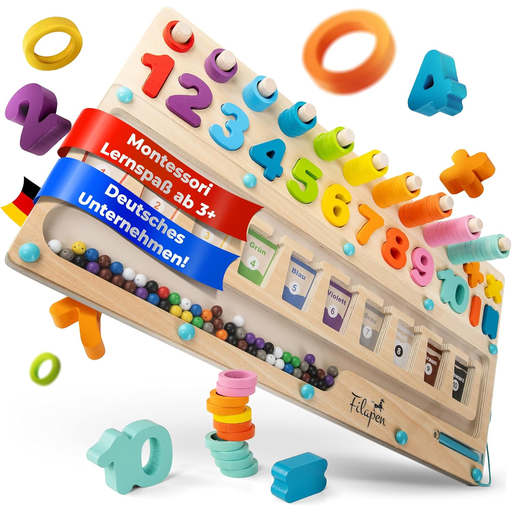
Why this product suits this profile: This wooden toy features an attached magnetic pen, colour sorting and numbers from 1 to 10. It’s an alternative to traditional magnetic tiles if you want to focus on fine motor skills, colours and early number learning.
The magnetic pen stays attached to the game board. This means there are fewer loose magnetic pieces during play than with magnetic building blocks that can be freely combined.
Solid wood, colour and number matching, a magnetic maze and no batteries required.
We’ve put together a complete, regularly updated list of products that meet these strict selection criteria and the safety regulations in force in the EU.
The age recommendation indicates the intended age range, but it doesn’t replace supervision. As many sets contain small pieces and strong magnets, adults should check the pieces regularly and stop using them immediately if they’re cracked, broken or have loose magnets.
For making first shapes and simple towers, 28 to 50 pieces may be enough. Sets with around 56 to 81 pieces are more practical for building larger structures or playing together. Sets with over 100 pieces offer a wider choice of shapes, but they also need more storage space and take longer to sort.
Most products can be cleaned with a soft, slightly damp cloth, then left to dry completely. Avoid harsh cleaning products and don’t immerse them in water. How long they last depends mainly on the materials, construction and how they’re handled. Regularly checking the magnet casings is more important than relying on a general claim about durability.