
Lieferung heute & morgen

Qualitätsgarantie

Willkommens-Angebote freischalten: KOSTENLOSE Lieferung | Bis zu 80 % RABATT | Kostenlose 30-Tage-JoyPlus-Testphase
App herunterladen
Magnetic building blocks for children combine free play with constructing shapes, towers and small play worlds. For parents, grandparents and relatives, choosing the right set isn't always straightforward. Similar product images promise strong magnets, educational value and durable materials, while important details about piece count, magnet encapsulation or age limits are often buried in the small print.
If you're looking to buy magnetic building blocks, you shouldn't just focus on colours and packaging. What really matters are clear product specifications and a good match for the child's age and where they'll be playing.
A high piece count sounds appealing at first. However, what really counts is the composition of the set. If it includes different shapes, square magnetic tiles and functional elements, you'll usually get more building variations than with lots of identical pieces. For a first set, a more modest selection can be better, so the child can easily sort and understand the pieces.
Magnetic strength alone tells you little about everyday usability. What matters is whether the magnets are securely enclosed inside the piece and whether the edges have been finished smoothly. Damaged pieces or loose magnets must not be used. This is particularly important because swallowed magnets can cause serious injuries.
Magnetic construction toys for ages 3 and up often contain small parts. The age labelling should therefore match the child's development. Even with a set marked "ages 3+", supervision is advisable if the child still tends to put toys in their mouth or take pieces apart.
For beginners, 50 to 56 pieces are often enough if they're starting with simple flat shapes, cubes or small towers. Sets with 76 or more pieces offer more scope for larger constructions and playing together. Also check:
Compatibility can be handy, but shouldn't be assumed without checking. Magnet positions, shapes and dimensions can vary between manufacturers.
The products mentioned use ABS plastic as the main material. However, the material alone isn't a complete safety guarantee. Also look for:
The products should be stored dry and cleaned according to the manufacturer's instructions. If a piece has cracks, is warped or has a loose magnet, it should be discarded.
Magnetic construction toys can give children the chance to practise spatial awareness, hand-eye coordination, fine motor skills and creative problem-solving in a playful way. However, that doesn't mean every set automatically replaces a learning programme. Terms like STEM toy or Montessori toy usually describe the intended play concept or design. The real benefit depends on whether the child is allowed to experiment independently and whether adults ask questions or suggest building ideas when needed.
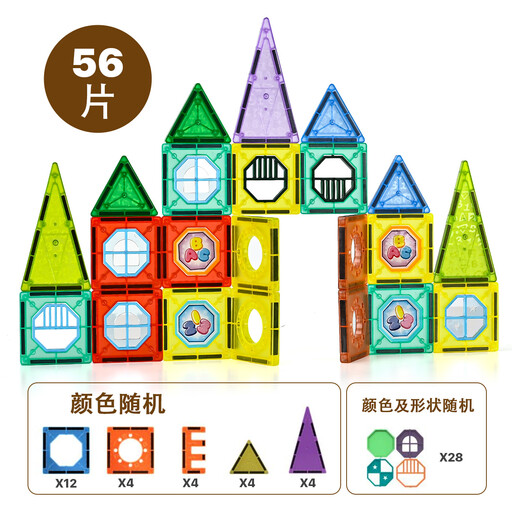
Why this product fits the profile: The set contains 56 pieces and is intended for children aged 3 and over according to the product information. It's suitable for first building shapes without needing to buy a very large collection straight away.
Piece count, ABS material and the warning about small parts are all stated. The product description also mentions enclosed magnets and smooth edges.
56 pieces, battery-free play and, according to the seller, compatible with other standard magnetic tiles.

Why this product fits the profile: 76 translucent pieces with a stated edge length of 3.75 cm provide a clearly described foundation for larger structures and playing together.
The product data lists material, piece count, dimensions and care instructions. This makes it easier to compare with sets where important details are missing.
Translucent magnetic tiles, 76 pieces and, according to the seller, enclosed magnets made from ABS plastic.
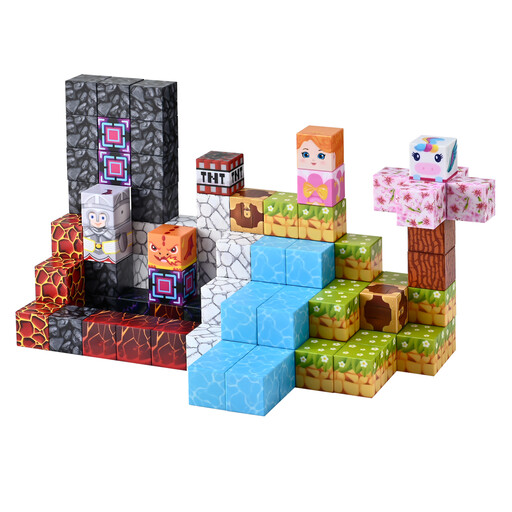
Why this product fits the profile: This set is designed for larger pixel worlds with buildings, figures and terrain shapes. 108 pieces and a stated block size of 2.5 cm support extensive constructions.
The description explicitly mentions warnings about small parts, magnets, damaged casings and storage. This provides clear rules for use.
Pixel design, 108 magnetic building blocks, ABS plastic and packaging that doubles as storage.
We've put together a complete, regularly updated list of products that fully meet these strict selection criteria and the safety regulations in force in the EU.
Before the first play session, a quick visual check is recommended. The pieces should be free from cracks, and magnets must not be visible or loose. After playing, clean them with a dry or slightly damp cloth according to the product instructions. Store the pieces in a box so that individual elements don't get lost.
For children aged 3 and over, simple tasks are a good starting point: copying a flat shape, building a tower or sorting colours. Older children can plan floor plans, bridges or their own scenes. This keeps the play open-ended without promising a specific learning outcome.
Many sets are intended for ages 3 and up according to the product information. However, the specific age labelling must always be checked on the packaging and product page. Because of the small parts and strong magnets, supervision is advisable, especially with younger children.
The lifespan depends on the material, workmanship and how they're handled. Store them dry, don't step on the pieces and check regularly for cracks or loose magnets. Damaged pieces should be removed from play immediately.
For first shapes, 50 to 56 pieces can be enough. If you're planning larger buildings or playing together, you can choose a set with 76, 100 or more pieces. Don't just look at the number, but also at the shapes included and the dimensions.