
Lieferung heute & morgen

Qualitätsgarantie

Willkommens-Angebote freischalten: KOSTENLOSE Lieferung | Bis zu 80 % RABATT | Kostenlose 30-Tage-JoyPlus-Testphase
App herunterladen
Magnetic building blocks have become a staple in many playrooms. As a creative building set, they encourage an understanding of geometry, physics, and spatial reasoning through play. However, the market is crowded, and not every set of magnetic tiles delivers on its promises. As your Joybuy Product Recommendation Officer, I'm here to help you identify the common pitfalls and make an informed decision.
Many products advertise with impressive images and high piece counts. In practice, however, three specific shortcomings often lead to disappointment and, in the worst-case scenario, safety hazards.
To avoid these problems, you should check three core aspects. These will help you objectively evaluate the quality of a set.
The way the magnets are encased inside the tiles is crucial. Look for products where the magnets are ultrasonically welded or securely riveted. This prevents them from coming loose, even during intense play. The tiles should be made from durable, non-toxic ABS plastic. An essential certification for the European market is compliance with the EN 71 toy safety standard, which sets strict requirements for the mechanical and chemical properties of toys.
A good construction toy for kids thrives on its versatility. A balanced ratio of different geometric shapes (squares, equilateral and isosceles triangles, rectangles) is more important than a high number of identical pieces. This variety is the foundation of a creative building set. Also, check the edge length of the standard tiles. Many manufacturers adhere to a standard size of 7.5 cm, which enables compatibility between different sets.
Good STEM toys should offer more than just entertainment. Magnetic tiles are an ideal educational toy for developing fine motor skills, as the precise assembly of the pieces requires dexterity. At the same time, they help train spatial awareness. A practical detail that is often overlooked is an included storage bag. It not only makes cleanup easier but also protects the tiles from dust and getting lost—an important criterion for a gift for kids ages 3 and up.
Based on these criteria, we have identified a few products suitable for different needs and play styles.
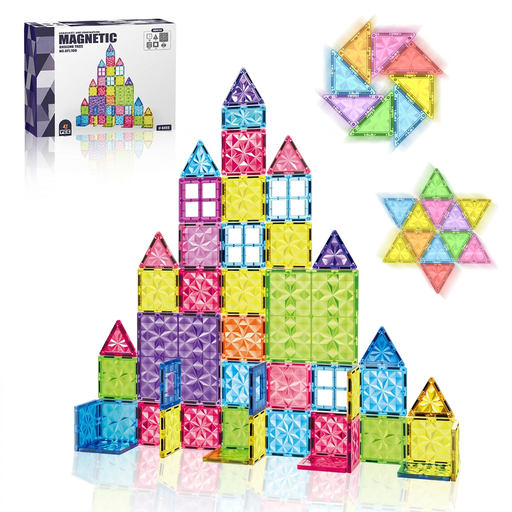
Why it's a good fit: This set is ideal for families looking to get started with the concept of magnetic building. With 47 pieces, it provides a solid foundation for initial 2D and 3D constructions without being overwhelming. It's designed as a classic magnetic toy for ages 3 and up.
According to the manufacturer, the magnets are ultrasonically sealed, which minimises the safety risk of loose parts. The set complies with EN71, CPC, and ASTM F963 standards. The piece count refers to magnetic building elements.
The set comes with a practical storage bag, which simplifies cleanup and supports the toy's longevity.
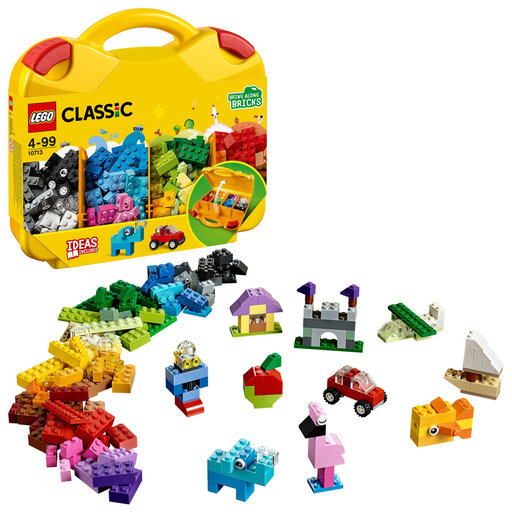
Why it's a good fit: For families who prefer a proven interlocking system without magnets. LEGO is the epitome of construction toys and promotes creativity and fine motor skills through a different building principle.
Since no magnets are used, the risk of weak connections or swallowable magnets is eliminated. LEGO's high manufacturing quality ensures precisely fitting parts without sharp edges.
The sturdy case is not just for transport; it also includes compartments for sorting the bricks. This encourages organisation and is expandable with the entire LEGO system.
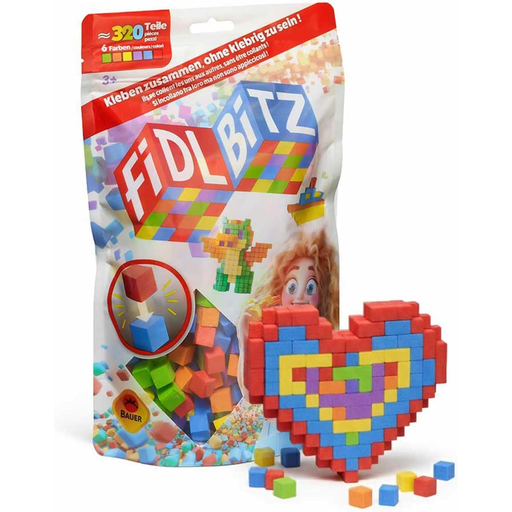
Why it's a good fit: An alternative for children who enjoy sensory stimuli and new materials. This creative building set works without magnets or interlocking connectors, offering a completely different tactile experience.
The system is based on soft foam cubes that stick together when pressed. There are no small parts or magnets, which bypasses the safety concerns of traditional sets.
Promotes fine motor skills through a unique mechanism. The crackling sound when pressed together and the ability to float in water provide additional sensory stimulation.
Proper storage is crucial for keeping toy sets complete and organised. We've curated a selection of practical solutions that meet these requirements.
1. From what age are magnetic toys truly suitable? Most manufacturers recommend an age of 3 years and up. This is primarily due to the potential hazard of small parts. It is crucial that the product meets the EN 71 safety standard and that the magnets are securely enclosed within the plastic. Especially with younger children, adult supervision is recommended to ensure safe handling.
2. How many pieces should a good starter set of magnetic tiles have? To get started, a set with 40 to 60 pieces is often a great choice. This size offers enough variety to learn the basic principles of magnetic building and create initial 3D structures without overwhelming the child with too many pieces.
3. What is the proper way to clean magnetic tiles? Magnetic tiles should not be submerged in water or cleaned in the dishwasher, as moisture can penetrate the interior and damage the magnets. To clean them, simply wipe the tiles with a slightly damp cloth and, if necessary, a mild detergent. Afterwards, they should be allowed to air-dry completely.