
Lieferung heute & morgen

Qualitätsgarantie

Willkommens-Angebote freischalten: KOSTENLOSE Lieferung | Bis zu 80 % RABATT | Kostenlose 30-Tage-JoyPlus-Testphase
App herunterladen
Magnetic building tiles for children combine open-ended play with learning about shapes, colours and spatial relationships. However, parents, grandparents and other family members may wonder which magnetic construction toy is genuinely suitable for a child’s age, play environment and stage of development.
A high piece count does not automatically mean greater play value. Key considerations include magnet encapsulation, materials, piece size, storage and expandability. The following advice will help you avoid common mistakes when buying magnetic tiles for children.
A set with 100 or more pieces may look extensive at first glance. However, if it mainly contains small or identical elements, building can be less varied than with a smaller set featuring wheels, windows, roof pieces or connecting elements.
For beginners, 32 to 56 pieces are often a manageable choice. Larger sets are more suitable when several children are building together or when compatible magnetic building tiles are already available.
A strong magnetic hold can be practical when building. However, for safety, it is equally important that the magnets are fully enclosed within the plastic housing. Cracks, loose parts or damaged casings may pose a risk.
Product information should therefore mention securely enclosed magnets, rounded edges and regular visual checks. The toy should no longer be used if it is damaged. Because of the risk posed by swallowable small parts, magnetic building tiles are not suitable for children under three years of age.
Loose magnetic tiles can quickly become scattered around the nursery, in the car or in luggage. A metal tin, storage bag or sturdy package makes sorting easier and reduces the risk of losing pieces. If you are buying a gift for a child, a box may also be more practical than simple cardboard packaging.
According to the product information, many of the magnetic building tiles featured are made from ABS plastic. Look for:
Statements such as “non-toxic” or “safe” should always be considered alongside the specific material and conformity information. An age recommendation does not replace adult supervision.
Magnetic tiles are not automatically compatible with one another. Measurements such as 2.5 cm, 3.75 cm, 5.5 cm or 7.5 cm refer to the size of the individual pieces and may affect how well they connect with other sets.
If you want to expand an existing set, compare the shapes, dimensions and connection systems. A smaller format saves space and is suitable for delicate patterns. Larger tiles are generally easier to grip and may offer a clearer introduction to 3D building.
Classic tiles allow children to create two-dimensional patterns and simple buildings. Additional elements change the way the set is used:
This means a construction set can be used as an educational toy for children, STEM toy or Montessori construction toy, without making blanket guarantees about its educational benefits. Actual play value also depends on the child’s age, interests and the support they receive.

Why this product suits the profile: With 32 pieces, this set is easy to manage for beginners and, according to the product description, comes in a portable metal tin. This makes it suitable for smaller play areas and taking on the go.
The number of pieces remains manageable for first constructions, while the metal tin helps reduce the common problem of untidy storage.
32 square magnetic tiles, an individual piece size of 3.75 cm, ABS plastic and a portable metal tin, according to the product information.

Why this product suits the profile: This set is aimed at children who want to try ball runs and light-up features as well as classic 3D constructions.
The product description states that the magnets are enclosed in transparent casings and that the rounded edges and components should be checked regularly for damage.
126 pieces, transparent 3D tiles, ball-run components and a light-up function requiring three AA batteries, which are not included.
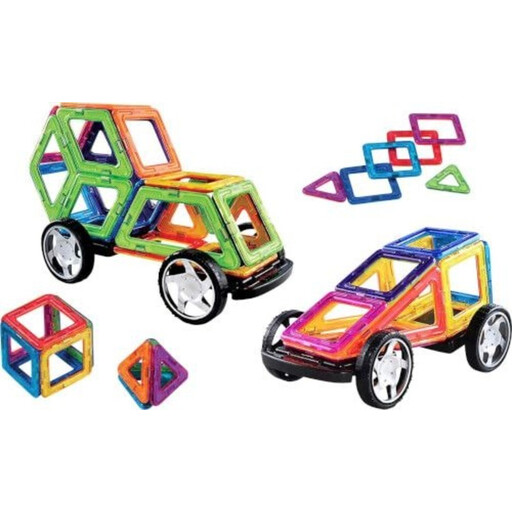
Why this product suits the profile: The integrated wheels and connectors extend the classic magnetic construction set, allowing children to build vehicles such as cars and lorries.
The additional functional pieces create a clear purpose and prevent the set from consisting solely of identical tiles.
32 pieces with magnetic components and wheels; according to the product information, suitable from three years of age with supervision.
We have put together a complete, regularly updated list of products that fully meet these strict selection criteria and the safety regulations applicable in the EU.
Before first use, adults should read the product information and warnings. For magnetic building tiles suitable from 3 years of age, the following rules are particularly important:
Many sets are intended for children aged three and over, according to the product information. However, they contain magnets and small parts. Children should therefore initially be supervised by adults, particularly when creating more complex constructions. For younger children, individual development is just as relevant as the stated age recommendation.
Their lifespan depends on the materials, construction and how they are used. Regular throwing, excessive pressure or dropping can damage the casings. If the pieces are checked, stored in a dry place and removed from use when visibly damaged, their everyday service life can be better maintained.
Most classic magnetic tiles and magnetic construction toys work manually and do not require batteries. Sets with light or sound functions, on the other hand, may need batteries. According to the product information, the Tokky 3D set with light-up function requires three AA batteries, which are not included.