
Lieferung heute & morgen

Qualitätsgarantie

Willkommens-Angebote freischalten: KOSTENLOSE Lieferung | Bis zu 80 % RABATT | Kostenlose 30-Tage-JoyPlus-Testphase
App herunterladen
Magnetic building tiles for children combine open-ended construction with geometric thinking. However, parents, grandparents and educational institutions will find a wide range of magnetic tiles, magnetic building blocks and construction sets: from compact starter packs to extensive 3D systems with marble runs.
The product name alone reveals little about a set’s actual suitability. The decisive factors are the recommended age, magnet encapsulation, piece size, storage and intended use. The following guidance helps you assess marketing claims and choose a suitable magnetic building set for home, travel or the classroom.
A 120-piece set may initially appear comprehensive. However, if it consists mainly of identical shapes, certain construction designs may only be possible to a limited extent. For simple houses and flat patterns, 32 to 56 pieces are often sufficient. For larger 3D structures, vehicles or collaborative building with several children, a broader selection of shapes and a higher piece count are more useful.
A high magnetic force can be useful during construction, but it is not in itself a sufficient safety feature. The magnets must remain permanently enclosed within the plastic housing. Damaged edges, cracks or magnets coming loose are disqualifying issues. Swallowed magnets can be particularly dangerous when multiple magnets come into contact with one another. For this reason, magnetic building blocks should not be given to children under three.
Magnetic building blocks cannot be combined reliably based solely on similar colours or shapes. Dimensions such as 2.5 cm, 3.75 cm, 5.5 cm or 7.5 cm refer to different systems. Before purchasing an expansion set, check whether the dimensions, magnet positions and shapes are genuinely compatible.
Many magnetic tiles for children and educational toys for ages 3+ are available for children aged three and over. However, age recommendations are only a guide. The smaller and more varied the pieces, the more important close adult supervision becomes. Even with a stated age recommendation of 3+, children should not put the building blocks in their mouths, bite them or play with individual magnets.
For nurseries and primary schools, a thorough inspection before and after every use is recommended. Damaged components should be removed immediately. This also applies to magnetic balls, track elements and small connecting pieces.
Many sets are made from ABS plastic. Important features include smooth, burr-free edges, a fully enclosed housing and clear safety information. Details such as EN 71, REACH or other conformity information should be verifiable directly in the product description or on the packaging. Certifications for individual markets do not automatically provide a complete assessment of every use in Germany.
For the products mentioned here, safety and material information comes from the respective product descriptions unless stated otherwise. Claims such as “non-toxic”, “sealed” or “durable” should therefore be understood as statements made by the manufacturer or seller and checked against the product supplied.
Dedicated storage for magnetic tiles helps prevent pieces from going missing and makes tidying up easier. For travel, compact packaging such as a metal tin or storage bag is ideal. At home, a larger box with sorting compartments may be more practical.
Also pay attention to the cleaning instructions. Many manufacturers recommend wiping the pieces with a soft cloth and advise against immersing them in water. Depending on the design, liquid may affect the housing, printed surfaces and magnetic components.

Why does it fit this profile? This set is appealing to families looking for an accessible introduction and a travel-friendly solution. According to the product description, it contains 32 square pieces with 3.75 cm edges and a metal storage tin.
The clearly stated piece count and individual dimensions make it easier to assess the set. The tin reduces the risk of pieces getting lost while travelling.
32 ABS pieces, metal storage tin, no assembly required and, according to the seller, suitable for children aged three and over.
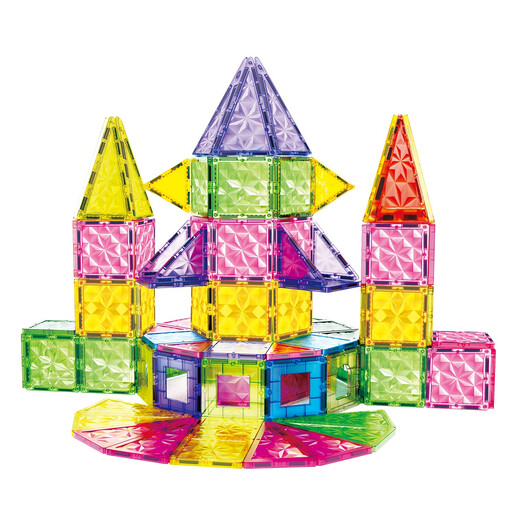
Why does it fit this profile? The 7.5 cm diamond tiles and 117 pieces are designed for children who want to experiment with larger structures and more complex 3D shapes. According to the product description, an idea booklet and storage solution are included.
The large tile size and stated compatibility are clearly specified. This makes it easier to check before buying whether the set will work with an existing system.
117 pieces, 7.5 cm format, ABS plastic and, according to the seller, enclosed magnets.

Why does it fit this profile? This set combines transparent tiles with marble-run elements and a lighting function. It is aimed at families who want to combine magnetic construction play with movement and early STEM learning.
The product details specify 126 pieces, the three required AA batteries and that batteries are not included. This makes ongoing additional costs clear before purchase.
126 pieces, transparent 3D components, marble-run parts and, according to the seller, ABS, PP, PE and PS plastic.
We have put together a current selection of products that can be compared based on age range, features, storage and safety information.
Magnetic building blocks primarily encourage open-ended construction, an understanding of shapes and spatial orientation. An experiment kit for children, by contrast, usually follows set procedures and focuses on observation. For children aged six or seven and over, sets such as the Kosmos Student Lab 636111, covering topics including light, shadows, air, water and the senses, can be a suitable complement. For children aged eight and over, options include a crystal-growing kit or a KOSMOS set with glowing balls.
For nurseries and primary schools, combining both types can be useful: magnetic tiles for open-ended group activities and an experiment kit for guided learning sessions. In each case, age recommendations and supervision requirements should be considered separately.
According to their product descriptions, many sets are intended for children aged three and over. Nevertheless, they contain small pieces and magnets. Children should be supervised while using them. If tiles are damaged or magnets are protruding or have come loose, the set should no longer be used.
Lifespan depends on the materials, build quality and how the set is handled. Do not throw the pieces, pull them apart with excessive force or store them in damp conditions. Regularly checking for cracks, loose magnets and sharp edges is more important than relying on a general lifespan estimate.
Traditional magnetic building blocks do not require batteries. Additional costs may arise from expansion sets. For electrically illuminated marble-run or magnetic tile sets, batteries must be budgeted for separately unless they are included in the package.