
Lieferung heute & morgen

Qualitätsgarantie

Willkommens-Angebote freischalten: KOSTENLOSE Lieferung | Bis zu 80 % RABATT | Kostenlose 30-Tage-JoyPlus-Testphase
App herunterladen
As a Joybuy Product Recommendation Officer, I see tradespeople and DIY enthusiasts searching for the right tools every day. A magnetic torpedo level is indispensable for precise work on metal surfaces and in confined spaces. However, the market is flooded with models that disappoint in real-world use. Before you make a decision, it's crucial to understand the typical weaknesses that often only become apparent on the job site or during assembly.
Many users invest in a tool that looks solid at first glance, only to find it fails to meet basic requirements. The most common problems are:
To avoid a poor purchase, you should focus on a few core technical parameters. These determine whether a small level is genuinely helpful in demanding day-to-day work.
The functionality of a level with a magnet lives or dies by the quality of its magnets. Look for models with integrated rare-earth magnets (e.g., neodymium magnets). These offer significantly higher holding power than conventional ferrite magnets and keep the level securely in position, even on painted or dirty metal surfaces. For plumbers and installers, a V-groove on the magnetic base is another important feature. This groove ensures the level for pipes and other round profiles sits perfectly and doesn't slip.
The precision of a spirit level is specified in millimetres per metre (mm/m). A professional standard is 0.5 mm/m. This means that over a length of one metre, the maximum deviation is just half a millimetre. Look for vials made of shatter-resistant acrylic glass that are firmly anchored in the frame. For versatile applications, a level with 45- and 90-degree vials is necessary in addition to the horizontal vial. A top-read window allows for convenient reading from above, which is particularly advantageous when working overhead or near the floor.
A professional aluminium level offers the best compromise between stability and low weight. A torsion-resistant die-cast aluminium or box-beam frame reliably protects the vials and maintains its shape even with rough handling. Models like a mini level at 23 cm in length are ideal for the toolbox and for work in electrical panels, drywall installation, or furniture assembly. This small level is a specialised tool used where standard models are too cumbersome.
Based on the quality features mentioned, we have identified several products that represent a suitable solution for specific user profiles.
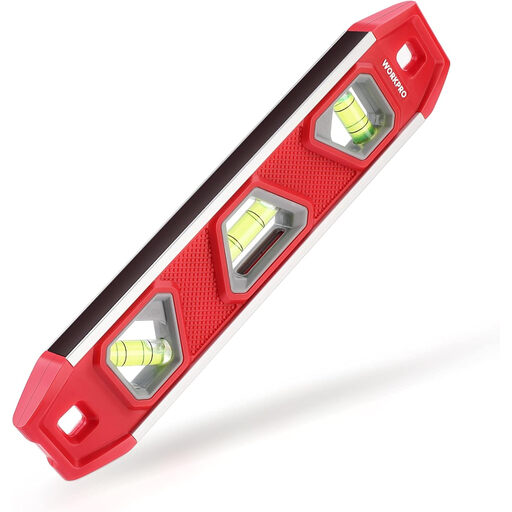
Why it's a good fit: Ideal for tradespeople who need a reliable and versatile tool for daily use. The combination of a strong magnet, three measuring angles, and robust construction covers most requirements in metalwork, drywall, and interior finishing.
The sturdy aluminium frame withstands impacts, while the strong magnets ensure a secure hold. The top-read window solves the problem of poor readability in awkward positions.
Three vials (45°/90°/180°) for all common angles. V-groove for a stable fit on pipes.
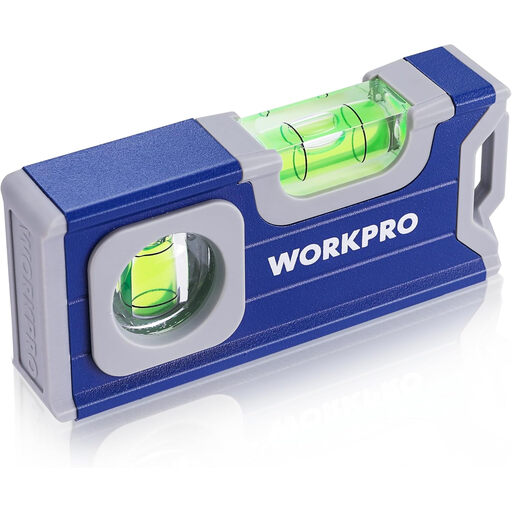
Why it's a good fit: Perfect for electricians, cabinet builders, or installers working in extremely confined conditions where even a 23 cm level is too large. It fits in any pocket and is ready for immediate use.
Despite its ultra-compact size, this model features a strong magnetic V-groove base. This specifically bypasses the typical weakness of mini-levels—insufficient holding power.
Extremely compact (115 mm) and lightweight. The accuracy of 0.5 mm/m is at a professional level, according to the manufacturer's specifications.
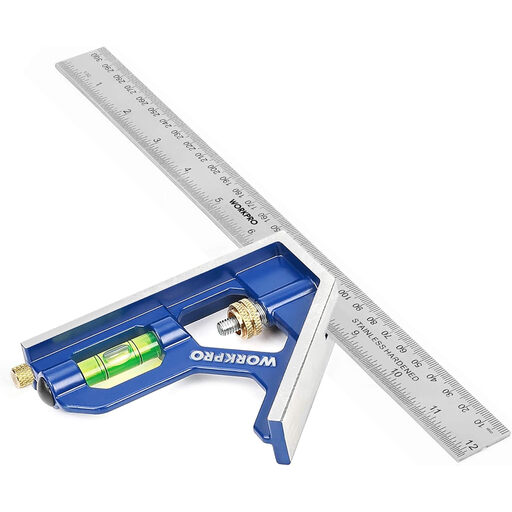
Why it's a good fit: An alternative for carpenters and joiners who need to perform precise angle measurements, depth gauging, and scribing tasks in addition to levelling. It's not just a levelling device but a multifunctional measuring tool.
This tool combines multiple functions in a robust stainless steel and zinc alloy body. It replaces several individual tools, thus avoiding the need to buy a separate, potentially inferior small level.
Combines a square (90°/45°), ruler, depth gauge, and spirit level. Integrated scriber for marking.
We've compiled a complete, up-to-date list of products that fully meet these strict selection criteria and UK regulations.
You can check the accuracy with a simple test. Place the level on a surface that is as flat as possible and note the bubble's position. Then, rotate the level 180 degrees and place it on the exact same spot. If the bubble is in the same position as before, the horizontal vial is accurate. For the vertical check, hold the level against a vertical wall and repeat the process.
This specification is a hallmark of quality for professional measuring tools. It indicates that the deviation from the exact horizontal or vertical is a maximum of 0.5 millimetres over a measuring distance of one metre. The smaller this value, the more precise the tool.
A torpedo level is a specialised tool for short distances, work on metal components, and quick angle checks in confined spaces. It is unsuitable for aligning long components like door frames, windowsills, or kitchen countertops. Here, the rule of thumb is: the length of the level should be at least two-thirds of the surface being measured. For such tasks, longer spirit levels (e.g., 60 cm, 120 cm, or 180 cm) are required to achieve an accurate result.