
Lieferung heute & morgen

Qualitätsgarantie

Willkommens-Angebote freischalten: KOSTENLOSE Lieferung | Bis zu 80 % RABATT | Kostenlose 30-Tage-JoyPlus-Testphase
App herunterladen
Magnetic building blocks have become a staple in countless children's playrooms. As a creative building set, they foster imagination and playfully introduce the first principles of geometry and physics. However, the market is vast, and quality differences are significant. Before you choose a gift for a child that ends up causing more frustration than joy, you should be aware of the common pitfalls that often only become apparent after unboxing.
Many parents report two central problems: weak magnets that cause structures to collapse even at low heights, and serious safety flaws. Cheaply made magnetic toys can have sharp edges or, more critically, the magnets are not securely enclosed within the plastic parts. If these come loose, they pose a significant hazard. Another issue is a lack of compatibility, which limits the building fun when existing sets cannot be expanded.
To make an informed decision that guarantees safety and long-lasting play value, you should carefully examine three technical aspects. These features separate a well-designed construction toy from a short-lived product.
Material safety is paramount. Look for products made from high-quality ABS plastic. This material is robust, shatterproof, and free from harmful plasticisers. A crucial manufacturing feature is ultrasonic welding. In this process, the plastic halves of the blocks are fused together, ensuring the magnets inside are safely and permanently encapsulated. Products that meet the European toy safety standard EN 71 have been tested for mechanical and chemical safety. This gives you the confidence that you are holding a safe educational toy for children aged 3 and up.
The strength of the magnets is directly responsible for the fun factor. Only sufficiently strong magnets allow for the construction of stable, three-dimensional structures that don't collapse at the slightest touch. A good indicator here is riveted or double-secured magnets. Compatibility is just as important. Many manufacturers adhere to a standard edge length of 7.5 cm for square magnetic tiles. Sets that follow this standard can be easily combined and expanded, multiplying the creative possibilities and making your investment future-proof.
A good set offers more than just squares and triangles. Various geometric shapes, windows, doors, or even wheelbases significantly expand the spectrum of play. They enable children to create complex scenarios and specifically promote spatial reasoning and fundamental STEM skills. The number of pieces should be appropriate for the child's age and experience. Starter sets with 50-80 pieces are often sufficient, while sets with over 100 pieces are more suitable for advanced builders.
Based on the objective criteria mentioned above, we have compiled a selection of products suitable for different user profiles.

Why This Fits Their Persona: This set offers a solid entry into the world of magnetic building blocks. With 58 pieces, it's comprehensive enough for initial creative projects without breaking the bank. It's a great choice for families who want to try out the play concept first.
The reinforced magnets ensure a secure connection and stable structures, avoiding the typical frustration of collapsing builds. The construction from non-toxic ABS plastic with rounded edges addresses fundamental safety concerns.
The set is compatible with other 7.5 cm magnetic building blocks and comes with a storage bag, which simplifies cleanup and makes it travel-friendly.

Why This Fits Their Persona: For children who already have building experience or love large-scale projects, this 125-piece set offers an enormous variety of geometric shapes. It allows for the construction of large, stable structures and promotes comprehensive STEM skills.
The superior magnet strength and robust construction using ultrasonic welding ensure that even tall and complex structures stand securely. The use of food-grade ABS material provides additional safety.
The set includes inspiration cards and a practical storage container. It is fully compatible with other common 7.5 cm magnetic tile sets, offering excellent expansion potential.
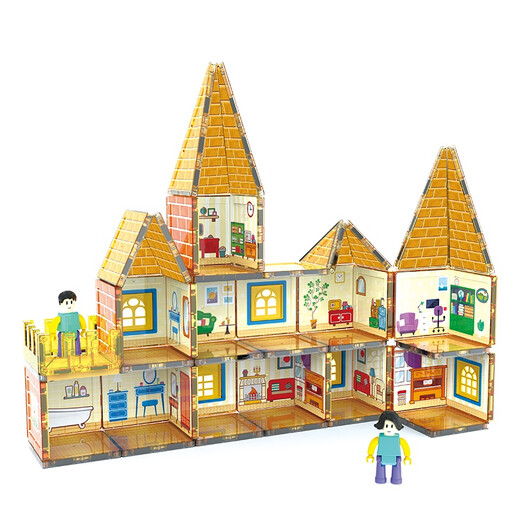
Why This Fits Their Persona: This set is ideal for children who love to invent stories and engage in role-playing. The specially printed pieces and architectural elements like roof tiles encourage the building of dream houses and entire neighbourhoods.
Despite the special designs, the set is based on the same high standards: strong, securely enclosed magnets and high-quality, burr-free ABS plastic. Stability for multi-story buildings is guaranteed.
Specifically promotes an understanding of architectural fundamentals like structural design and spatial planning through hands-on play. It inspires creative design and imaginative play.
We have compiled a complete, up-to-date list of products that fully meet these strict selection criteria and UK/EU safety regulations.
Most manufacturers recommend magnetic building blocks for children from 3 years of age. The main reason for this is the hazard posed by small parts that could be swallowed. It is essential to ensure the product has a CE mark and, ideally, certification according to the EN 71 standard. Regularly inspect the blocks for cracks or damage. If a part is damaged, dispose of it immediately to prevent a magnet from coming loose. Play should take place under adult supervision, especially with younger children.
Cleaning is straightforward. Wipe the surfaces of the blocks with a slightly damp cloth. Do not use aggressive cleaning agents or abrasive scourers, as these can damage the plastic. It is important not to immerse the blocks in water or clean them in the dishwasher, as moisture can penetrate the interior and cause the magnets to rust, which weakens their force. Allow them to dry thoroughly after cleaning.
Compatibility is a common issue. However, many reputable manufacturers have agreed on a standard size of 7.5 cm x 7.5 cm for the basic square tiles. If you buy sets that conform to this measurement, it is highly likely that they can be combined. Before purchasing, check the product description for information on compatibility or the size of the individual tiles to avoid disappointment later.