
Lieferung heute & morgen

Qualitätsgarantie

Willkommens-Angebote freischalten: KOSTENLOSE Lieferung | Bis zu 80 % RABATT | Kostenlose 30-Tage-JoyPlus-Testphase
App herunterladen
Magnetic toys for children can support open-ended building, spatial thinking and shared play. At the same time, there are clear differences between magnetic building blocks, magnetic tiles and magnetic family games. A high piece count alone says little about how practical a set really is for everyday use.
100 or more pieces may look impressive on the packaging. However, what matters is which shapes are included. Lots of identical squares offer fewer building options than a balanced mix of squares, triangles, connectors and special pieces. So check the product photos and the precise contents carefully.
A strong magnetic connection can be useful for taller structures. More important is that the magnets are securely enclosed in the plastic. Do not continue using the toy if it has damaged edges, cracks or loose magnets. Swallowed magnets can cause serious injuries. Magnetic components must therefore always be kept out of reach of children under three.
A magnetic construction toy for children aged 3 and over is not automatically suitable for every child of that age. Small parts, complex building ideas or the fine motor skills required may overwhelm younger children. A strategy game involving magnets may, in turn, have a higher recommended age, even if the rules appear simple.
Pay attention to the manufacturer’s information, warning notices and the size of the individual components. For the sets for children aged 3 and over considered here, small parts and magnets are expressly identified as potential hazards. The recommended age is not a guarantee that the toy can be used unsupervised. Younger children should be accompanied by an adult, particularly when playing for the first time.
ABS plastic is used in many magnetic building sets. Relevant features include rounded, burr-free edges, durable construction and a permanently sealed magnet chamber. Details such as ultrasonic welding or fully sealed magnets provide more specific information than general terms such as “safe material”. Anyone buying a set should also check it regularly for cracks, deformation and loose parts.
32 or 50 pieces may be enough for beginners. Larger sets with 62, 76 or 126 pieces provide more scope for building structures, but also require more storage space. For train journeys, visits to grandparents or meals out, a tin, carry bag or folding box can be useful. A magnetic travel game with just a few pieces does not need to offer the same capabilities as a large construction set for children.

Why this product suits this profile: The set contains 32 square magnetic tiles with an edge length of 3.75 cm and comes in a tin. This makes it a manageable introduction to magnetic building and keeps the pieces neatly stored after play.
The piece count and included storage are clearly specified. Before buying, bear in mind that small parts and strong magnets are not suitable for children under 3.
32 pieces, ABS plastic, no batteries required and a compact tin for storage and transport.
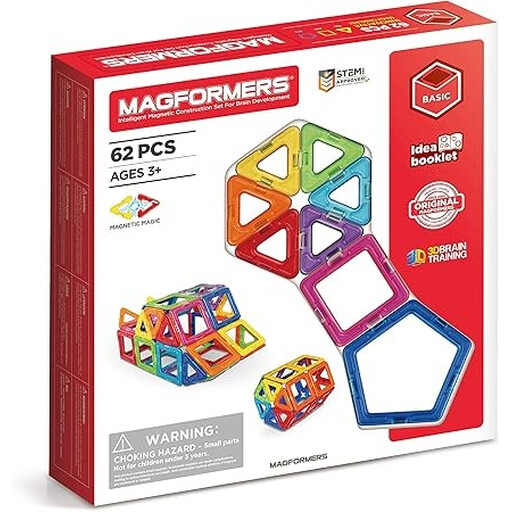
Why this product suits this profile: The 62-piece selection is designed for combining shapes, creative building and developing spatial awareness. According to the product description, it is suitable from the age of 3.
The product details specify the piece count, material composition and learning objectives. Regular checks for damaged parts and adult supervision are still required.
62 pieces, no batteries required and a focus on combining shapes, creative thinking and spatial awareness.
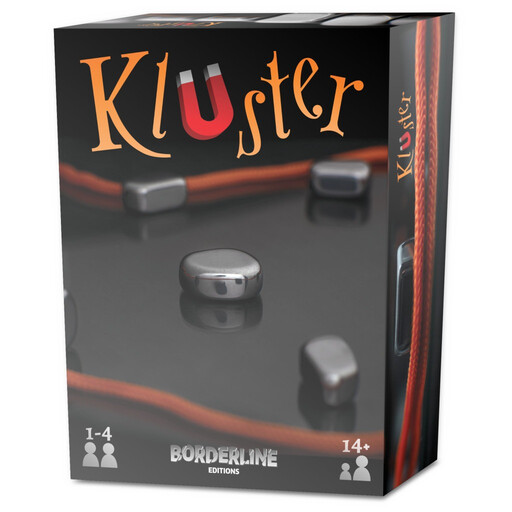
Why this product suits this profile: According to the product information, KLUSTER is designed for 1 to 4 players, 10 to 15 minutes of play and ages 14 and over. Its compact format makes it suitable for travel and short game sessions.
The recommended age clearly distinguishes this game from educational toys for children aged 3 and over. The rules, the string playing area and the contents are all described clearly.
Magnetic stones, string, 1 to 4 players and a stated playing time of 10 to 15 minutes.
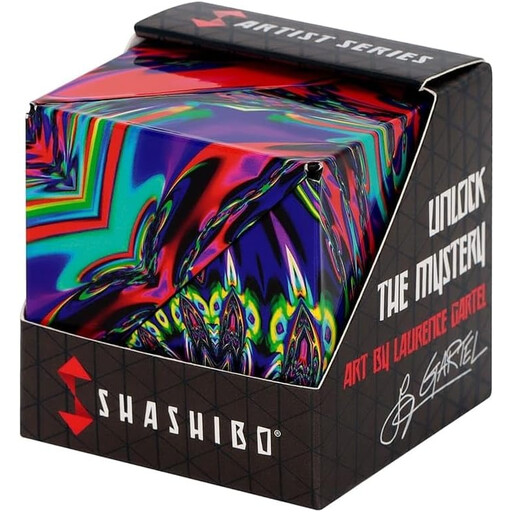
Why this product suits this profile: According to the product description, the compact cube is intended for children aged 8 and over and adults. It can be transformed into numerous shapes, making it suitable for trips or short breaks.
The minimum age of 8 prevents it from being confused with magnetic building blocks for pre-school children. The product details specify 36 magnets and a compact format measuring approximately 5.84 cm per side.
Handy format, 36 integrated magnets and the option to connect several cubes together.
We have put together a complete, regularly updated list of products that fully meet these strict selection criteria and the safety regulations applicable in the EU.
Many magnetic building blocks and magnetic tiles are offered for children aged 3 and over. However, the specific age recommendation and warning notices for the individual product are always decisive. If a set contains small parts or strong magnets, it is not suitable for children under 3. Adult supervision is advisable for younger children.
Their lifespan depends on the quality of the construction and how they are handled. Enclosed magnet chambers, sturdy plastic housings and dry storage can help extend their service life. Throwing, bending or heavy impacts can damage the housing and magnetic connections. Regular checks are more important than a generic durability statement.
For initial building attempts, 32 to 50 pieces are often sufficient. A set with 62 to 76 pieces offers more possibilities for three-dimensional constructions. Sets with 100 or 126 pieces are particularly worthwhile if children build regularly or several children play together. For travel, compact sets or a magnetic family game with its own storage are usually more practical than a large construction set.