
Lieferung heute & morgen

Qualitätsgarantie

Willkommens-Angebote freischalten: KOSTENLOSE Lieferung | Bis zu 80 % RABATT | Kostenlose 30-Tage-JoyPlus-Testphase
App herunterladen
Magnetic building toys for children combine open-ended construction with simple physical principles. Children can join tiles, blocks or connectors without tools and create their own buildings, vehicles or imaginary worlds. For parents, grandparents and educational settings, however, choosing the right set is not always easy: product images often show large structures, while the set itself may contain only a few shapes in practice. Terms such as “STEM”, “Montessori” or “strong magnets” also reveal little on their own about the product’s actual suitability.
A magnetic building set with 100 pieces sounds extensive. What matters, however, is which shapes are included. Lots of identical squares allow for different constructions than a mixed set containing triangles, rectangles, wheels or speciality blocks. So check the images and the detailed pack description carefully.
A high level of magnetic attraction can be helpful during construction. For everyday use, however, securely enclosed magnets, rounded edges and durable plastic are just as important. If a component is damaged and a magnet becomes visible or loose, it should no longer be used.
Magnetic toys for ages 3 and over usually contain small parts. The age marking is not simply a marketing detail; it needs to match the child’s developmental stage. Particular care is required for children who still put components in their mouths. Magnets must never be swallowed or inhaled. If this is suspected, seek medical help immediately.
For a first introduction, 32 to 48 pieces are often sufficient. A set containing 62 to 76 pieces offers more possibilities for flat patterns and simple 3D models. Larger pixel or building-block sets with 100 or 108 pieces are generally better suited to children who can already concentrate on building for longer periods.
The size of the pieces also matters: in the sets described, individual tiles measure either 3.75 × 3.75 cm, while individual pixel blocks measure 2.5 cm. Larger tiles are usually easier for small hands to grip. Smaller pixel blocks, on the other hand, allow for more detailed figures and landscapes, but require closer supervision.
Many magnetic building blocks are made from ABS plastic. Look for clear information about:
Information such as “BPA-free” or references to REACH-SVHC requirements are useful, but they do not replace checking the specific product labelling. In Germany, toys should include, among other things, an understandable age recommendation and the required safety markings. The CE mark is a manufacturer’s declaration that the product complies with applicable EU requirements; it is not an independent quality seal.
Magnetic tiles usually connect quickly and are well suited to geometric shapes. Pixel blocks with textured surfaces are designed more for figures, terrain and scenes. Sets with wheels appeal to children who want to build vehicles. For a fair comparison, therefore, consider not only magnetic strength but also the connecting surfaces, the weight of the pieces and the intended construction method.
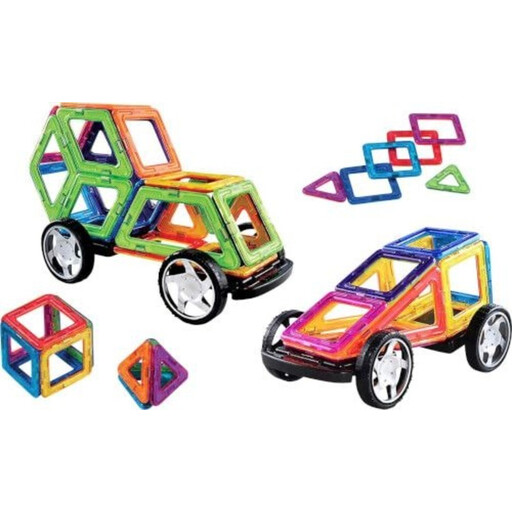
Why this product suits this profile: The set contains 32 pieces and wheels for creating first vehicle models. It is a manageable option if you want to try out whether creative building will become part of your family’s everyday routine.
The number of pieces and intended use are clearly stated. This makes it easier to set realistic expectations about the scale of construction possible.
32 magnetic components, wheels and an age recommendation of 3 years and over; no batteries required.
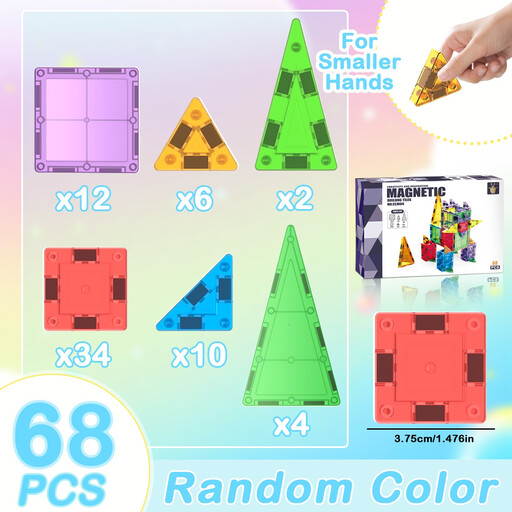
Why this product suits this profile: According to the product description, the flat 3.75 cm tiles are made from ABS plastic and the magnets are permanently enclosed. The format is designed for 2D patterns and 3D constructions.
The product details specify the tile dimensions, material, age limit and care instructions. Damaged pieces with visible magnets should be removed from use.
68 pieces, a compact storage box, rounded edges and stated compatibility with the same 3.75 cm tile format.

Why this product suits this profile: The 76 transparent tiles are described as suitable for individual and group play. The set is a good fit for families, pre-school groups or settings where different building ideas are explored using a shared supply of pieces.
The number of pieces, the 3.75 cm format and the storage instructions are clearly specified. This makes it easier to plan the space required and use the set with a group.
76 pieces, enclosed magnets, ABS plastic and shapes for castles, animals or vehicles; clean with a soft cloth.
Magnetic construction toys can support fine motor skills, spatial awareness, pattern recognition and problem-solving when children plan and experiment independently. However, describing a product as a STEM toy or Montessori building toy does not automatically prove an educational benefit. What matters is whether the set allows for open-ended activities and suits the child’s age and interests.
For shared play, try questions such as: Which shapes hold together better? How could you make a tower wider? What changes when one component is removed? This turns a gift for children into an activity that can involve language, planning and collaboration.
We have put together a complete, regularly updated list of products that fully meet these strict selection criteria and the safety regulations applicable in the EU.
Many of the products mentioned here are marked as suitable for ages 3 and over. The specific age recommendation on the packaging and product page is the deciding factor. Magnetic toys should not be used by younger children or by children who put small parts in their mouths.
Its lifespan depends on the material, usage and storage conditions. Check the pieces regularly for cracks, loose connections and visible magnets. Store the building blocks in a dry place and, where possible, keep them together in a box. Damaged pieces should no longer be used for play.
Yes, provided that the number of pieces, age recommendation and the child’s interests are a good match. Sets with wheels are ideal for vehicle enthusiasts, while magnetic tiles allow children to create geometric constructions. Larger pixel sets suit children who enjoy designing figures, houses or landscapes.