
Lieferung heute & morgen

Qualitätsgarantie

Willkommens-Angebote freischalten: KOSTENLOSE Lieferung | Bis zu 80 % RABATT | Kostenlose 30-Tage-JoyPlus-Testphase
App herunterladen
A MagSafe car mount promises an elegant solution to two everyday problems in the car: securely mounting and simultaneously charging your smartphone. But the market is flooded with products that often fail to live up to their promises. As a Joybuy Product Recommendation Officer, I see daily which features truly matter and which are just marketing hype. Before you make a decision, you should know the three most common pitfalls that lead to a bad purchase.
To avoid these problems, you should focus on the technical fundamentals. An informed buying decision is based on objective criteria, not marketing slogans.
The foundation for in-car wireless charging is the Qi standard. However, a modern car phone mount with charging should offer more.
Important Note: To get the full 15W of charging power, you need a compatible car adapter for the cigarette lighter. It should have a USB-C port with Power Delivery (PD) and provide at least 20 watts.
The choice of mounting location affects stability, your field of view, and the aesthetics of your cockpit.
A good magnetic car phone mount is distinguished by the quality and arrangement of its magnets. Products that explicitly state the number or type of magnets (e.g., N52) often offer more transparency and, as a rule, greater holding power. The material of the mount itself is also relevant. A combination of durable plastic (ABS/PC) and heat-dissipating metal components (aluminum) is an indicator of longevity.
Based on these objective criteria, we have identified several models that provide a suitable solution for specific user profiles.
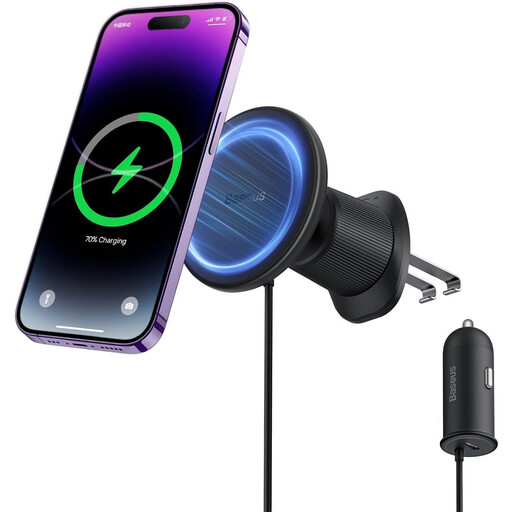
Why This Fits Their Persona: Ideal for drivers looking for a straightforward, all-in-one solution. This kit combines a magnetic air vent mount with a powerful car charger that can power both the mount (15W) and another device via an additional USB-C port (25W).
It solves the "false charging promise" problem because the matching, high-power adapter is included. The total 40W output ensures that the 15W for MagSafe charging is delivered reliably.
All-in-one package (mount + charger). Additional 25W USB-C port for a second device. Integrated lighting for easy use in the dark.
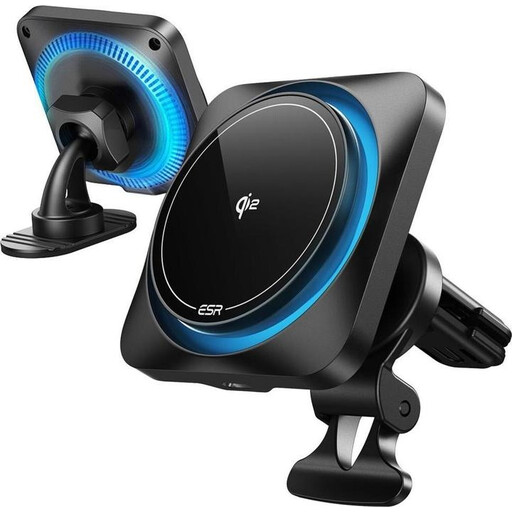
Why This Fits Their Persona: For users who value the latest technology and maximum charging efficiency. This model is not only Qi2 certified but also features active cooling technology (CryoBoost) to keep temperatures low during charging.
It actively combats overheating—a primary cause of throttled charging speeds. The cooling ensures that the 15W charging power can be consistently maintained even during extended use, such as navigation.
Qi2 certification for future-proofing. Active CryoBoost cooling for consistent charging performance. Flexible mounting options for both air vent and dashboard are included.
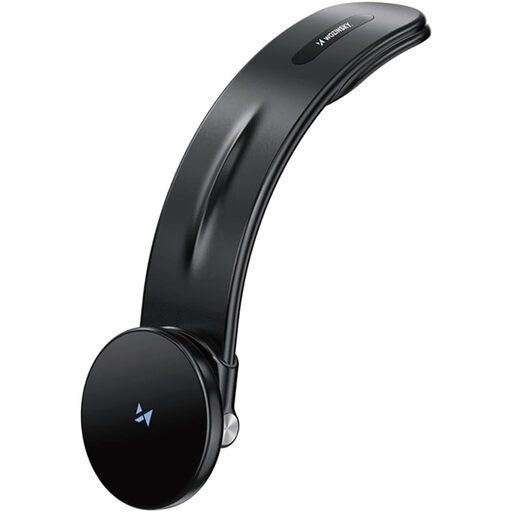
Why This Fits Their Persona: Perfect for drivers who prefer custom smartphone positioning and want to keep their air vents clear. The flexible arm and dashboard or windshield mounting allow for optimal alignment in their field of view.
It bypasses the instability of many air vent mounts by using a solid mounting base. The 20 built-in N52 magnets address the concern of a weak grip, ensuring a secure hold even on bumpy roads.
Highly flexible positioning via an adjustable arm. Strong holding power from 20 N52 magnets. Elegant aluminum alloy design.
We have compiled a complete, up-to-date list of products that fully meet these strict selection criteria and safety standards.
Yes, but the case must be compatible. For optimal adhesion and charging efficiency, you should use a MagSafe-compatible case with a built-in magnetic ring. Very thin standard cases (under 2 mm) might work, but the magnetic force will be significantly weaker. Cases with metal elements, credit card slots, or integrated kickstands are not compatible.
Yes, in most cases. To achieve the maximum 15-watt charging speed, you need a USB-C car charger that supports the Power Delivery (PD) standard and provides an output of at least 20 watts (e.g., 9V/2.22A). A standard USB-A port or a weaker power adapter will limit the charging speed to 5W or 7.5W.
Yes, extreme heat is a risk factor. In particular, mounts attached to the dashboard with adhesive pads can lose their grip in direct sunlight. Furthermore, both the smartphone and the inductive car charging station itself generate heat. If the device is charging in the blazing sun, it can overheat, which stops the charging process and can damage the battery over time. Models with active cooling or those made from heat-dissipating materials have an advantage here. It is generally recommended to park your vehicle in a shady spot.