
Lieferung heute & morgen

Qualitätsgarantie

Willkommens-Angebote freischalten: KOSTENLOSE Lieferung | Bis zu 80 % RABATT | Kostenlose 30-Tage-JoyPlus-Testphase
App herunterladen
A MagSafe car mount with wireless charging combines three functions: it secures your smartphone in the vehicle, positions it for navigation and powers it while you drive. On paper, many models sound similar. In practice, however, the type of mount, charging protocol and power supply determine whether the solution works reliably over the long term.
Many drivers are specifically looking for a wireless phone holder for the car that works with a MagSafe iPhone, a Qi2 smartphone or an Android device with a magnetic ring. Before buying, however, you should be aware of a few common pitfalls.
The specification 15W Wireless Charger Auto usually describes the maximum output. In reality, charging speed depends on the smartphone, the charging protocol used and the vehicle’s power adapter. With some devices, 15 watts can only be achieved with Qi2, a compatible MagSafe system or a suitable USB-C PD or QC power adapter.
A mount with a USB-C connection may therefore require a suitable car charger. For fast charging, the Joyroom JR-ZS219, for example, requires a QC 2.0 or QC 3.0-compatible adapter; according to the product details, this is not included.
A MagSafe iPhone has an integrated magnetic ring. Other smartphones, on the other hand, need a compatible case or an adhesive metal or magnetic ring. Without this, the device may be able to charge wirelessly, but it cannot necessarily be secured safely to a magnetic car mount.
Thick, non-magnetic or metal-containing cases can also interfere with the alignment of the charging coil. Before buying, you should therefore check whether your smartphone and the case you use are explicitly supported.
A phone holder for the air vent can save space, but the weight of the smartphone places strain on the slats. Some models are designed specifically for horizontal slats, while others use hooks or dual clips and are also suitable for certain vertical vents.
For a dashboard, you will need a suction or clamp mount instead. It requires a clean, smooth surface and must not obstruct your field of vision or interfere with the airbag area.
You should also look for overcurrent, overvoltage, short-circuit and overheating protection. These features reduce operating risks, but they do not replace the use of a suitable power adapter and cable.
A 360° rotating car mount makes it easier to switch between portrait and landscape orientation. It is important that the joint does not gradually drop under the weight of the smartphone. With air-vent mounts, the clip should sit firmly without permanently bending the slats.
Dashboard models often offer greater freedom when positioning your phone. However, they require a stable mounting surface. An adjustable arm length can be useful if you want to bring the display closer to the driver.
Wireless charging generates heat. Direct sunlight, a very hot vehicle interior or a thick protective case can reduce charging performance. If your smartphone becomes unusually hot, stop charging and investigate the cause.
For a car mount with charging function, the mount itself is not always sufficient. Check whether a USB-C cable is included and whether the available USB port or 12-volt adapter provides enough power.
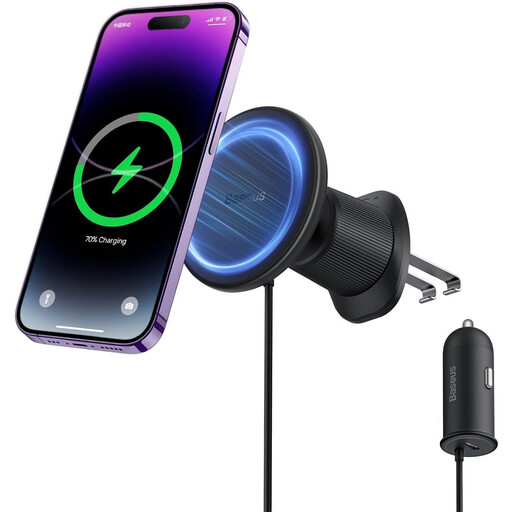
Why this product suits this profile: The combination of a magnetic mount and car charger is practical for anyone who wants to avoid buying lots of separate components. The product details specify up to 15W for the magnetic charging surface, as well as an additional USB-C output of up to 25W.
Power does not rely solely on the vehicle’s USB port, as a 12-volt charger is included. Nevertheless, MagSafe compatibility should be checked before buying.
Up to 40W total output according to the product description, USB-C cable included and air-vent mounting.
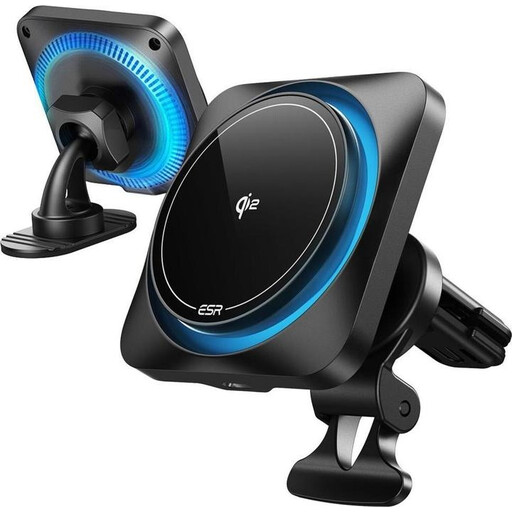
Why this product suits this profile: According to the product details, this model supports Qi2 at 15W and can be mounted on either an air vent or the dashboard. The CryoBoost cooling function is designed to dissipate heat more effectively while charging.
The Qi2 specification makes the charging setup clearer than a standalone 15-watt marketing claim. However, the cooling surface must not be covered.
Qi2 support, MagSafe compatibility and two mounting options with USB-C cable.
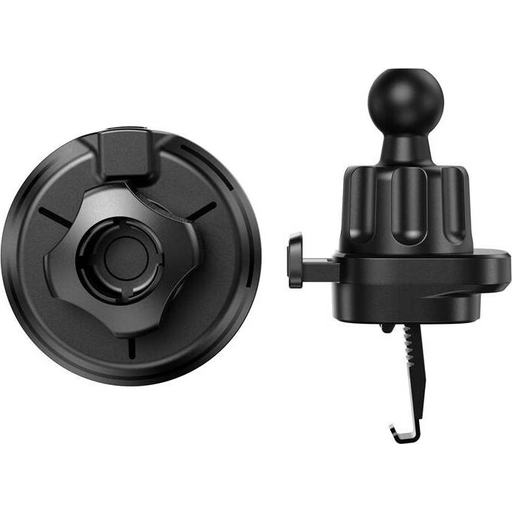
Why this product suits this profile: Automatic magnetic alignment is practical for commuters and frequent drivers. The mount is designed for Qi2-certified devices and MagSafe-compatible iPhones, and can be rotated 360°.
The specifications explicitly state Qi2, 15W and a recommended power connection of at least 15W. This makes it easier to check the necessary setup before buying.
N55 neodymium magnets, 360° rotation, USB-C connection and one-handed operation according to the product description.
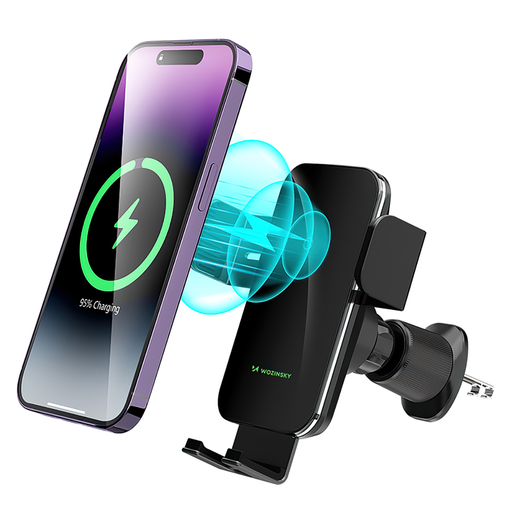
Why this product suits this profile: The automatic clamp is suitable for Qi-enabled smartphones with screen sizes from 4.7 to 6.9 inches. This makes it an option for users who do not want to rely exclusively on magnetic attachment.
The device is held by side arms rather than solely by a magnetic ring. This means the mount is also designed for Qi smartphones without MagSafe accessories.
Automatic clamping, 360° adjustment, dual-hook attachment and 15W Qi charging according to the product details.
We have put together a complete, regularly updated list of products that fully meet these strict selection criteria and the safety regulations applicable in the EU.
Install the mount before setting off and check that it is firmly secured to the air vent or dashboard. The smartphone must not obstruct your view of the road, controls or airbag areas. Do not adjust its position while driving.
Keep coins, keys and magnetic-stripe cards away from the area between the smartphone and the charging surface. If you notice unusual heat, an odour or visible damage, disconnect the power supply. Service life depends, among other things, on temperature, mechanical stress, cable quality and regular checks of the mounting.
No. The Android device needs Qi charging support for wireless charging, as well as a magnetic interface, such as a compatible case or suitable ring. Without a magnetic connection, a clamp mount may be the more suitable solution.
A USB-C PD or suitably specified 12-volt adapter may be required to achieve maximum charging output. The specifications of the mount, smartphone and power adapter are the key factors. A basic USB port in the vehicle does not always provide sufficient power.
Energy consumption depends on charging output, efficiency and the smartphone’s charge level. When the engine is running, the mount is normally powered via the USB port or 12-volt socket. When the vehicle is parked, the mount should not be left connected unnecessarily for extended periods.