
Lieferung heute & morgen

Qualitätsgarantie

Willkommens-Angebote freischalten: KOSTENLOSE Lieferung | Bis zu 80 % RABATT | Kostenlose 30-Tage-JoyPlus-Testphase
App herunterladen
A MagSafe power bank promises effortless wireless charging on the go. Simply attach it magnetically to your iPhone, and the battery starts to fill up. However, the market is flooded with models whose marketing promises often fall short in practice. Many users invest in a device that becomes useless after a short time due to weak magnets, disappointing charging performance, or misleading capacity claims.
As your Joybuy Product Recommendation Officer, I'm here to help you identify these pitfalls. This guide will show you the three most common marketing traps and explain the crucial technical features you need to check before buying to make an informed decision.
Before you choose a model, you should be aware of the typical problems that lead to frustration and wasted money.
To find a power bank that meets your needs, you should check three core technical parameters.
The most important value is the Rated Capacity, not the battery capacity. Rated capacity, also measured in milliampere-hours (mAh), describes the amount of energy that is actually delivered to your device after all conversion losses. Reputable manufacturers list this value in the fine print or on the product itself. A 10000mAh magnetic power bank should have a rated capacity of at least 5,800 mAh to fully charge a modern iPhone about 1.5 times.
The future of wireless charging is called Qi2. This new standard integrates a Magnetic Power Profile and, similar to Apple's MagSafe, enables a charging output of up to 15W. Unlike the older Qi standard, the magnetic alignment ensures a stable connection and less energy loss.
The most practical power bank is the one you actually want to carry with you. A slim power bank with a low weight is ideal for daily use. Additional features can significantly enhance its utility:
Here are some recommendations tailored to specific use cases that avoid the pitfalls mentioned above.
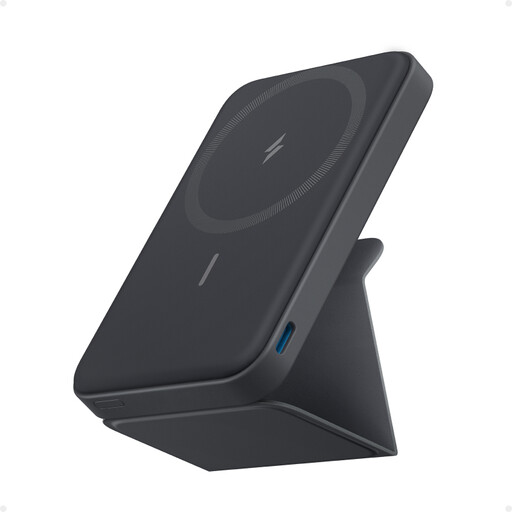
Why This Fits Their Persona: Perfect for the daily commute or a short trip. Its compact size and low weight make it unobtrusive, while the integrated kickstand turns the smartphone into a useful display on a desk or train.
The magnetic force is strong and reliable, ensuring the device stays securely attached to the smartphone. Anker's MiniCell technology allows for a compact design without overheating.
Integrated Kickstand: Allows for hands-free viewing in both portrait and landscape modes. Compact Design: Highly portable at just 12.8 mm thick.
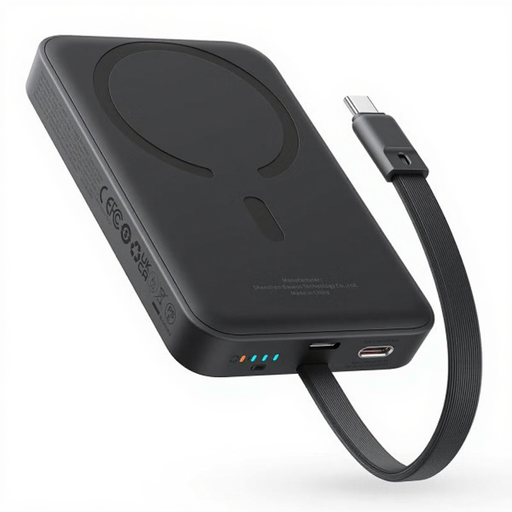
Why This Fits Their Persona: Those who travel extensively need capacity and flexibility. With 10,000 mAh, this model offers enough power for multiple charges and can supply several devices simultaneously thanks to its integrated cable and additional port.
The rated capacity of 5,800 mAh is clearly stated, delivering real-world performance. The 30W PD fast charging via cable is a genuine value-add, not just an empty marketing claim.
High Capacity: 10,000 mAh for multiple recharges. Integrated USB-C Cable: Enables charging without needing an extra cable, both for the power bank and other devices.
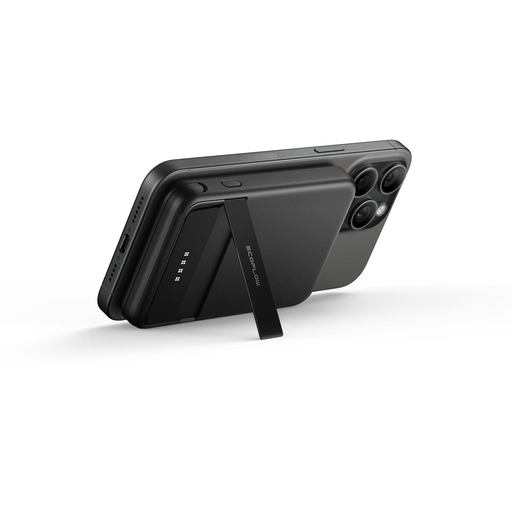
Why This Fits Their Persona: For users who value the latest technology and maximum efficiency. The Qi2 certification guarantees future-proof, fast 15W wireless charging, making it the optimal choice for current and upcoming devices.
This model avoids the misleading charging speed trap by being explicitly Qi2-certified, verifiably delivering 15W wirelessly instead of just advertising it.
Qi2-Certified: Delivers 15W fast wireless charging. High Wired Power: Supports up to 30W via the USB-C port for rapidly recharging the power bank itself.
We have compiled a complete, real-time updated list of products that fully meet these strict selection criteria and UK safety regulations.
1. How many charges can I get from a 10,000mAh MagSafe power bank? It depends on the power bank's rated capacity and your smartphone's battery size. A 10,000mAh power bank with a typical rated capacity of around 5,800 mAh can charge an iPhone 15 Pro (approx. 3,274 mAh battery) about 1.7 times. Keep in mind that wireless charging incurs additional energy losses, which can slightly reduce the number of charges.
2. Does a MagSafe power bank work with a case? Yes, but only with compatible cases. For a stable magnetic connection and efficient charging, you need either an official MagSafe case from Apple or a third-party case explicitly marked as "MagSafe-compatible." Standard cases without built-in magnets are too thick and will prevent the power bank from attaching securely.
3. Is a Qi2 power bank compatible with my older iPhone (e.g., iPhone 12)? Yes, a Qi2 power bank is backward-compatible. You can use it to magnetically charge an iPhone 12. However, the charging speed will be limited to 7.5W, as the iPhone 12 series and older models do not fully support the 15W Qi2 standard. You will get the full 15W speed with the iPhone 13 series and newer models.