
Lieferung heute & morgen

Qualitätsgarantie
App herunterladen
Kategorien
A reliable mobile power supply is a technical necessity for users of modern smartphones and laptops. The technology has evolved from simple external batteries to intelligent charging solutions with magnetic attachment and optimised charging protocols. Technologies like MagSafe, the newer Qi2 standard, and USB-C Power Delivery (PD) are redefining the efficiency and convenience of portable chargers. This article analyses the technical parameters that are crucial when selecting a magnetic power bank for iPhones and other compatible devices.
Selecting the right model is based on an analysis of capacity, charging technology, power, and form factor. An informed decision requires an understanding of these core specifications.
Capacity, measured in milliampere-hours (mAh), determines how many times a device can be charged.
Magnetic alignment is the core feature of this power bank category.
Power, measured in watts (W), indicates the charging speed.
Material, dimensions, and weight affect everyday handling. Some models offer integrated kickstands for media viewing while charging or feature displays to show the remaining capacity and charging power.
The following models have been selected based on their technical specifications and practical utility for different user profiles.
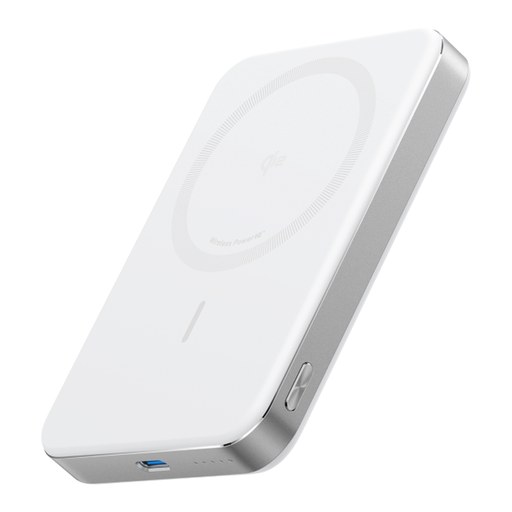
Model Analysis: This model from Anker combines an everyday-ready capacity of 10,000 mAh with a remarkably slim design. Its Qi2 certification ensures 15W of wireless charging power, providing a rapid energy boost for compatible iPhones. The additional 30W USB-C port enhances flexibility, enabling fast charging for other devices. According to the manufacturer, Aerogel insulation provides optimised thermal management during operation.
Pros:
Best Suited For: Users seeking a powerful yet portable power bank for their iPhone for daily use. The combination of high capacity, fast charging (both wireless and wired), and a slim profile makes it a versatile solution for commuters and travellers.
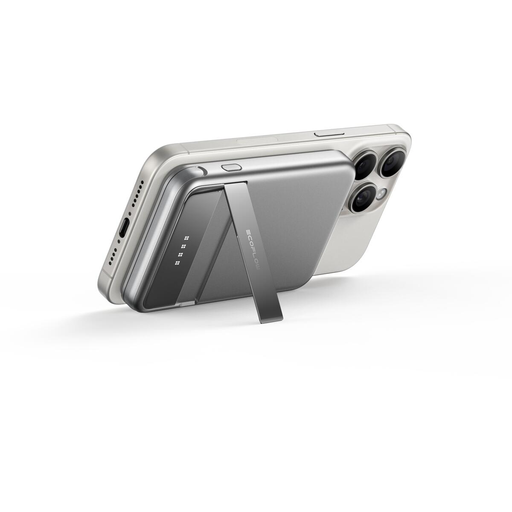
Model Analysis: The EcoFlow RAPID Powerbank is designed for maximum portability and rapid deployment. With 5,000 mAh, it offers enough energy for an emergency charge on the go. Its standout feature is the high 30W output via the USB-C port, which is uncommon for a power bank of this size. Qi2 certification also ensures 15W of wireless power. An integrated kickstand enhances its practical utility.
Pros:
Best Suited For: Users who need an extremely compact and lightweight portable charger for short trips or as a backup. The high wired charging speed makes it attractive for anyone who needs to top up power quickly without carrying much weight.
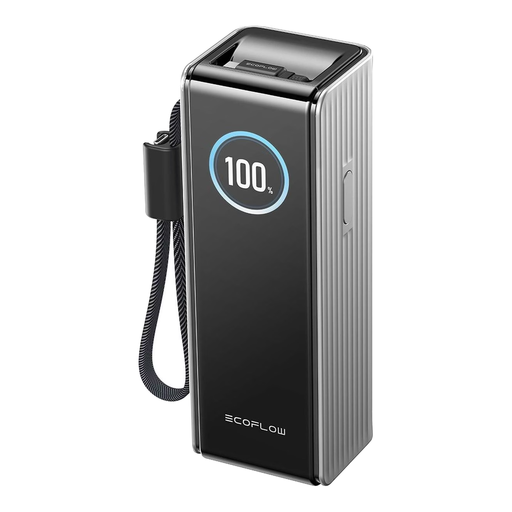
Model Analysis: This model is engineered for users who need an uncompromising charging solution for multiple devices, including laptops. With a 25,000 mAh capacity (90 Wh, airline-approved) and a total output of 170W, it can power up to four devices simultaneously. Its unique features include two integrated USB-C cables and two additional ports, three of which can deliver up to 100W. The TFT display provides detailed, real-time information on charge status and power distribution.
Pros:
Best Suited For: Power users, digital nomads, and travellers looking for a single power bank for their laptop, smartphone, tablet, and other devices. Its high power and capacity make it the ultimate mobile charging hub for demanding users.
If the models featured here don't perfectly match your requirements, you can find a broader selection of devices with different capacities and feature sets in our main category.
Discover more models in the category: Portable Power Bank Charger Battery
1. What is the difference between MagSafe and Qi2? MagSafe is Apple's proprietary standard. Qi2 is an open industry standard that builds on MagSafe's technology. For the user, this means a Qi2 power bank offers similar magnetic attachment and a comparable 15W charging speed for compatible iPhones, but will also potentially be compatible with future Android devices.
2. Can a MagSafe power bank also charge older iPhones or Android devices? Yes. The magnetic function is limited to iPhone 12 series models and newer (or devices with a MagSafe-compatible case). However, most magnetic power banks also function as standard wireless Qi chargers and can charge other Qi-enabled devices (older iPhones, Android smartphones) when placed correctly. Additionally, all devices can be charged via a cable using the USB-C power bank port.
3. How many charge cycles does a power bank last? The lifespan of a lithium-ion battery in a power bank is measured in charge cycles. One cycle corresponds to a full discharge and recharge. Most manufacturers specify a lifespan of 300 to 500 cycles before the battery capacity noticeably degrades (typically to about 80% of its original capacity).
Written by: Joybuy Product Recommendation Officer