
Lieferung heute & morgen

Qualitätsgarantie

Willkommens-Angebote freischalten: KOSTENLOSE Lieferung | Bis zu 80 % RABATT | Kostenlose 30-Tage-JoyPlus-Testphase
App herunterladen
A good vegetable slicer promises to speed up kitchen prep and deliver perfectly uniform slices, strips, or cubes. However, the market is flooded with models whose value often proves questionable only after purchase. Many users report devices that cause more frustration than relief. Before you make a decision, it's crucial to understand the typical weaknesses that can quickly turn a supposed kitchen upgrade into a dust collector in the back of your cabinet.
The most common problems are not always obvious at first glance. These include:
A functional vegetable slicer should eliminate these problems from the outset.
To avoid a bad buy, you should focus your attention on a few critical technical parameters. These determine the longevity, safety, and practical usability of the device in your daily routine.
The heart of any slicer is its blade. Here, the material is crucial. Blades made of high-quality stainless steel (e.g., 18/10 rust-proof stainless steel) offer long-lasting sharpness and are corrosion-resistant. Check whether the blades are designed for specific cuts, such as fine strips (as a julienne slicer) or uniform slices. A sharp blade cuts cleanly through vegetables instead of crushing them, which better preserves texture and nutrients.
A professional mandoline or a simple slicer must be safe to handle. Two features are indispensable here:
Consider what tasks the slicer needs to perform. Do you only need thin slices, or also cubes, sticks, or spirals? Multifunctional sets often offer interchangeable inserts, for example, for a spiralizer or a coarse kitchen grater. A model with an integrated collection container keeps the kitchen clean and makes it easier to process the cut food. For easy cleaning, the manual chopper should be easy to disassemble and ideally dishwasher-safe.
Based on these objective criteria, we have identified several models that are suitable for different user profiles and requirements.
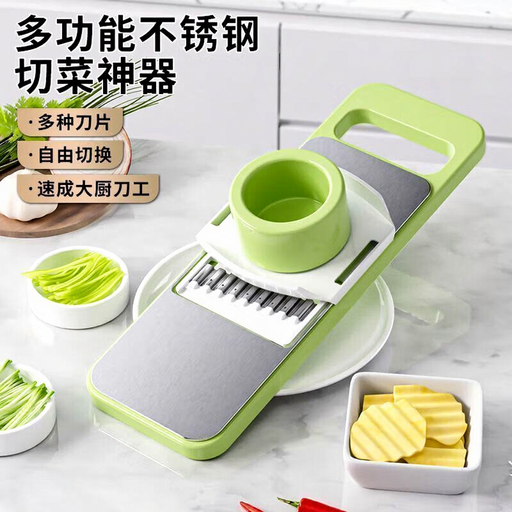
Why This Fits Their Persona: Ideal for home cooks looking for a straightforward tool for basic slicing tasks. It covers the essential functions without overwhelming with unnecessary accessories, making it a great choice for occasional use.
This model directly addresses the safety trap with an included hand guard. This is a crucial feature that is missing from many basic slicers.
The 3-in-1 functionality with three stainless steel blades offers flexibility for different types of cuts. Its compact design makes storage easy.
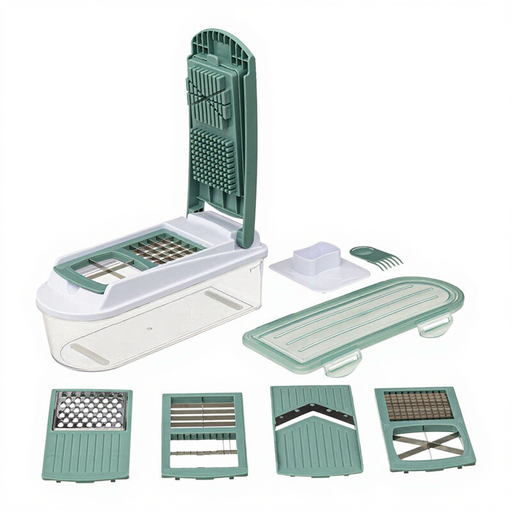
Why This Fits Their Persona: Perfect for creative cooks and families who regularly prepare a variety of dishes. The set replaces multiple individual gadgets, allowing for slicing, dicing, and grating with a single system.
This set solves the problem of mess and unhygienic prep. The integrated collection container catches food directly, keeping the work surface clean.
High versatility with 10 pieces for various cutting styles. The included finger guard and stable ABS construction ensure safe use.

Why This Fits Their Persona: For users who value durability, precision, and premium materials. This grater is designed for frequent use and delivers consistently excellent results with hard cheese, chocolate, or nuts.
The patented Z-Cut blade technology made from 18/10 stainless steel counteracts the problem of dull blades. Non-slip pads prevent slipping and increase stability and safety.
Efficient two-way grating speeds up prep work. The integrated finger guard and practical collection container offer a high degree of safety and convenience.
We've compiled a complete, up-to-date list of products that fully meet these strict selection criteria and German safety regulations.
Proper cleaning is crucial for hygiene and longevity. Disassemble the slicer after each use according to the instructions. Rinse all parts immediately under running water to prevent residue from drying. Many models are dishwasher-safe, but hand-washing the sharp blades is often gentler on the material. Use a brush to remove residue from the blades, being careful not to cut yourself. Let all parts dry completely before reassembling.
Both materials have their merits. Stainless steel blades are essential for cutting performance. For the body of the device, stainless steel offers high stability and durability. However, high-quality plastic (e.g., ABS plastic) can also be very robust, lighter, and often easier to clean. A good design often combines both: a sturdy plastic frame with sharp stainless steel blades and non-slip elements.
The term mandoline typically refers to a vegetable slicer with a flat surface and one or more very sharp, often adjustable blades. Mandolines are known for their ability to cut extremely thin and uniform slices. They are often aimed at more ambitious cooks and usually feature advanced safety features like a food holder. A simpler vegetable slicer or kitchen grater may have fewer adjustable options and be designed for more specific tasks, such as grating cheese or carrots.